logo

All Exams

Notifications

All Exams

Explore All Exams at KGS

All Exams
Home>Current Affairs>News in Short
Current Affairs made simple.

Current Affairs provides you with the best compilation of the Daily Current Affairs taking place across the globe: National, International, Sports, Science and Technology, Banking, Economy, Agreement, Appointments, Ranks, and Report and General Studies

banner-image

News in Short

Pinaka Long Range Guided Rocket

Context: Recently, DRDO successfully conducted the maiden flight test of Pinaka Long Range Guided Rocket (LRGR 120) from Chandipur, Odisha.

More on the News
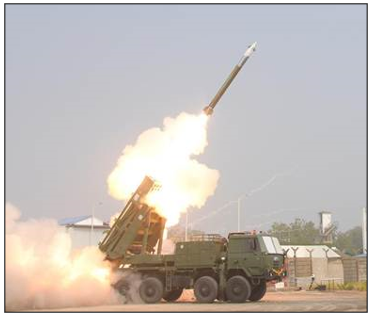
  • The Pinaka Long Range Guided Rocket (LRGR-120) is an indigenous multi-barrel rocket system with a range of 120 km that uses an integrated navigation, guidance, and control kit for high-precision strike. 
  • This rocket is designed by Armament Research and Development Establishment in association with High Energy Materials Research Laboratory and supported by Defence Research and Development Laboratory and Research Centre Imarat.
  • The LRGR was launched from the in-service Pinaka launcher, demonstrating its versatility and providing launch capability of Pinaka variants of different ranges from the same launcher.

Key Highlights of the Test

  • Strike Range: The rocket was tested for its maximum range of 120 km, significantly extending the reach of previous Pinaka variants which targeted 40 km to 75+ km.
  • Precision and Performance: The LRGR-120 followed its planned trajectory and hit the designated target with "textbook precision" after performing all intended in-flight maneuvers.
  • Platform Versatility: The rocket was launched from an in-service Pinaka launcher, proving the system's ability to fire multiple rocket variants with different ranges from a single platform.
  • Strategic Approval: The test coincided with the Defence Acquisition Council (DAC) clearing procurement proposals worth ₹79,000 crore, which included the long-range guided rockets for the Indian Army.

INS Vagsheer

Context: Recently, President Droupadi Murmu, the Supreme Commander of the Indian Armed Forces, carried out a sea sortie aboard INS Vagsheer (S26), the sixth and final submarine of the Kalvari class.

Key Highlights of the Sortie

  • President Murmu is only the second Indian President to undertake a submarine sortie, following Dr. APJ Abdul Kalam, who did so in 2006. She is also the first head of state to sail in a Kalvari-class (Scorpene-class) submarine.

About INS Vagsheer

  • Class: It is the sixth and final submarine of the Project-75 Scorpene-class, entirely built by Mazagon Dock Shipbuilders Limited (MDL).
  • Commissioning: The submarine was commissioned into the Indian Navy in January 2025.
  • Capabilities: It is an indigenous combatant designed with advanced stealth features and high automation, serving as a pillar of the Aatmanirbhar Bharat initiative in defence.

Project 75

  • The conventional diesel-electric submarines such as the Scorpene, under Project 75, come with improved stealth features.
  • The six submarines under Project-75 are INS Kalvari, INS Khanderi, INS Karanj, INS Vela, INS Vagir and INS Vagsheer.
  • Project-75 (India), also known as P-75(I), succeeds the P75 under which six diesel-electric attack submarines of the Kalvari class, based on the Scorpene class, were being built at MDL.
  • Of the total 24 submarines to be built in India, six will be nuclear-powered.

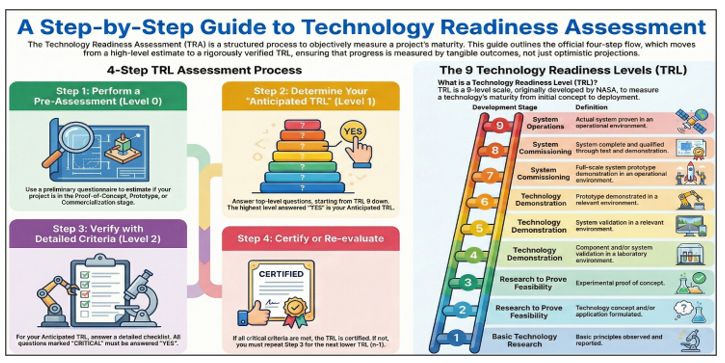
National Technology Readiness Assessment Framework (NTRAF)

Context: Recently, the Principal Scientific Adviser (PSA) to the Government of India, unveiled the "National Technology Readiness Assessment Framework (NTRAF)" to Standardise Innovation Assessment in India.

More on the News

  • The framework has been developed by the Office of the Principal Scientific Adviser in collaboration with the Confederation of Indian Industry.
  • It establishes a unified national methodology to assess the maturity of technology projects from laboratory research to commercial deployment.
  • The framework has been opened for public consultation until January 31, 2026 to incorporate stakeholder feedback before wider adoption.
  • The framework assesses technologies across nine Technology Readiness Levels, ranging from early proof of concept to full operational deployment.
  • It categorises development stages into proof of concept levels one to three, prototype development levels four to six, and operational deployment levels seven to nine.

Key features of the Framework include

  • Global Best Practices, Indian Context: Adapted from global standards (such as NASA) but tailored to the specific needs of the Indian R&D ecosystem.
  • Objectivity over Subjectivity: Replaces qualitative estimation with a structured, evidence-based checklist for every stage of development.
  • Sector-Specific Nuances: Includes specialised annexures for distinct sectors like Healthcare & Pharmaceuticals and Software, acknowledging that development pathways differ across domains.
  • Self-Assessment Tool: Empowers Project Investigators to realistically gauge their standing and identify technical gaps before seeking funding.

Guidelines for Shipbuilding Assistance and Development Schemes

Context: The Ministry of Ports, Shipping and Waterways notified guidelines for the Shipbuilding Financial Assistance Scheme and the Shipbuilding Development Scheme.

More on the News

  • Guidelines aim to boost domestic shipbuilding capacity and global competitiveness, the Centre has notified operational guidelines for two major shipbuilding schemes with a total outlay of ₹44,700 crore.
  • The schemes seek to strengthen forward and backward linkages in the maritime manufacturing ecosystem.
  • Both schemes will remain valid till March 31, 2036 with an in-principle extension envisaged up to 2047.

Shipbuilding Financial Assistance Scheme (SBFAS)

  • The scheme has a total corpus of ₹24,736 crore to support domestic shipbuilding activities.
  • It provides financial assistance ranging from 15 percent to 25 percent per vessel depending on vessel category.
  • Aims to increase India's commercial shipbuilding capacity to 4.5 million gross tonnage (GT) per annum by 2047.

Shipbuilding Development Scheme (SbDS)
  • The scheme has a budgetary outlay of ₹19,989 crore and focuses on long-term capacity creation.
  • It supports the development of greenfield shipbuilding clusters with full capital support for common infrastructure.
  • The core component of the scheme is to develop new facilities with 100% capital support for common infrastructure via a 50:50 Centre–State SPV model.
  • Upgrading existing shipyards with 25% capital assistance for critical infrastructure.
  • Disbursements will be milestone-based and monitored by independent evaluation agencies.

footer image

The most trusted learning platform on your phone

With our training programs, learning online can be a very exciting experience! Take the next step toward achieving your professional and personal objectives


app-storeplay-store
logo
Khan Global Studies Pvt. Ltd. 5th Floor,
A13A, Graphix 1 Tower B, Sector 62,
Noida, Uttar Pradesh 201309

Course Related Query: [email protected] Store Related Query: [email protected]

Get Free Academic Counseling & Course Details

KGS best learning platform

About Khan Global Studies

We love learning. Through our innovative solutions, we encourage ourselves, our teams, and our Students to grow. We welcome and look for diverse perspectives and opinions because they enhance our decisions. We strive to understand the big picture and how we contribute to the company’s objectives. We approach challenges with optimism and harness the power of teamwork to accomplish our goals. These aren’t just pretty words to post on the office wall. This is who we are. It’s how we work. And it’s how we approach every interaction with each other and our Students.


What Makes Us Different

Come with an open mind, hungry to learn, and you’ll experience unmatched personal and professional growth, a world of different backgrounds and perspectives, and the freedom to be you—every day. We strive to build and sustain diverse teams and foster a culture of belonging. Creating an inclusive environment where every students feels welcome, appreciated, and heard gives us something to feel (really) good about.

Copyright 2025 KhanGlobalStudies

Have a question?

Get Free academic Counseling & Course Details

floatButton
News in Short | Current Affairs