Explore All Exams at KGS


All Exams
Explore All Exams at KGS

Khan Sir Courses
Geography I Polity I History | World Map I Indian Map I Economics I Biology

UPSC & State PSC
UPSC I BPSC I UP-PSC I MP-PSC

State Exams
UP I Bihar I MP | Rajasthan

NEET | JEE | CUET
NEET | JEE | CUET

Defence Exams
NDA I CDS I CAPF I AFCAT I SSB I Agniveer

Police Exams
UP SI | Bihar SI | Delhi Police | UP Constable

SSC Exams
CGL I CPO I CHSL I MTS I SSC GD I Delhi Police

Foundation Courses
Physics I Chemistry I Biology I History I Geography I Polity I NCERT I Math I English | Map I Reasoning

Railway Exams
RRB | RPF

Teaching Exams
TET | Teaching | UGC

Banking Exams
SBI | RBI | IBPS

Engineering Exams
Civil | Electrical | Mechanical
UGC NET
UGC NET/JRF
News Highlights provides you with the best compilation of the Daily News Highlights taking place across the globe: National, International, Sports, Science and Technology, Banking, Economy, Agreement, Appointments, Ranks, and Report and General Studies

1.
The Ministry of Electronics and Information Technology has directed Meta, the parent body of several social media platforms, to disable advertisements and content promoting and facilitating access to child sexual exploitative and abuse material (CSEAM) on Instagram, according to government sources. It has also sought an explanation on the issue. "The Ministry has ordered Instagram to disable such advertisements.
2.
The Union government has withdrawn most provisions of an emergency natural gas supply regulation order following the resumption of liquefied natural gas (LNG) shipments through the Strait of Hormuz. In a notification issued on Saturday, the Ministry of Petroleum and Natural Gas amended the Natural Gas (Supply Regulation) Order, 2026, omitting key operational provisions which led to all domestically produced natural gas and imported LNG to be sold as per a priority customer list drawn by the government.
3.
Hindi will be introduced as an official language in the Assam Assembly, along-side Assamese, English and Bodo, from the Budget Session starting on Mon-day, Speaker Ranjeet Ku-mar Dass said on Sunday. Addressing a press conference, Mr. Dass said the decision was taken at the general-purpose committee meeting held a day ago. "Since Hindi is a 'Rashtra Bhasa', as a sign of respect for it, we have decided to introduce it in the House," the Speaker said.
4.
On June 24, 2026, a member of India's Ministry of External Affairs (MEA) released a startling statement. The Indian passport, the person said, is a "travel document" and not a "citizenship document". The assertion set off a minor storm. The reasonable question that followed from many was if the passport would not do it, what document would?
The MEA's statement and the questions it raises become something of a red herring. A passport can only be issued to a non-citizen in exceptional circumstances, where the Government of India is of the opinion that it is necessary to do so in "public interest". Surely, therefore, barring those cases where this power is exercised, a passport must be seen as conclusive proof of a person's citizenship.
5.
Japanese Prime Minister Sanae Takaichi's first official visit to India turned out to be an occasion to signal enhanced bilateral coordination in the face of global uncertainties. Rapid changes in geopolitics and technological advances are forcing all countries into fresh thinking, most consequentially with regard to China. The U.S. appears less enthusiastic about the Quad grouping (with India, Japan and Australia) and is unsure of the nomenclature "Indo-Pac-ific" in its strategy.
6.
The Strait of Hormuz has long been recognised as one of the world's most critical maritime routes. Nearly a fifth of global oil consumption passes through this narrow waterway, making it indispensable to global energy security and international trade. Any disruption here immediately reverberates across shipping, freight, insurance and commodity markets.
7.
EPFO's recent changes signal continuity, not radical reform
The Union Labour and Employment Minis-try's notification of fresh rules for the Employees' Provident Fund (EPF), Employees' Pension Scheme (EPS), and Employees' Deposit Linked Insurance (EDLI) is a procedural formality following the enforcement of the Code on Social Security, 2020, since November last year. Four months ago, the Central Board of Trus-tees (CBT) of the Employees' Provident Fund Organisation (EPFO) approved the implementation of social security measures framed as a sequel to the Code that subsumes nine laws, including the Employees' State Insurance Act, 1948, and the Employees' Provident Funds and Miscellaneous Provisions Act, 1952.
8.
India's conservation of the Asiatic lion is widely celebrated as a remarkable success story. From a population which was reduced to just a few dozen in the early 20th century, the number of Asiatic lions has increased to approx. 891 today. Yet, behind this achievement lies a persistent policy failure: the inability to establish a second, geographically separate population. Scientific institutions, government bodies, and even the Supreme Court have long warned that without such a step, the species remains vulnerable to extinction from a single catastrophic event.
9.
The legislative tangle behind the political switches in Maharashtra raises questions about the grey areas in the Tenth Schedule of the Constitution. Paragraph 5 gives the grounds for exemption from disqualification. It says that the Speaker or the Deputy Speaker or the Chairperson or the Deputy Chairperson shall not be disqualified if "he, by reason of his election to such office, voluntarily gives up the membership of the political party to which he belonged immediately before such election and does not, so long as he continues to hold such office thereafter, rejoin that political party or become a member of another political party."
10.
India has a very large and old marine fishing population. Every day, both small-scale and mechanised trawl fishers go out to earn a living and provide the nation with food. The Government of India recently released its latest prognosis of the country's ocean fisheries (February 11, 2026). Its press release emphasised that Indian marine fisheries are largely sustainable, suggesting the country has avoided the bane of international fishing, namely overfishing.
11.
Union Home and Cooperation Minister Amit Shah will lay the foundation stone for 47 grain storage godowns and inaugurate several major projects on Monday to mark the completion of five years since the formation of the Cooperation Ministry, a government statement said.
The Minister, among other initiatives, would al-so launch a centralised core banking platform, and Sahakar Sahyogi, a conversational Al-powered platform, for Urban Cooperative Banks.
The Ministry emphasised cooperation with States as a key pillar of implementing its initiatives over the past five years, a Ministry official said on Sunday.
12.
Union Minister for Rural Development and Agriculture Shivraj Singh Chouhan on Sunday released the first instalment of ₹25,863 crore to the States for the rural employment programme under the Viksit Bharat-Guarantee for Rozgar and Ajeevika Mission (Gramin) Act, or VB-G RAM G, even as concerns re-main over the centralised the planning for programme.
Uttar Pradesh received the highest allocation at 3,210.76 crore, followed by Andhra Pradesh at ₹2,545.5 crore, and Rajas-than at ₹2,274.37 crore. Ta-mil Nadu received 2,176.84 crore, placing it just below Rajasthan in the fourth position, while Ker-ala received a considerably smaller allocation of ₹925.33 croге.
13.
Prime Minister Narendra Modi on Monday said the life of Syama Prasad Mookerjee, founder of the Bharatiya Jana Sangh, exemplified unwavering nationalism, public ser-vice, and dedication to the country's unity and development, adding that his ideals remain relevant even today.
Paying tribute to Mookerjee on his 125th birth anniversary in an oped article titled "A life devoted to India's unity and progress", Mr. Modi lauded him as a leader who combined intellectual achievement and integrity.
14.
The Indian Space Research Organisation (ISRO) has successfully carried out the first ground test of the solid motor-based Sub-Orbital Launch Vehicle for Experiments (SOLVE) at its Static Test Facility at the Satish Dhawan Space Centre in Sriharikota. The SOLVE solid motor is a key component for conducting Gaganyaan test missions and the first ground test was carried out on July 3. The ISRO is developing a solid motor-based SOLVE as a test platform to carry out Integrated Parachute Tests for validation of deceleration system of Gaganyaan's crew module un-der various test conditions.
15.
India will host the two-day BRICS Heads of Anti-Drug Agencies meeting in Guwahati from Monday. Organised by the Narcotics Control Bureau, the meeting will focus on is-sues such as combating synthetic drugs, strengthening intelligence sharing and operational coordination, and capacity building and institutional cooperation.
16.
The study documented milk yield in three bovine categories and found that high temperatures, in combination with high humidity during July and August "significantly reduced milk production"
It found that indigenous cattle were more tolerant to heat stress, and maintained homeostasis, with more advanced evaporative cooling compared to buffaloes
The text concluded that indigenous breeds should be conserved as "reservoirs of climate-resilient traits," and policies must prioritise in-situ conservation and farmer-led breed improvement programmes
17.
Researchers from the University of Minnesota have developed a synthetic cell that can grow and divide. The team 'started' the cell as a liposome, a small bubble made of fats. Inside was a protein-making system called PURE, which contained all the necessary 'machinery' for the cell to turn DNA into proteins. The DNA consisted of 90,000 base pairs.
The synthetic cells ate by fusing with smaller feeder liposomes. The cell's DNA instructed it to produce a protein called alphahemolysin that becomes like a hook on the cell's surface. The hook grabbed the feeder bubbles and pulled them in, providing the lipids and nutrients the cell needs to expand.
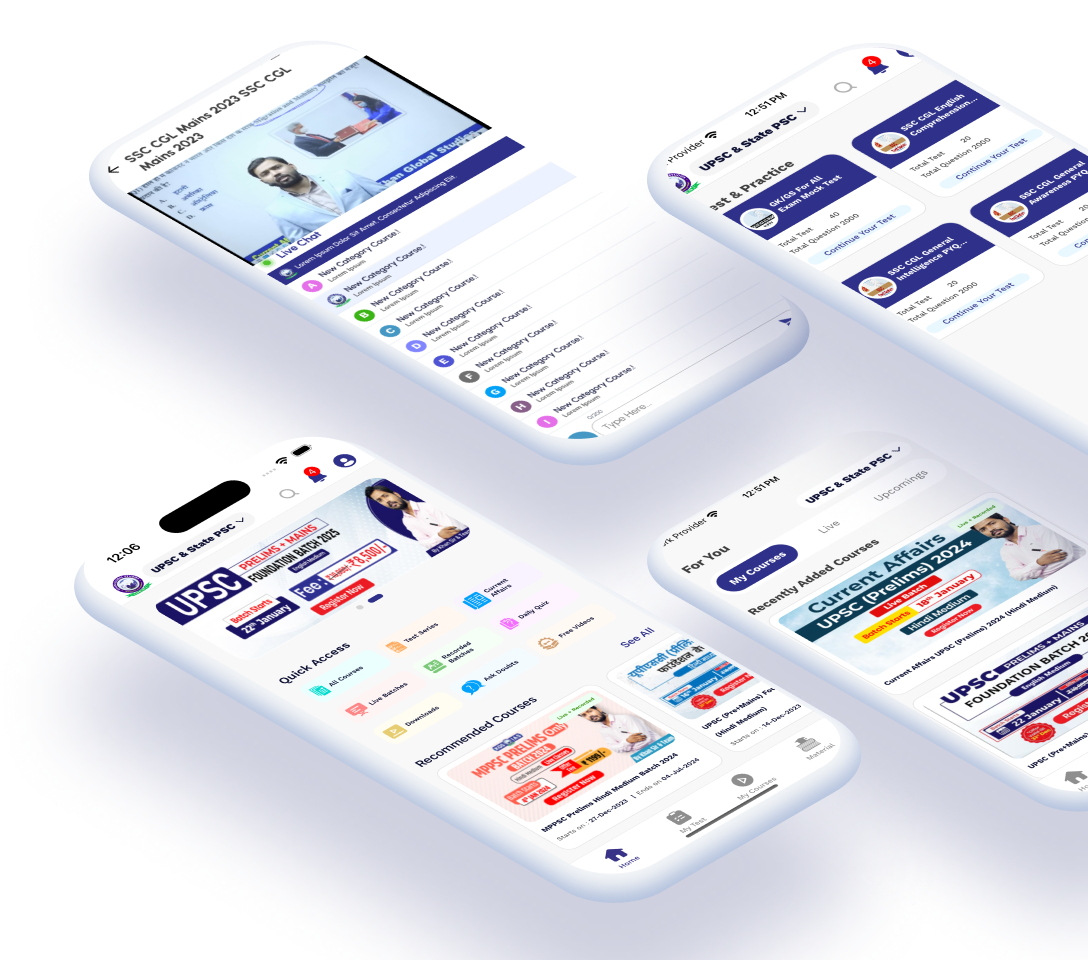
Khan Global Studies App
With our training programs, learning online can be a very exciting experience. Take the next step toward achieving your professional and personal objectives.


Course Related Query:
Ask Your DoubtsStore Related Query:[email protected]NEET | JEE | CUET
NCERT Books
Resources
We love learning. Through our innovative solutions, we encourage ourselves, our teams, and our Students to grow. We welcome and look for diverse perspectives and opinions because they enhance our decisions. We strive to understand the big picture and how we contribute to the company’s objectives. We approach challenges with optimism and harness the power of teamwork to accomplish our goals. These aren’t just pretty words to post on the office wall. This is who we are. It’s how we work. And it’s how we approach every interaction with each other and our Students.
Come with an open mind, hungry to learn, and you’ll experience unmatched personal and professional growth, a world of different backgrounds and perspectives, and the freedom to be you—every day. We strive to build and sustain diverse teams and foster a culture of belonging. Creating an inclusive environment where every students feels welcome, appreciated, and heard gives us something to feel (really) good about.