You're all caught up—no notifications available.
Explore All Exams at KGS


All Exams
Explore All Exams at KGS

Khan Sir Courses
Geography I Polity I History | World Map I Indian Map I Economics I Biology

UPSC & State PSC
UPSC I BPSC I UP-PSC I MP-PSC

State Exams
UP I Bihar I MP | Rajasthan

NEET | JEE | CUET
NEET | JEE | CUET

Defence Exams
NDA I CDS I CAPF I AFCAT I SSB I Agniveer

Police Exams
UP SI | Bihar SI | Delhi Police | UP Constable

SSC Exams
CGL I CPO I CHSL I MTS I SSC GD I Delhi Police

Foundation Courses
Physics I Chemistry I Biology I History I Geography I Polity I NCERT I Math I English | Map I Reasoning

Railway Exams
RRB | RPF

Teaching Exams
TET | Teaching | UGC

Banking Exams
SBI | RBI | IBPS

Engineering Exams
Civil | Electrical | Mechanical
UGC NET
UGC NET/JRF
News Highlights provides you with the best compilation of the Daily News Highlights taking place across the globe: National, International, Sports, Science and Technology, Banking, Economy, Agreement, Appointments, Ranks, and Report and General Studies
1.
India and France adopted an 'Innovation Roadmap 2030' and established a Dialogue on Economic Security during bilateral talks between Prime Minister Narendra Modi and French President Emmanuel Macron held in Nice on Sunday.
A press release from the government outlined a number of themes - including calling for the fast adoption of the India-EU Free Trade Agreement (FTA).
2.
Today, June 15, marks the 84th anniversary of a historic meeting we have allowed ourselves to forget, which led to the birth of the Indian National Army (INA). I learned about it on a visit to the Thai-Bharat Cultural Lodge (TBCL) in Bangkok, discovering a remarkable, overlooked chapter of history that reveals Thailand's vital role as a neutral, strategic beacon for Indian revolutionaries seeking refuge from British colonial rule. From its humble beginnings as a hub for cultural and intellectual exchange, the organisation evolved into a cornerstone of the Indian independence movement, providing the essential infrastructure for the formation of the INA.
3.
India's May retail inflation at 3.93%, the high-est in the current CPI series and roughly a 15-month high if compared with the previous series, has begun to reflect the pass-through effects of surging food and fuel costs more clearly than in previous months. However, last month's wholesale inflation numbers, the first under the new WPI series and due later this month along-side India's first Producer Price Index (PPI), should reveal how much of the price shock producers and wholesalers continue to absorb. May's food inflation rose at a faster clip to 4.78% from 4.20% in April.
4.
For decades, India's early childhood agenda has focused on ensuring that children survive early childhood, reducing under-five mortality from 43 in 2012 to 32 in 2020 (UNICEF and World Bank data) with sufficient inputs invested toward their health, nutrition, immunisation and sanitation conditions. The Anganwadi system reflects these priorities at scale: approximately eight crore children (ages 0-6 years) receive supplementary nutrition, growth monitoring and health services, alongside counselling and home visits for their parents.
5.
India can make an efficient insolvency system that benefits everyone by using a universal CIIRP model based on financial interest instead of institutional identity.
6.
The nodal agency for regulating global shipping is the IMO, a United Nations agency. Though the IMO has the means to regulate the technical, commercial, environmental and safety aspects of global shipping through consensus and rulemaking, it has often fallen short in protecting ships and seafarers. Quite often, national governments take unilateral action, and typical of an UN agency, the IMO has been unable to act to prevent or take remedial action.
The law governing the oceans is the United Nations Convention on the Law of the Sea (UNCLOS). Its acts and mandates are extensive and are an outcome of decades of negotiations and consensus-building. UNCLOS is thorough and considers various situations, including transits across straits such as the Hormuz. But many nations have not signed on to it. The U.S. refused to sign it on the grounds that UNCLOS considers the deep seabed as the commons. Iran has signed the convention but has not ratified it. There really is no overarching body for enforcement. Things are often left to the good sense of governments.
7.
Inaugurating the Bharat Innovates 2026 event in Nice in France, Prime Minister Narendra Modi pitched India as a destination for innovation and development. Both the Prime Minister and French President Emmanuel Macron focused on themes of trust and cooperation in technology.
8.
Indian Naval Ship (INS) Sharda departed Colombo on June 13 after a successful port call that further strengthened maritime cooperation and friendship between India and Sri Lanka. The visit featured a range of professional, training and sporting engagements between the two maritime forces. The Indian Navy informed that as part of capacity-building initiatives, Sri Lankan Navy personnel received training in small arms handling, basic firefighting, first-aid and rescue procedures aboard the ship. The engagements were aimed at enhancing operational preparedness and fostering greater interoperability between the two forces.
9.
As the Council of Scientific and Industrial Research (CSIR) accelerates the deployment of technologies in Kusunpur, a remote village in Odisha's Kendrapara district, as part of the 'Smart Village' initiative, residents may soon receive alerts whenever crocodiles stray dangerously close to their homes.
The CSIR laboratories are planning to introduce an artificial intelligence (AI)-enabled wild animal detection and alert system. The system is likely to be installed at two key entry points to the village.
10.
New companies are likely to invest in India to manufacture memory chips while existing investors will scale up production to address the demand-supply gap in the segment, Union Minister Ashwini Vaishnaw said.
Strong demand for memory (data storage) cards and advanced chips has tightened global supplies and supported higher prices in past quarters, and manufacturers have been sprucing up investments and production capacities to meet market requirements worldwide.
11.
China is capable of a direct missile strike on Australia and the threat is growing as Beijing amasses long-range and hypersonic weapons and builds islands in the South China Sea, an Australian think tank said on Sunday.
12.
Voters in Switzerland have cast their final ballots on Sunday on an initiative championed by the top right-wing party to cap the rich Alpine country's population at 10 million. Early results showed voters were leaning against it.
13.
• The dengue vaccine in Brazil, Butantan-DV, is pretty similar, if not identical, to India's upcoming dengue vaccine, DengiAll. Both have live but weakened versions of the dengue viruses (DENVs)
• Both vaccines are said to be tetravalent because each vaccine is a physical mixture of four live, weakened DENVS
• In Brazil's dengue vaccination campaign, of 42 vaccine recipients who displayed serious side-effects, two people died and one had to receive intensive care
• Medical researchers should look into whether this could be due to antibody-dependent enhancement. They should also clarify if DengiAll will manifest a similar risk when it is rolled out in India
14.
A new study published in Science has reported the first global map of the earth's vast underground network of arbuscular mycorrhizal (AM) fungi.
These fungi have sustained plant life for millions of years but their scale and distribution has been largely invisible until now.
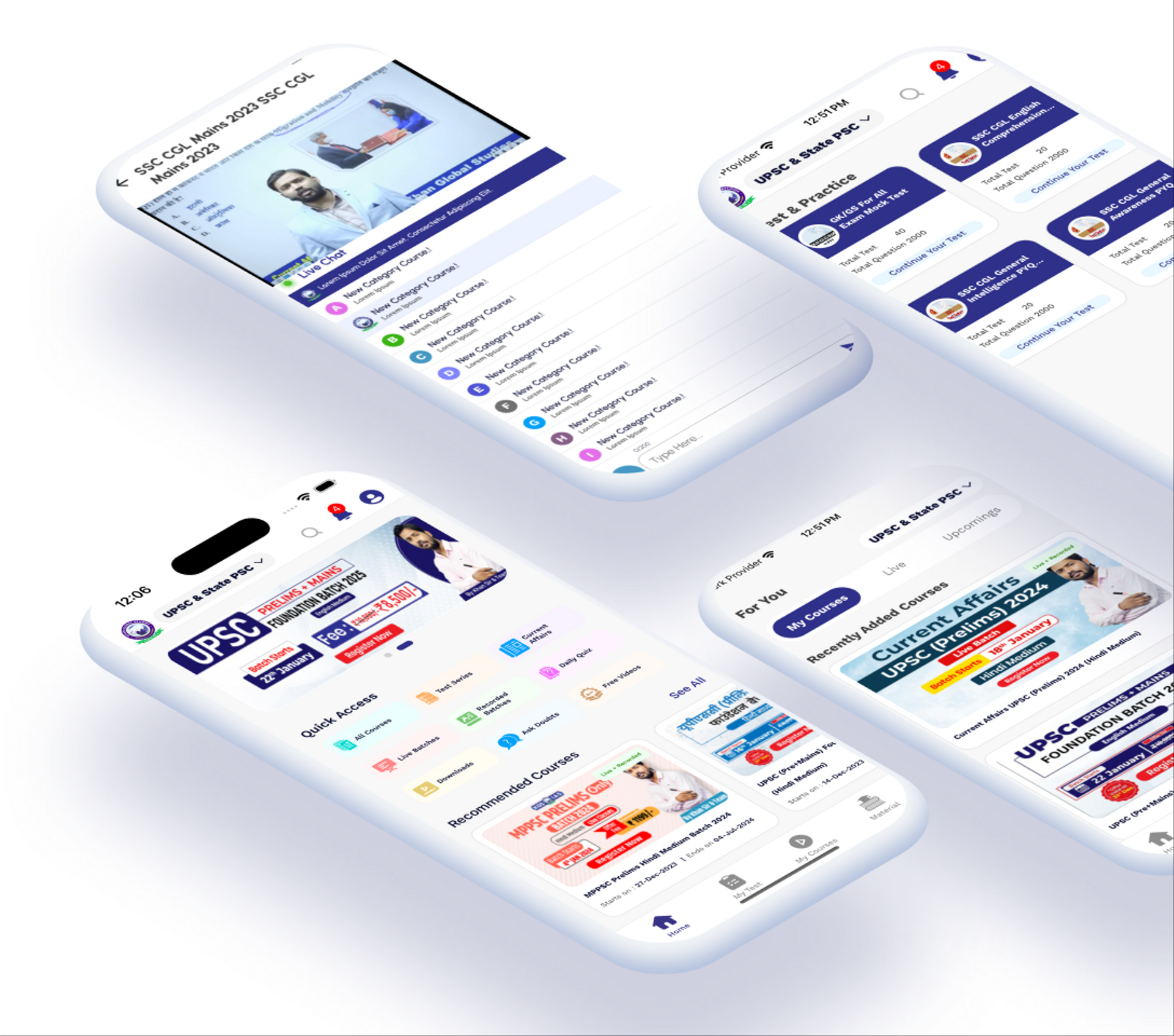
The most trusted learning platform on your phone
With our training programs, learning online can be a very exciting experience! Take the next step toward achieving your professional and personal objectives


Course Related Query:
Ask Your DoubtsStore Related Query:[email protected]NEET | JEE | CUET
NCERT Books
Resources
We love learning. Through our innovative solutions, we encourage ourselves, our teams, and our Students to grow. We welcome and look for diverse perspectives and opinions because they enhance our decisions. We strive to understand the big picture and how we contribute to the company’s objectives. We approach challenges with optimism and harness the power of teamwork to accomplish our goals. These aren’t just pretty words to post on the office wall. This is who we are. It’s how we work. And it’s how we approach every interaction with each other and our Students.
Come with an open mind, hungry to learn, and you’ll experience unmatched personal and professional growth, a world of different backgrounds and perspectives, and the freedom to be you—every day. We strive to build and sustain diverse teams and foster a culture of belonging. Creating an inclusive environment where every students feels welcome, appreciated, and heard gives us something to feel (really) good about.
Get Free academic Counseling & Course Details