Explore All Exams at KGS


All Exams
Explore All Exams at KGS

Khan Sir Courses
Geography I Polity I History | World Map I Indian Map I Economics I Biology

UPSC & State PSC
UPSC I BPSC I UP-PSC I MP-PSC

State Exams
UP I Bihar I MP | Rajasthan

NEET | JEE | CUET
NEET | JEE | CUET

Defence Exams
NDA I CDS I CAPF I AFCAT I SSB I Agniveer

Police Exams
UP SI | Bihar SI | Delhi Police | UP Constable

SSC Exams
CGL I CPO I CHSL I MTS I SSC GD I Delhi Police

Foundation Courses
Physics I Chemistry I Biology I History I Geography I Polity I NCERT I Math I English | Map I Reasoning

Railway Exams
RRB | RPF

Teaching Exams
TET | Teaching | UGC

Banking Exams
SBI | RBI | IBPS

Engineering Exams
Civil | Electrical | Mechanical
UGC NET
UGC NET/JRF
News Highlights provides you with the best compilation of the Daily News Highlights taking place across the globe: National, International, Sports, Science and Technology, Banking, Economy, Agreement, Appointments, Ranks, and Report and General Studies

1.
China Announced Friday it was adding 14 European entities to an export control list in retaliation for the European Union penalizing 14 Chinese enterprises as part of its latest round of sanctions against Russia.
Chinese companies will not be allowed to export dual-use items, which can be used for both civilian and military purposes, to the 14 European organizations, China's Commerce Ministry said in a statement.
2.
Bangladesh President Mohammed Shahabuddin, a former ally of deposed prime minister Sheikh Hasina, resigned on Friday, two years ahead of the end of his tenure.
3.
United Nations committee voted Friday to inscribe a major archaeological site in the West Bank and a set of castles in southern Lebanon as World Heritage sites, despite objections from Israel, which had urged the committee to reject the bids.
The decision at a UN Educational, Scientific and Cultural Organization meeting in South Korea came days after Israel's Foreign Ministry urged committee to reject efforts to designate the small West Bank town of Sebastia and the Lebanese castles, calling nominations a "weaponization of cultural heritage."
4.
A Day after Prime Minister Narendra Modi announced fast-track courts and a tough new law to punish those involved in exam paper leaks, the Union Cabinet Friday approved a draft Bill with provisions for a jail term up to 10 years, penalty up to Rs 10 crore, statutory backing for fast-track courts and a five-month timeline for investigation and trial of cases, official sources said.
5.
The US Friday imposed 10% tariffs on India, lower than the 12.5% rate proposed in March when the United States Trade Representative (USTR) identified 60 countries under Section 301 of the US Trade Act, citing import of goods produced with forced labour.
This comes weeks after the Directorate General of Foreign Trade (DGFT) announced prohibition of import of goods produced using forced labour, along with parallel negotiations for a trade deal with the US.
6.
RSS Chief Mohan Bhagwat on Friday batted for inclusion of knowledge on Hindu gods in school textbooks.
Addressing a programme organised by the RSS on the topic of 'Contemporary Motherhood', he said that the new generation seeks logic in everything, and believes in discussion, not dictation. "Sometimes, children ask these questions, especially abroad, why this god with a monkey face and why does this god have an elephant face? They come home and ask these questions but the father doesn't know, the mother doesn't know. This should be part of textbooks, even as children can't be left to textbooks alone," he said.
7.
Amid Continued demand for the resignation of Union Education Minister Dharmendra Pradhan, the first week of the Monsoon Session ended in a washout on Friday, with the exception of the introduction of The Prevention of Insults to National Honour (Amendment) Bill, 2026, in the Rajya Sabha.
8.
Barely two-and-a-half months before the 2024 Lok Sabha elections, the then Narendra Modi government brought the Public Examinations (Prevention of Unfair Means) Bill, 2024, in Parliament, which sought to prevent "unfair means" in order to "bring greater transparency, fairness and credibility to the public examinations system".
9.
Chandipura Virus spreads through the bite of infected sandflies and small insects. The virus belongs to the Rhabdoviridae family and can cause inflammation of the brain. Children, particularly those below 15 years are considered more vulnerable.
10.
In 1991, the US pressured India on nuclear proliferation, human rights, and its economy.
In 2026, US pressures are on Indian exports, trade-related labour and other standards, and imports of Russian oil.
11.
Washington's Decision to sign a civil nuclear cooperation agreement with Saudi Arabia marks an important shift in Middle East geopolitics-and highlights the growing role of advanced technologies in the regional power balance. The agreement will face close scrutiny in the US Congress, along with opposition from Israel's supporters and the non-proliferation community. The deal will help Riyadh build a civilian nuclear energy programme and reduce its dependence on hydrocarbons. Washington wants American companies to build Saudi reactors and secure a long-term position in its nuclear infrastructure.
12.
Discounts on Russian oil for Indian refiners have vanished again amid the resurgence of conflict in West Asia and the sharp drop in energy flows through the Strait of Hormuz, a senior official with government-owned refiner Bharat Petroleum Corporation (BPCL) has said.
Amid all this, the demand for oil from other regions has shot up once again, leading to erosion of discounts on Russian oil-the mainstay of India's oil imports.
13.
Even as the value of the rupee tumbled to multiple all-time lows following the onset of the war in West Asia, India used its domestic currency to pay for nearly $15 billion worth of imports in March, April, and May.
The payment in rupees may have been for oil bought from Russia, whose share in India's oil imports surged after the US and Israel's attack on Iran in late February led to the closure of the Strait of Hormuz.
14.
As the US imposed fresh tariffs of 10% on India after a Section 301 investigation, Indian exporters said the country is better positioned than most of its competitors, particularly China and Vietnam.
But Indian textile exporters said that due to new textile tariff-rate quotas (TRQs) for Bangladesh, Cambodia, Indonesia, and Malaysia, based on their imports of US cotton, sourcing of cotton, yarn and other intermediate goods from India could be reduced.
15.
• The new US tariff architecture-meant to reconstruct the IEEPA tariffs struck down by the Supreme Court - is yet to fully take shape.
• Only the first set of tariffs has been imposed, and multiple Section 301 investigations are still ongoing.
16.
Five Trademark applications submitted by the Shree Jagannath Temple Administration (SJTA), the statutory body that administers the 12th century temple in Puri, have cleared the second round of examination by the Trade Marks Registry and been approved for publication in the upcoming Trademark Journal.
SJTA chief administrator Arvind Padhee said Thursday that the Registry had approved names such as "Jagannath Dham", "Shree Kshetra", "Mahaprasad", "Nilachakra" and "Koili Vaikuntha" - associated with Jagannath culture and the shrine. SJTA has filed a total of 29 such applications so far.
17.
The ongoing youth protests at Jantar Mantar in Delhi and in several other cities, demanding the resignation of Education Minister Dharmendra Pradhan and seeking education reforms, have brought attention to the state of education in India.
Education falls under the Concurrent list in the Seventh Schedule of the Indian Constitution.
The schedule essentially divides powers and responsibilities between the Union and state governments through three lists -Union, State and Concurrent. Both the Centre and state governments can legislate on subjects under the Concurrent list.
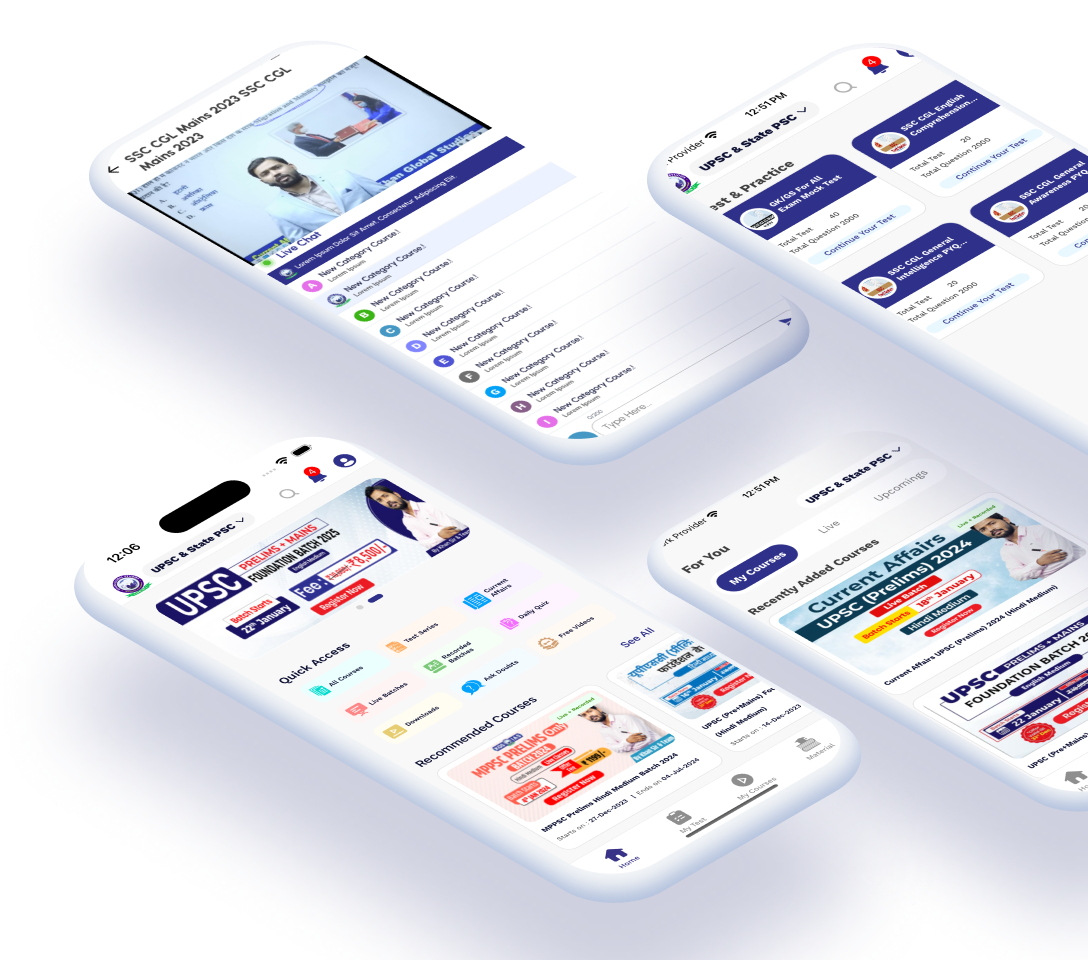
Khan Global Studies App
With our training programs, learning online can be a very exciting experience. Take the next step toward achieving your professional and personal objectives.


Course Related Query:
Ask Your DoubtsStore Related Query:[email protected]NEET | JEE | CUET
NCERT Books
Resources
We love learning. Through our innovative solutions, we encourage ourselves, our teams, and our Students to grow. We welcome and look for diverse perspectives and opinions because they enhance our decisions. We strive to understand the big picture and how we contribute to the company’s objectives. We approach challenges with optimism and harness the power of teamwork to accomplish our goals. These aren’t just pretty words to post on the office wall. This is who we are. It’s how we work. And it’s how we approach every interaction with each other and our Students.
Come with an open mind, hungry to learn, and you’ll experience unmatched personal and professional growth, a world of different backgrounds and perspectives, and the freedom to be you—every day. We strive to build and sustain diverse teams and foster a culture of belonging. Creating an inclusive environment where every students feels welcome, appreciated, and heard gives us something to feel (really) good about.