You're all caught up—no notifications available.
Explore All Exams at KGS


All Exams
Explore All Exams at KGS

Khan Sir Courses
Geography I Polity I History | World Map I Indian Map I Economics I Biology

UPSC & State PSC
UPSC I BPSC I UP-PSC I MP-PSC

State Exams
UP I Bihar I MP | Rajasthan

NEET | JEE | CUET | Boards
NEET | JEE | CUET | Boards

Defence Exams
NDA I CDS I CAPF I AFCAT I SSB I Agniveer

Police Exams
UP SI | Bihar SI | Delhi Police | UP Constable

SSC Exams
CGL I CPO I CHSL I MTS I SSC GD I Delhi Police

Foundation Courses
Physics I Chemistry I Biology I History I Geography I Polity I NCERT I Math I English | Map I Reasoning

Railway Exams
RRB | RPF

Teaching Exams
TET | Teaching | UGC

Banking Exams
SBI | RBI | IBPS

Engineering Exams
Civil | Electrical | Mechanical
UGC NET
UGC NET/JRF
News Highlights provides you with the best compilation of the Daily News Highlights taking place across the globe: National, International, Sports, Science and Technology, Banking, Economy, Agreement, Appointments, Ranks, and Report and General Studies

1.
Chinese Artificial Intelligence (Al) start-up DeepSeek's R1 model, which has disrupted the tech sector, holds lessons for India to develop the critical technology in cost-effective ways and without massive computational resources, the nation's top researchers told. Researchers are of the view that although the US and China lead the Al race, India can certainly catch up. "With the right focus, India can position itself as a strong contender in the global Al ecosystem. The open-sourcing of DeepSeek models is creating a ripple effect, triggering global competition and collabo-ration. India should embrace this momentum," said Mayank Vatsa, professor of Computer Science at IIT-Jodhpur.
2.
From attempting to address concerns over the omission of Waqf-by-user, the need to consider the long-term links between the tenants' associations and Waqf properties and suggestions for a legislation to check declaration of tribal lands as Waqf properties, the 655-page draft report of the Joint Committee on Waqf (Amendment) Bill has flagged several aspects of the proposed legislation.
The draft report was adopted by the panel via a 15-11 vote. The committee, however, is of the view that this clause should be subject to the condition that the property is not involved in a dispute or is a government property. The Waqf Act of 1995 states that "Waqf includes a Waqf by user, but such Waqf shall not cease to be a Waqf by reason only of the user having ceased irrespective of the period of such cesser."
3.
The Supreme Court held that domicile-based reservation for admission to post-graduate medical courses within the State quota is unconstitutional as it violates the Right to Equality under Article 14. "So far as question... whether providing for domicile/residence-based reservation in admission to PG medical courses within the State quota is constitutionally in-valid and impermissible is concerned, our answer is in the affirmative. Yes, it is constitutionally invalid. In other words, providing for domicile or residence-based reservation in PG medical courses is constitutionally impermissible and cannot be done," said a three-Judge Bench of Justices Hrishikesh Roy, Sudhanshu Dhulia and SVN Bhatti. The court said that while such reservation may be permissible "to a certain degree" in MBBS courses, it is impermissible in PG medical courses.
4.
The Indian Space Research Organisation achieved a significant milestone of completing 100 launches as the GSLV-F15 lifted-off from Sriharikota and placed in orbit the second generation navigational satellite NVS-02. The NVS-02 is the second satellite in the second generation of satellites developed for the Indian Regional Navigation Satellite System (IRNSS), containing an indigenous atomic clock. Some of the previous generation satellites had stopped providing location data owing to the malfunctioning atomic clocks. A satellite-based positioning system determines the location of objects by accurately measuring the time it takes for a signal to travel to and back from it using the atomic clocks on board.
2025 will finally see the next GSLV F-16 launch the NASA-ISRO SAR Mission (NISAR), which was delayed because of a repair needed to one of its reflectors.
5.
The Us Food and Drug Administration (FDA) has approved Novo Nordisk's diabetes-cum-weight loss drug Ozempic for patients with both chronic kidney disease and diabetes. This came after clinical trials showed it reduced risk of kidney failure, disease progression and death due to heart problems.
This is a significant break-through in managing diabetes-related conditions. FDA approval is based on results from a trial investigating effects of once-a-week Ozempic injections on major kidney and cardiovascular outcomes in adults with Type 2 diabetes and chronic kidney disease
6.
A minnow compared to the Big Four in China's tech sector (Baidu, Alibaba, Tencent and Xiaomi), DeepSeek made ripples last year when it released its V3 model, which was described by Andrej Karpathy, one of the founders of OpenAl, as a "frontier-grade LLM, trained on a joke of a budget" (a "mere" $6 million, compared to the over $500 million that OpenAl has reportedly spent on ChatGPT). The January 20 de-but of R1, a reasoning model developed on a shoestring budget and with second-rate chips which can, nonetheless, perform as well as OpenAl's most advanced model, shook one of the central tenets of Al development in the US - that it takes billions of dollars to produce cutting-edge technology.
7.
Technology is a thread that runs through every sector in the UK-India economic partnership. In 2024, the UK was third behind the USA and China in attracting venture-capital investment into its technology companies. London alone has more technology start-ups than the rest of Europe combined. At the same time, India has become a technology superpower. So much can be achieved when businesses and universities in the two countries collabo-rate. Advanced manufacturing and defence is another area where UK and Indian firms are co-developing technology. Few markets have India's scale or need for new capability, but at the same time, UK firms can benefit from India's cost-effective manufacturing. We can do more to plug Indian companies into UK supply chains. Our message to UK business is clear - consider India a strategic partner, not just a market.
8.
In a major diplomatic breakthrough, New Delhi and Beijing have decided on a slew of measures to repair bilateral ties: resuming Kailash Mansarovar Yatra this summer, restoring direct flights between the two capitals, issuing visas for journalists and think tanks, and sharing trans-border river data, a statement from the Ministry of External Affairs (MEA) said. On Kailash Mansarovar Yatra, the two statements al-most echo each other, but the Chinese statement reflects more urgency. As many as 539 scheduled direct flights, with a cumulative capacity of more than 1.25 lakh passengers, operated between India and China each month, as of 2019. On trans-border rivers like the Brahmaputra, both sides agreed to hold an early meeting of the India-China Expert Level Mechanism. This will involve sharing of data, which has been an issue in recent times.
9.
With Its first launch of 2025, the Indian Space Research Organisation (ISRO) clocked a century of launches, a significant milestone for the space agency. ISRO has so far developed at least six generations of launch vehicles, of which four remain operational. The first two generations of launchers, which are no longer in service, saw limited use. The SLV-3, that could carry a measly 40 kg to Low Earth Orbit (LEO), saw three developmental and one operational flight. Its successor ASLV-an augmented version of the SLV-3 which could carry upto 150 kg to LEO-saw four developmental flights. It was with the third generation PSLV, which continues to be ISRO's workhorse launcher today, that ISRO truly came into its own. The four-stage rocket with solid and liquid fuel-based engines is capable of carrying just under 2,000 kg to LEO. Till date, the PSLV has gone to space 62 times, including three development flights. Only two PSLV launches have been unsuccessful.
10.
The Percentage of proprietary units headed by females in the un-incorporated, non-agricultural enterprises increased to 26.2 per cent in 2023-24 from 22.9 per cent in 2022-23, with the highest share seen in manufacturing, the full report of Annual Survey of Unincorporated Enterprises (ASUSE) 2023-24 released by Ministry of Statistics and Programme Implementation (MOSPI) showed. Of the total 12.06 crore workers employed in the unincorporated, non-agricultural enterprises, which refer to the non-corporate entities that are broadly informal in nature, female workers comprised 28.1 per cent of the total workers, with 46.5 per cent in manufacturing, 22.5 per cent in other services and 19.2 per cent in trade in 2023-24, the survey showed
11.
Before the presentation of the Union Budget for the next financial year 2025-26, the government on Wednesday approved the introduction of a new credit guarantee scheme for the micro, small and medium enterprises (MSMEs) that was announced in the FY25 Budget. The scheme, which is called Mutual Credit Guarantee Scheme for MSMES (MCGS-MSME), will ex-tend credit guarantee coverage to lending institutions for credit facilities of up to Rs 100 crore to eligible MSMEs, for the procurement of equipment and machinery, a statement by the Ministry of Finance said. sUnder the scheme, the MSMEs should have a valid Udyam Registration Number, the loan amount guaranteed under the scheme will not exceed Rs 100 crore; project cost could be of higher amounts, and minimum cost of equipment/machinery will be 75 per cent of project cost. Loan upto Rs 50 crore under the scheme will have repayment period of upto 8 years with upto 2 years moratorium period on principal installments
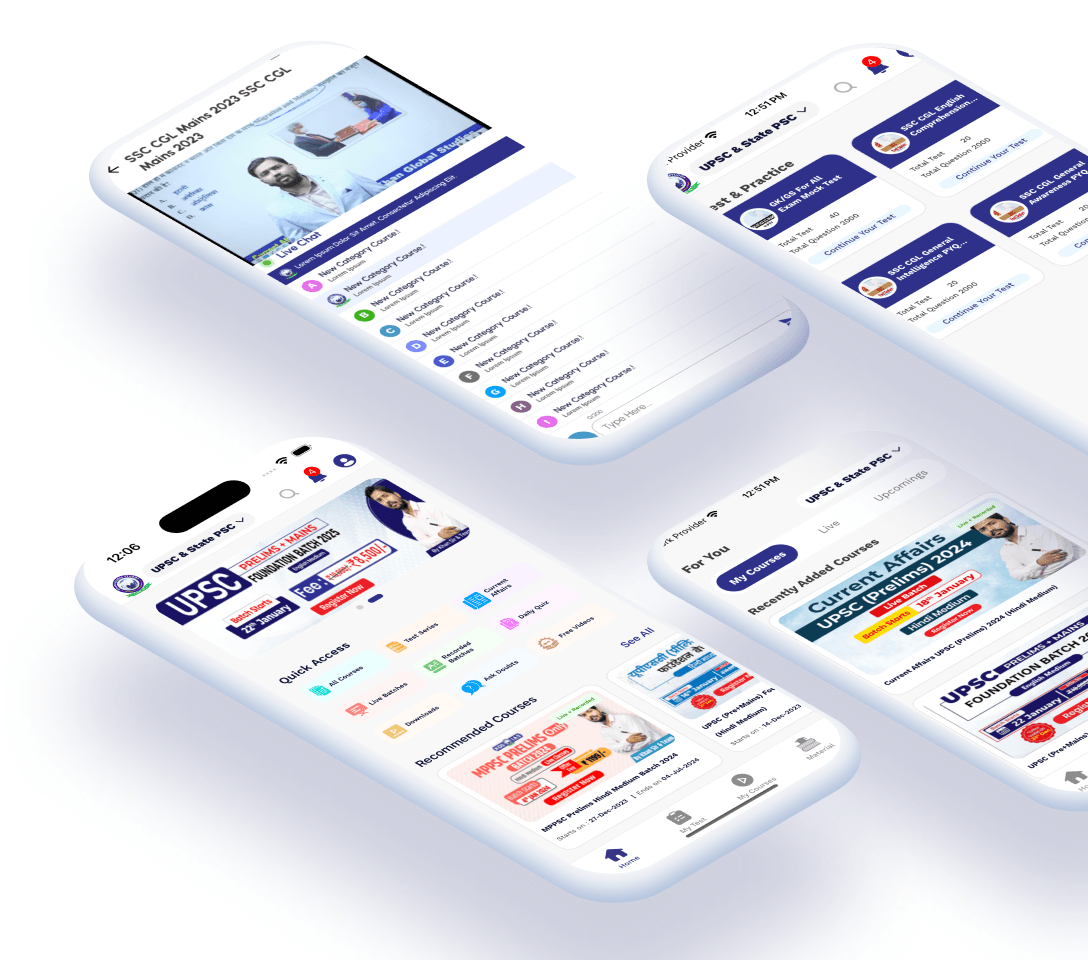
The most trusted learning platform on your phone
With our training programs, learning online can be a very exciting experience! Take the next step toward achieving your professional and personal objectives


NCERT Books
Resources
We love learning. Through our innovative solutions, we encourage ourselves, our teams, and our Students to grow. We welcome and look for diverse perspectives and opinions because they enhance our decisions. We strive to understand the big picture and how we contribute to the company’s objectives. We approach challenges with optimism and harness the power of teamwork to accomplish our goals. These aren’t just pretty words to post on the office wall. This is who we are. It’s how we work. And it’s how we approach every interaction with each other and our Students.
Come with an open mind, hungry to learn, and you’ll experience unmatched personal and professional growth, a world of different backgrounds and perspectives, and the freedom to be you—every day. We strive to build and sustain diverse teams and foster a culture of belonging. Creating an inclusive environment where every students feels welcome, appreciated, and heard gives us something to feel (really) good about.
Get Free academic Counseling & Course Details