You're all caught up—no notifications available.
Explore All Exams at KGS


All Exams
Explore All Exams at KGS

Khan Sir Courses
Geography I Polity I History | World Map I Indian Map I Economics I Biology

UPSC & State PSC
UPSC I BPSC I UP-PSC I MP-PSC

State Exams
UP I Bihar I MP | Rajasthan

NEET | JEE | CUET | Boards
NEET | JEE | CUET | Boards

Defence Exams
NDA I CDS I CAPF I AFCAT I SSB I Agniveer

Police Exams
UP SI | Bihar SI | Delhi Police | UP Constable

SSC Exams
CGL I CPO I CHSL I MTS I SSC GD I Delhi Police

Foundation Courses
Physics I Chemistry I Biology I History I Geography I Polity I NCERT I Math I English | Map I Reasoning

Railway Exams
RRB | RPF

Teaching Exams
TET | Teaching | UGC

Banking Exams
SBI | RBI | IBPS

Engineering Exams
Civil | Electrical | Mechanical
UGC NET
UGC NET/JRF
News Highlights provides you with the best compilation of the Daily News Highlights taking place across the globe: National, International, Sports, Science and Technology, Banking, Economy, Agreement, Appointments, Ranks, and Report and General Studies

1.
The Indian Space Research Organisation launched its historic 100th mission GSLV-F15 lifting off with a navigation satellite from the Satish Dhawan Space Centre in Sriharikota. The launch vehicle with an indigenous cryogenic stage lifted off from the spaceport's second launch pad at 6.23 a.m. The rocket successfully placed the NVS-02 satellite in the intended orbit.
2.
The U.S., the world's richest nation, owning a third of the world's wealth, and with the highest annual gross domestic product, is singularly responsible for global warming, having contributed well over a fifth of the cumulative emissions of carbon dioxide, from the pre-industrial era to date. Under the principles and terms of the United Framework Convention on Climate Change (UNFCCC), to which the U.S. is a signatory, it is also supposed to take the lead in climate action while providing the financial and technological means to developing countries to do the same.
By any reckoning, climate action by the U.S. has always fallen well short of its responsibility under the global climate regime, irrespective of the dispensation in Washington DC. Its emissions steadily rose from 1992 to 2005, while its political class consistently swung away from serious efforts, resulting in the U.S. Congress, through a bipartisan consensus, keeping the country out of the Kyoto Protocol. Since then, its emissions have declined, though at a rate that is much slower than what it owes the world. Developing countries, in the face of the U.S.'s withdrawal from the Paris Agreement, need a calibrated strategy that must not fall prey to the illusion that they can make up the huge gap created by America's stand.
3.
The efficacy of a welfare programme is directly proportional to the enthusiasm of the government implementing it. The Mahatma Gandhi National Rural Employment Guarantee Scheme (MGNREGS) will soon be completing 20 years of its implementation. The fact that it has not only survived but also thrived under two regimes across multiple terms suggests its utility and popularity among the rural poor, though, under the National Democratic Alliance, the scheme has acquired a status of being an un-wanted necessity after being seen initially as someone else's baby. But as the COVID-19 pandemic showed, the MGNREGS was a necessity and vital in terms of the sustenance it provided to both rural workers and migrant labour returning to their rural homes after the lockdowns were announced.
4.
For a long time, India has told the incredible supply side story of its milk revolution. The White Revolution that was initiated by Verghese Kurien propelled India to become the world's largest milk producer. Milk, a vital source of protein, calcium, and other micronutrients, is integral to plant-heavy Indian diets. Research links milk consumption to lower odds of stunting, underweight, and anthropometric failure in Indian children aged between six months and five years. However, milk consumption remains highly inequitable across socio-economic groups and regions. As the Union Budget 2025-26 approaches, addressing these disparities is essential to improved health outcomes for all. The latest Household Consumer Expenditure Surveys (HCES) by the National Sample Survey Office (NSSO) show that households in the top-income decile consume three to four times more milk (equivalent) per capita compared to households in the lowest-income decile. Despite sharper increases in consumption among lower-income groups, the poorest 30% consumed just 18% of India's milk.
5.
During the recent Margazhi season or music season in Chennai, rasikas (connoisseurs) hopped from concert to concert. While tuning into the music, they also had to keep in mind copyright law as the sabhas (performance venues) forbade them from unauthorised recording. Copyright law has seldom been at the forefront of discussion in the Carnatic music sphere as there is a general belief that copyright law does not apply to it. In Indian Performing Right Society Ltd. v. Eastern Indian Motion Pictures Association (1977), Justice V.R. Krishna Iyer asked whether music meant only the composition of a piece or extended to the soulful tune, voice, and rendering of the piece. This remains unanswered in Parliament. Apart from being a metaphysical question, what is music is also a legal question. The idea that music is only a composition stems from a western classical understanding of music. The lawmakers of the Indian Copyright Act, 1914, failed to understand Indian music before enacting the law. The same colonial understanding followed even in the legislation enacted in 1957.
6.
With Budget FY2025-26 scheduled to be presented, here is a look at some of the recently launched schemes, older schemes with significantly reduced funding, schemes under the Production Linked Incentive (PLI) umbrella, and those promoting electric mobility in India. Other schemes are the Rashtriya Gram Swaraj Abhiyan to re-imagine panchayati raj institutions, the scheme to upgrade Industrial Training Institute (ITIs) and the controversial PM Vishwakarma scheme, which aims to nurture the guru-shishya parampara or family-based practice of traditional skills. Schemes with the goal of promoting AI in India such as the INDIA AI mission and Centres of Excellence for Al are also a part of the list.
7.
The Supreme Court held that residence-based reservation for admission to postgraduate (PG) medical courses within the State quota ran counter to the very idea of one citizenship for all and the right to equality under the Constitution. A Bench of Justices Hrishikesh Roy, Sudhanshu Dhulia, and S.V.N. Bhatti said "domicile" or residence-based reservation in PG medical courses was "constitutionally impermissible". However, it said that the judgment would not impact admissions already granted. The court acknowledged that though residence-based reservation was allowed to a reasonable degree for MBBS courses, a long line of judgments had clearly decided in the negative as far as PG courses were concerned.
8.
Anguished by the years of abuse an impoverished tribal woman from Chhattisgarh suffered as a domestic worker in the national capital and neighbouring cities, the Supreme Court directed the Union government to work on bringing a law to protect this burgeoning but unorganised workforce from exploitation. "The simple reason for this harassment and rampant abuse, which seems to be prevalent throughout the country, is the legal vacuum which exists vis-à-vis the rights and protection of domestic workers... As a result, they frequently endure low wages, unsafe environments, and extended hours without effective recourse," the court observed in a judgment.
A Bench of Justices Surya Kant and Ujjal Bhuyan ordered the Centre to form an interministerial committee to "consider the desirability of recommending a legal framework for the benefit, protection and regulation of the rights of domestic workers".
9.
Nearly a year after the Centre launched the ₹75,000-crore PM Surya Ghar scheme, 8.5 lakh households have installed rooftop solar connections, Union Minister for New and Renewable Energy said. The scheme, on the whole, targets one crore household installations across India. Mr. Joshi said that this target is likely to be met "within the next two or three years".
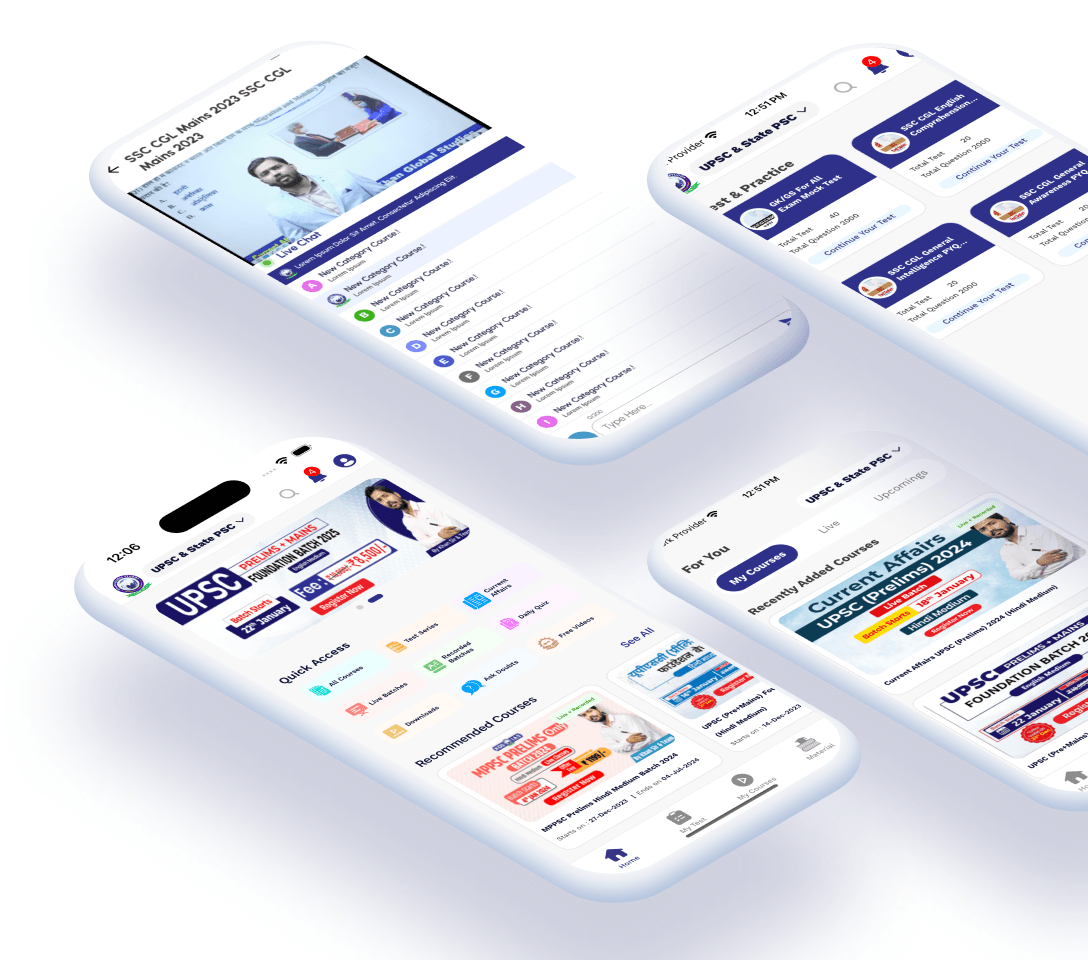
The most trusted learning platform on your phone
With our training programs, learning online can be a very exciting experience! Take the next step toward achieving your professional and personal objectives


NCERT Books
Resources
We love learning. Through our innovative solutions, we encourage ourselves, our teams, and our Students to grow. We welcome and look for diverse perspectives and opinions because they enhance our decisions. We strive to understand the big picture and how we contribute to the company’s objectives. We approach challenges with optimism and harness the power of teamwork to accomplish our goals. These aren’t just pretty words to post on the office wall. This is who we are. It’s how we work. And it’s how we approach every interaction with each other and our Students.
Come with an open mind, hungry to learn, and you’ll experience unmatched personal and professional growth, a world of different backgrounds and perspectives, and the freedom to be you—every day. We strive to build and sustain diverse teams and foster a culture of belonging. Creating an inclusive environment where every students feels welcome, appreciated, and heard gives us something to feel (really) good about.
Get Free academic Counseling & Course Details