You're all caught up—no notifications available.
Explore All Exams at KGS


All Exams
Explore All Exams at KGS

Khan Sir Courses
Geography I Polity I History | World Map I Indian Map I Economics I Biology

UPSC & State PSC
UPSC I BPSC I UP-PSC I MP-PSC

State Exams
UP I Bihar I MP | Rajasthan

NEET | JEE | CUET | Boards
NEET | JEE | CUET | Boards

Defence Exams
NDA I CDS I CAPF I AFCAT I SSB I Agniveer

Police Exams
UP SI | Bihar SI | Delhi Police | UP Constable

SSC Exams
CGL I CPO I CHSL I MTS I SSC GD I Delhi Police

Foundation Courses
Physics I Chemistry I Biology I History I Geography I Polity I NCERT I Math I English | Map I Reasoning

Railway Exams
RRB | RPF

Teaching Exams
TET | Teaching | UGC

Banking Exams
SBI | RBI | IBPS

Engineering Exams
Civil | Electrical | Mechanical
UGC NET
UGC NET/JRF
Current Affairs provides you with the best compilation of the Daily Current Affairs taking place across the globe: National, International, Sports, Science and Technology, Banking, Economy, Agreement, Appointments, Ranks, and Report and General Studies

SYLLABUS
GS-1: Role of women and women’s organization, population and associated issues, poverty and developmental issues, urbanization, their problems and their remedies.
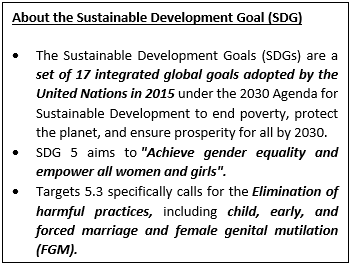
Context: Recently, the African Union released the Presidential Champion Report on Ending Child Marriage in Africa, warning that the continent is not on track to meet Sustainable Development Goal (SDG) 5.3, which targets elimination of child marriage by 2030.
More on the News
• The report was launched during the 39th Ordinary Session of the African Union Heads of State and Government and presented by Zambian President Hakainde Hichilema, the AU Champion on Ending Child Marriage.
Key Highlights of the Report
• Scale of the challenge: Africa accounts for one in three child brides globally.
• Regional Distribution: Sub-Saharan Africa bears the highest burden globally.
The Sahel is a vast semi-arid transitional zone separating the Sahara Desert in the north from the tropical savannas in the south.
• Drivers of Child Marriage; The “Polycrisis” Effect: The report highlights overlapping crises worsening vulnerabilities:
• Climate-Specific Findings: A 10% rainfall deviation is linked to a 1% rise in child marriage.
• Case Study-Zambia’s Progress: Zambia is highlighted as an example of strong political commitment and reform in tackling child marriage.
Strategic Pathways for AU Member States
• Governance and Legal Reforms: AU member states should set 18 years as the minimum marriage age without exceptions, harmonise statutory, customary, and religious laws, and strengthen enforcement and accountability systems.
• Social and Economic Measures: Governments should invest in girls’ education and empowerment while expanding cash transfers, scholarships, vocational training, and survivor-centred policies.
• Climate and Humanitarian Integration: Child marriage prevention should be integrated into climate adaptation strategies and humanitarian and disaster response frameworks.
• Technology and Data: Countries should deploy digital tools for awareness, reporting, and age verification while improving real-time data and predictive analytics.
• Regional Cooperation: The report calls for stronger collaboration through Regional Economic Communities (RECs), sharing best practices, and harmonising cross-border responses.
Source:
Down To Earth
UNICEF
The most trusted learning platform on your phone
With our training programs, learning online can be a very exciting experience! Take the next step toward achieving your professional and personal objectives


Course Related Query:
Ask Your DoubtsStore Related Query:[email protected]NCERT Books
Resources
We love learning. Through our innovative solutions, we encourage ourselves, our teams, and our Students to grow. We welcome and look for diverse perspectives and opinions because they enhance our decisions. We strive to understand the big picture and how we contribute to the company’s objectives. We approach challenges with optimism and harness the power of teamwork to accomplish our goals. These aren’t just pretty words to post on the office wall. This is who we are. It’s how we work. And it’s how we approach every interaction with each other and our Students.
Come with an open mind, hungry to learn, and you’ll experience unmatched personal and professional growth, a world of different backgrounds and perspectives, and the freedom to be you—every day. We strive to build and sustain diverse teams and foster a culture of belonging. Creating an inclusive environment where every students feels welcome, appreciated, and heard gives us something to feel (really) good about.
Get Free academic Counseling & Course Details