Explore All Exams at KGS


All Exams
Explore All Exams at KGS

Khan Sir Courses
Geography I Polity I History | World Map I Indian Map I Economics I Biology

UPSC & State PSC
UPSC I BPSC I UP-PSC I MP-PSC

Judiciary
CLAT

State Exams
UP I Bihar I MP | Rajasthan

NEET | JEE | CUET
NEET | JEE | CUET

Defence Exams
NDA I CDS I CAPF I AFCAT I SSB I Agniveer

Police Exams
UP SI | Bihar SI | Delhi Police | UP Constable

SSC Exams
CGL I CPO I CHSL I MTS I SSC GD I Delhi Police

Foundation Courses
Physics I Chemistry I Biology I History I Geography I Polity I NCERT I Math I English | Map I Reasoning

Railway Exams
RRB | RPF

Teaching Exams
TET | Teaching | UGC

Banking Exams
SBI | RBI | IBPS

Engineering Exams
Civil | Electrical | Mechanical
UGC NET
UGC NET/JRF
Current Affairs provides you with the best compilation of the Daily Current Affairs taking place across the globe: National, International, Sports, Science and Technology, Banking, Economy, Agreement, Appointments, Ranks, and Report and General Studies
Current Affairs
SYLLABUS
GS-1: Distribution of key natural resources across the world (including South Asia and the Indian sub-continent); factors responsible for the location of primary, secondary, and tertiary sector industries in various parts of the world (including India).
Context: The Union Cabinet has approved the Capex Support Scheme to Promote Critical Mineral Processing, with an outlay of ₹2,814 crore over five years (FY 2026–27 to 2030–31), to develop domestic processing capacity, promote value addition and reduce import dependence.
About the ‘Capex Support Scheme to Promote Critical Mineral Processing’
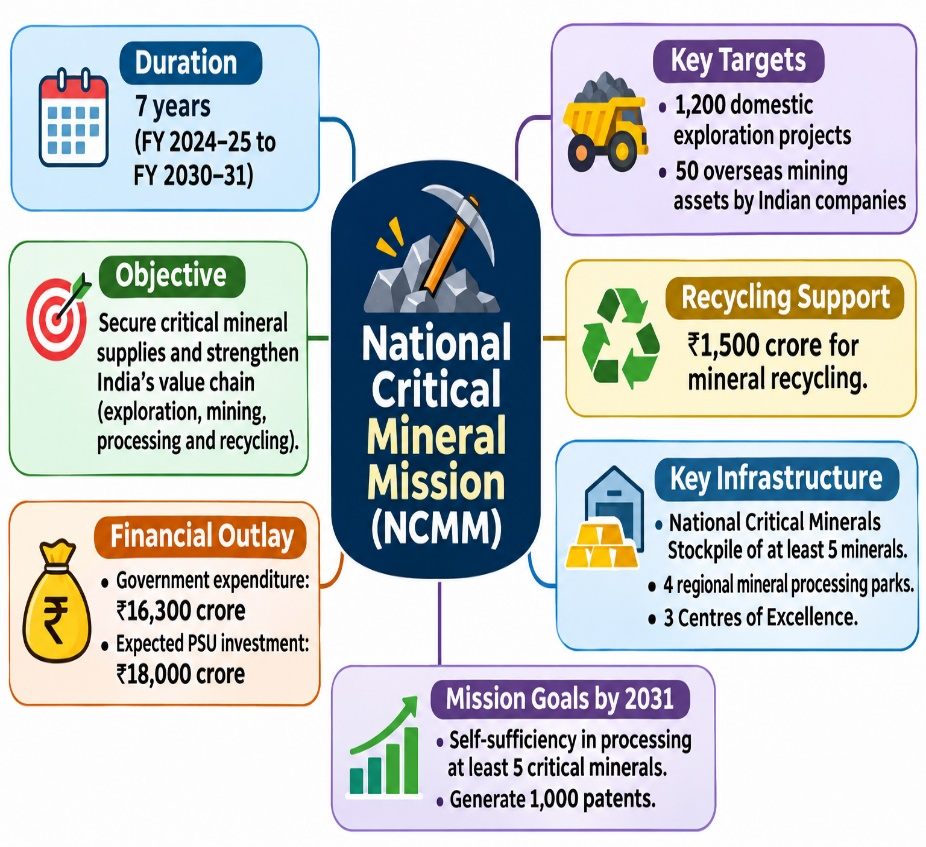
• Nodal Initiative: The scheme is part of the government's broader efforts under the National Critical Mineral Mission (NCMM) to strengthen India's critical mineral value chain.
• Objective: To establish and operationalise domestic processing facilities for critical minerals, promote domestic value addition, reduce import dependence and develop resilient end-to-end value chains.
• Financial Outlay: ₹2,814 crore over five years (FY 2026–27 to FY 2030–31).
• Nature of Assistance: Capital subsidy of 30% of eligible investment for establishing four critical mineral processing plants.
• Targeted Processing Facilities:
• Maximum Capital Support:
• Mineral Processing: The scheme targets the processing of lithium and nickel ores/intermediate products into high-purity compounds.
• Beneficiary Selection: A two-stage process involving:
1. Technical assessment of applications to determine eligibility.
2. Financial bidding, with two beneficiaries selected for each mineral based on the least-cost criterion (lowest capital support sought).
• Disbursement Mechanism: Financial assistance will be released in three tranches linked to the achievement of specified project milestones.
• Target Sectors: Electric mobility, Battery Energy Storage Systems (BESS), electronics, defence and speciality steel.
Need and Significance of the Scheme
• Reduce Import Dependence: Reduce India's substantial import dependence on refined intermediates and high-purity lithium, nickel and cobalt materials by developing domestic processing capacity.
• Strengthen Supply Chain Resilience: Reduce vulnerability to geopolitical disruptions, export restrictions and price volatility, particularly given China's control over approximately 90% of global critical mineral processing.
• Promote Domestic Value Addition: Enable domestic processing of lithium and nickel ores and intermediate products into high-purity compounds, strengthening India's critical mineral value chain.
• Support Strategic Industries: Strengthen mineral availability for electric vehicles, battery energy storage systems (BESS), electronics, semiconductors, defence equipment and speciality steel.
• Advance Clean Energy Transition: Support battery manufacturing, decarbonisation targets and Atmanirbhar Bharat by strengthening domestic capabilities and economic security.
About Critical Minerals
• Critical minerals are minerals essential for a nation's economic development, technological advancement and national security.
• Criticality: Their criticality is determined by two factors:
• India's List of Critical Minerals (2023): The Ministry of Mines released a list of 30 critical minerals for India:
• Classification of Important Mineral Groups:
• Applications: These minerals are essential for manufacturing mobile phones, tablets, electric vehicles, solar panels, wind turbines and fibre-optic cables, as well as applications in the defence and medical sectors.
• Extraction and Refining: Although critical minerals are found across the globe, their extraction and refining are costly, technically challenging and energy-intensive.
Khan Global Studies App
With our training programs, learning online can be a very exciting experience. Take the next step toward achieving your professional and personal objectives.



Course Related Query:
Ask Your DoubtsStore Related Query:[email protected]NEET | JEE | CUET
NCERT Books
Resources
We love learning. Through our innovative solutions, we encourage ourselves, our teams, and our Students to grow. We welcome and look for diverse perspectives and opinions because they enhance our decisions. We strive to understand the big picture and how we contribute to the company’s objectives. We approach challenges with optimism and harness the power of teamwork to accomplish our goals. These aren’t just pretty words to post on the office wall. This is who we are. It’s how we work. And it’s how we approach every interaction with each other and our Students.
Come with an open mind, hungry to learn, and you’ll experience unmatched personal and professional growth, a world of different backgrounds and perspectives, and the freedom to be you—every day. We strive to build and sustain diverse teams and foster a culture of belonging. Creating an inclusive environment where every students feels welcome, appreciated, and heard gives us something to feel (really) good about.