Explore All Exams at KGS


All Exams
Explore All Exams at KGS

Khan Sir Courses
Geography I Polity I History | World Map I Indian Map I Economics I Biology

UPSC & State PSC
UPSC I BPSC I UP-PSC I MP-PSC

State Exams
UP I Bihar I MP | Rajasthan

NEET | JEE | CUET
NEET | JEE | CUET

Defence Exams
NDA I CDS I CAPF I AFCAT I SSB I Agniveer

Police Exams
UP SI | Bihar SI | Delhi Police | UP Constable

SSC Exams
CGL I CPO I CHSL I MTS I SSC GD I Delhi Police

Foundation Courses
Physics I Chemistry I Biology I History I Geography I Polity I NCERT I Math I English | Map I Reasoning

Railway Exams
RRB | RPF

Teaching Exams
TET | Teaching | UGC

Banking Exams
SBI | RBI | IBPS

Engineering Exams
Civil | Electrical | Mechanical
UGC NET
UGC NET/JRF
Current Affairs provides you with the best compilation of the Daily Current Affairs taking place across the globe: National, International, Sports, Science and Technology, Banking, Economy, Agreement, Appointments, Ranks, and Report and General Studies

Current Affairs
SYLLABUS
GS-3: Science and Technology- Developments and their Applications and Effects in Everyday Life; Indigenization of Technology and Developing New Technology.
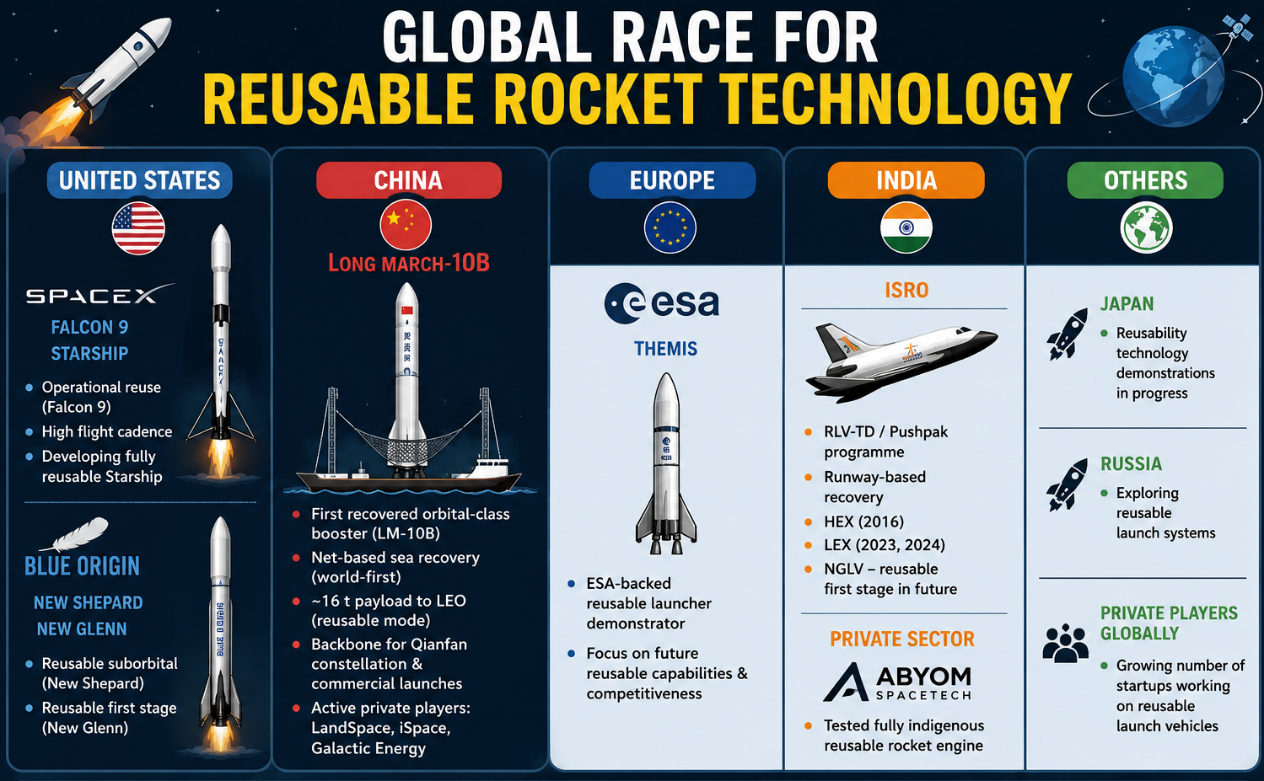
Context: China successfully recovered and landed the first stage of its Long March-10B rocket, marking its first successful demonstration of an orbital-class reusable launch vehicle and a major milestone in its space programme.
More on the News
• The Long March-10B successfully completed a controlled descent and vertical landing on a sea-based recovery platform, becoming China's first recovered orbital-class reusable rocket booster.
• Unlike conventional landing-leg recovery systems, the booster was captured using a net-based recovery system mounted on an offshore platform, a method claimed to be a world-first in reusable rocket recovery.
• The rocket can carry about 16 tonnes to Low Earth Orbit (LEO) in reusable mode and is expected to support China's Qianfan satellite constellation, commercial launch market, and future lunar exploration missions.
Reusable Rocket Technology: Concepts and Types
• What are Reusable Rockets?
• Why Does Reusability Matter?
• Types of Recovery Systems
The rocket launches vertically and returns to land vertically using controlled engine burns and precision guidance systems.
Requires advanced navigation, thrust-vector control, and autonomous landing technologies.
Examples: SpaceX Falcon 9, SpaceX Starship Booster, Blue Origin New Shepard, China's Long March-10B
The vehicle returns through the atmosphere and lands on a runway like an aircraft.
Requires aerodynamic control surfaces and robust thermal protection systems.
Examples: ISRO's Pushpak Reusable Launch Vehicle (RLV), NASA Space Shuttle
• How Reusable Rockets Work
Significance of Reusable Rocket Technology
• Lowering the Cost of Space Access: Reusing expensive booster stages significantly reduces launch costs, making space missions more affordable.
• Increasing Launch Frequency: Faster turnaround and reuse enable more frequent launches than conventional expendable rockets.
• Supporting Mega Satellite Constellations: Reusable launch systems facilitate the cost-effective deployment of large satellite networks for communication and internet services.
• Enabling Future Deep-Space Missions: Reduced launch costs improve the feasibility of sustained lunar, planetary, and human spaceflight missions.
• Expanding the Commercial Space Economy: Affordable and frequent launches encourage private-sector participation and enhance competitiveness in the global space market.
India's Reusable Launch Vehicle Efforts
• ISRO's RLV Programme
• Key Milestones
• Significance for India
Challenges in Mastering the Reusable Technology
• Precision Recovery: Achieving reliable landings under varying atmospheric and operational conditions remains technologically demanding.
• Thermal Protection: Re-entry generates extreme temperatures, requiring advanced heat-shield materials and durable structures.
• Refurbishment Requirements: Frequent inspection, repair, and maintenance can reduce the economic benefits of reusability.
• Economic Viability: Reusable systems become cost-effective only when refurbishment costs and turnaround times remain significantly lower than the cost of building a new rocket.
• Safety and Reliability: Launch vehicles must maintain high performance and reliability across multiple flight cycles.
Future Outlook
• Reusable rockets are expected to become the backbone of commercial launch services and satellite-constellation deployment.
• Advances in propulsion, automation, and materials science will further improve the efficiency of reusable launch systems.
• As more countries and private companies master reusability, competition is likely to reduce launch costs and expand global access to space.
• Reusable launch vehicles will play a crucial role in future lunar missions, deep-space exploration, and the long-term commercialisation of outer space.
Khan Global Studies App
With our training programs, learning online can be a very exciting experience. Take the next step toward achieving your professional and personal objectives.



Course Related Query:
Ask Your DoubtsStore Related Query:[email protected]NEET | JEE | CUET
NCERT Books
Resources
We love learning. Through our innovative solutions, we encourage ourselves, our teams, and our Students to grow. We welcome and look for diverse perspectives and opinions because they enhance our decisions. We strive to understand the big picture and how we contribute to the company’s objectives. We approach challenges with optimism and harness the power of teamwork to accomplish our goals. These aren’t just pretty words to post on the office wall. This is who we are. It’s how we work. And it’s how we approach every interaction with each other and our Students.
Come with an open mind, hungry to learn, and you’ll experience unmatched personal and professional growth, a world of different backgrounds and perspectives, and the freedom to be you—every day. We strive to build and sustain diverse teams and foster a culture of belonging. Creating an inclusive environment where every students feels welcome, appreciated, and heard gives us something to feel (really) good about.