Explore All Exams at KGS


All Exams
Explore All Exams at KGS

Khan Sir Courses
Geography I Polity I History | World Map I Indian Map I Economics I Biology

UPSC & State PSC
UPSC I BPSC I UP-PSC I MP-PSC

Judiciary
CLAT

State Exams
UP I Bihar I MP | Rajasthan

NEET | JEE | CUET
NEET | JEE | CUET

Defence Exams
NDA I CDS I CAPF I AFCAT I SSB I Agniveer

Police Exams
UP SI | Bihar SI | Delhi Police | UP Constable

SSC Exams
CGL I CPO I CHSL I MTS I SSC GD I Delhi Police

Foundation Courses
Physics I Chemistry I Biology I History I Geography I Polity I NCERT I Math I English | Map I Reasoning

Railway Exams
RRB | RPF

Teaching Exams
TET | Teaching | UGC

Banking Exams
SBI | RBI | IBPS

Engineering Exams
Civil | Electrical | Mechanical
UGC NET
UGC NET/JRF
Current Affairs provides you with the best compilation of the Daily Current Affairs taking place across the globe: National, International, Sports, Science and Technology, Banking, Economy, Agreement, Appointments, Ranks, and Report and General Studies
Current Affairs
SYLLABUS:
GS-3: Conservation, environmental pollution and degradation, environmental impact assessment.
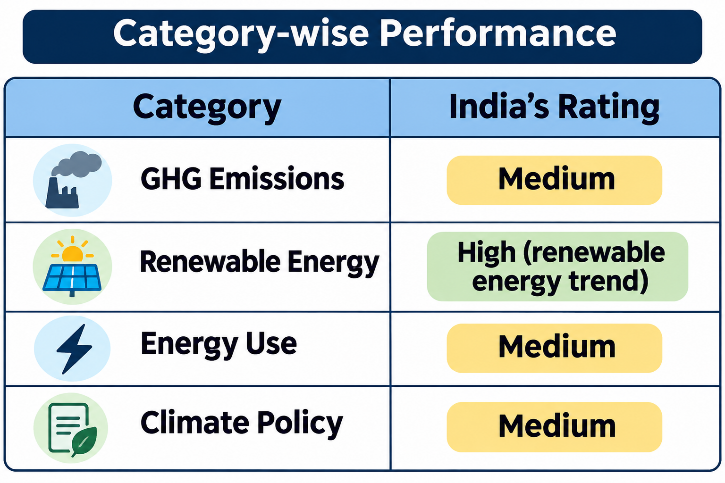
Context: India has slipped five positions to 28th rank in the Climate Change Performance Index (CCPI) 2027, scoring 60.85 points, while retaining its overall ‘medium’ performance rating.
About the Climate Change Performance Index (CCPI)
• Published by: Germanwatch and NewClimate Institute, Germany.
• Launched: 2005; published annually, usually alongside the United Nations Climate Change Conference (COP).
• Purpose: To monitor and compare countries' climate mitigation efforts and promote transparency in national and international climate policies.
• Coverage: Assesses 64 countries and the European Union (EU), collectively accounting for over 90% of global greenhouse gas (GHG) emissions.
• Expert Participation: Around 500 climate and energy experts contribute to the assessment of countries' national and international climate policies.
• Assessment Methodology: The CCPI uses a standardised framework comprising 14 indicators across four categories.
• Performance Ratings: Very High, High, Medium, Low and Very Low.
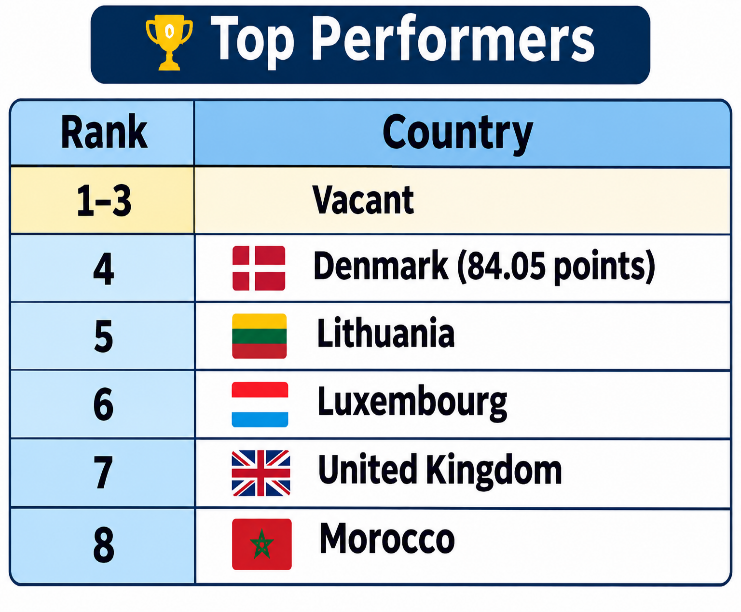
• Ranking Convention: The first three positions remain vacant because no country has demonstrated sufficiently strong performance across all categories to be aligned with the Paris Agreement's climate goals.
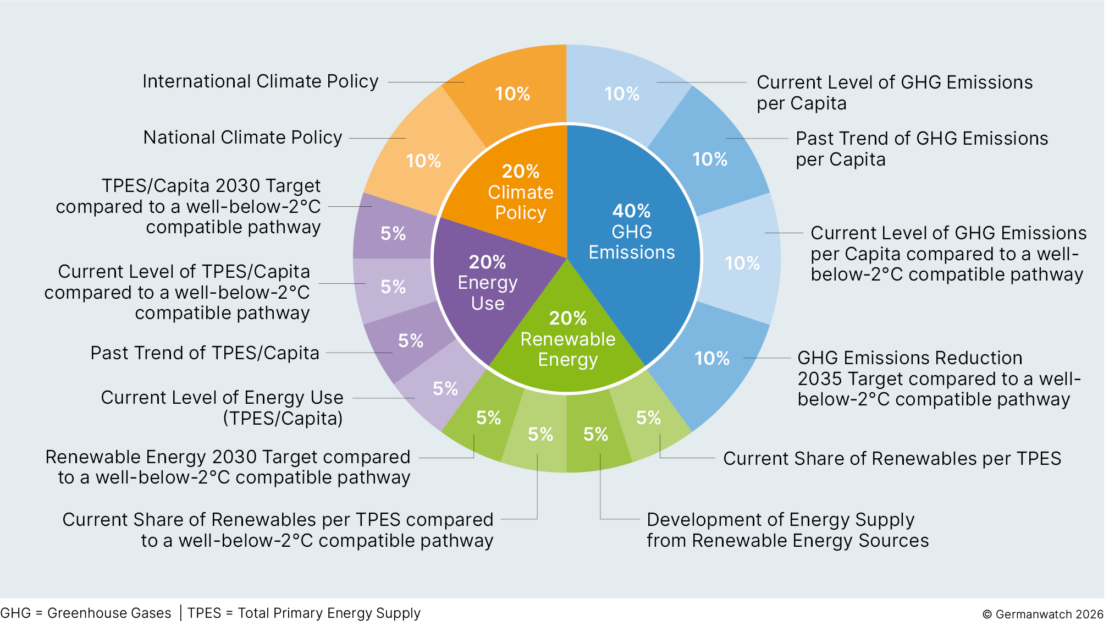
Key Findings of CCPI 2027
• India's Performance:
• Progress in Renewable Energy:
• India's Updated Nationally Determined Contributions (NDCs) for 2035:
• Major Challenges for India:
• Global Performance:
• G20 Performance:
Recommendations / Way Forward
• Strengthen Grid Infrastructure: Expand electricity transmission networks and energy storage facilities to improve the utilisation of renewable energy.
• Improve Energy Efficiency: Reduce energy consumption through greater efficiency across sectors.
• Accelerate Clean Energy Deployment: Convert installed renewable energy capacity into actual electricity generation.
• Reduce Coal Dependence: Establish a clearer and time-bound roadmap for reducing fossil fuel dependence.
• Strengthen Climate Action: Translate climate commitments and announced targets into faster implementation across the economy.
Khan Global Studies App
With our training programs, learning online can be a very exciting experience. Take the next step toward achieving your professional and personal objectives.


Course Related Query:
Ask Your DoubtsStore Related Query:[email protected]NEET | JEE | CUET
NCERT Books
Resources
We love learning. Through our innovative solutions, we encourage ourselves, our teams, and our Students to grow. We welcome and look for diverse perspectives and opinions because they enhance our decisions. We strive to understand the big picture and how we contribute to the company’s objectives. We approach challenges with optimism and harness the power of teamwork to accomplish our goals. These aren’t just pretty words to post on the office wall. This is who we are. It’s how we work. And it’s how we approach every interaction with each other and our Students.
Come with an open mind, hungry to learn, and you’ll experience unmatched personal and professional growth, a world of different backgrounds and perspectives, and the freedom to be you—every day. We strive to build and sustain diverse teams and foster a culture of belonging. Creating an inclusive environment where every students feels welcome, appreciated, and heard gives us something to feel (really) good about.