You're all caught up—no notifications available.
Explore All Exams at KGS


All Exams
Explore All Exams at KGS

Khan Sir Courses
Geography I Polity I History | World Map I Indian Map I Economics I Biology

UPSC & State PSC
UPSC I BPSC I UP-PSC I MP-PSC

State Exams
UP I Bihar I MP | Rajasthan

NEET | JEE | CUET | Boards
NEET | JEE | CUET | Boards

Defence Exams
NDA I CDS I CAPF I AFCAT I SSB I Agniveer

Police Exams
UP SI | Bihar SI | Delhi Police | UP Constable

SSC Exams
CGL I CPO I CHSL I MTS I SSC GD I Delhi Police

Foundation Courses
Physics I Chemistry I Biology I History I Geography I Polity I NCERT I Math I English | Map I Reasoning

Railway Exams
RRB | RPF

Teaching Exams
TET | Teaching | UGC

Banking Exams
SBI | RBI | IBPS

Engineering Exams
Civil | Electrical | Mechanical
UGC NET
UGC NET/JRF
Current Affairs provides you with the best compilation of the Daily Current Affairs taking place across the globe: National, International, Sports, Science and Technology, Banking, Economy, Agreement, Appointments, Ranks, and Report and General Studies
SYLLABUS
GS-2: Important Aspects of Governance, Transparency and Accountability.
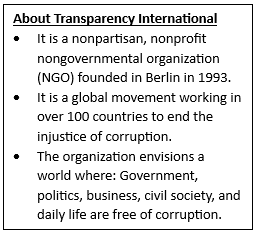
Context: Transparency International recently released the CPI 2025, which measures perceived levels of public-sector corruption across 182 countries and territories.
About the Corruption Perceptions Index (CPI)
• CPI is the most widely used global corruption ranking in the world, published annually by Transparency International since 1995.
• The index ranks 180-182 countries and territories by their perceived levels of public sector corruption.
• The index uses a scale from 0 to 100, where:
• It aggregates 13 independent data sources (e.g., World Bank, WEF, risk consultancies) to provide a comparative global governance benchmark rather than a direct measure of corruption incidents.
• The CPI is widely used by governments, investors, researchers, and international organisations as a benchmark for governance quality, investment risk, and institutional transparency.
Key Findings of the Index
• Global Scores and Trends:
• Top and Bottom Performers:
• Long-Term Trends:
India-Specific Findings
• India has been ranked 91st out of 182 countries, with a score of 39/100 in CPI 2025 (a one-point improvement over 38 in the previous year)
• Despite the slight uptick, India’s score remains below the global average (42), indicating that corruption is still perceived as a systemic challenge.
• In its neighbourhood, India lags behind Bhutan (score 71, rank 18) and China (43, 76) but outperforms others, namely, Sri Lanka (35, 107), Nepal (34, 109), Pakistan (28, 136), Bangladesh (24, 150), with Afghanistan and Myanmar (16, 169).
Concerns Raised
• Transparency International warns of a “decline in leadership” on anti-corruption, even in established democracies like the US (64), Canada (75), New Zealand (81), UK (70), France (66) and Sweden (80), all of which have seen score slippage in recent years.
• In 36 of the 50 countries with the biggest CPI declines since 2012, civic space has also shrunk, with governments restricting NGOs, media and protests through legal and informal pressures.
• Between 2012 and 2025, 150 journalists investigating corruption were murdered outside conflict zones, over 90% in countries scoring below 50, including India (39), Brazil (35), Mexico (27), Pakistan (28) and Iraq (28).
Key Recommendations
• Strengthening Institutions: Strengthen independent justice systems and oversight institutions to ensure impartial investigation and prosecution of corruption cases.
• Ensuring Transparency: Enhance transparency in political finance, lobbying, and public procurement, reducing undue influence over policymaking.
• Protecting Civic Space: Protect civic space, including safeguarding journalists, whistle-blowers, and civil society organisations from intimidation or legal harassment.
• Tackling Transnational and Illicit Financial Flows: Combat transnational corruption by increasing beneficial-ownership transparency, regulating professional intermediaries, and facilitating asset recovery.
• Empowering Citizens: Give citizens and communities accessible complaint mechanisms and legal remedies against corruption, ensuring that those harmed can seek justice.
The most trusted learning platform on your phone
With our training programs, learning online can be a very exciting experience! Take the next step toward achieving your professional and personal objectives



Course Related Query:
Ask Your DoubtsStore Related Query:[email protected]NCERT Books
Resources
We love learning. Through our innovative solutions, we encourage ourselves, our teams, and our Students to grow. We welcome and look for diverse perspectives and opinions because they enhance our decisions. We strive to understand the big picture and how we contribute to the company’s objectives. We approach challenges with optimism and harness the power of teamwork to accomplish our goals. These aren’t just pretty words to post on the office wall. This is who we are. It’s how we work. And it’s how we approach every interaction with each other and our Students.
Come with an open mind, hungry to learn, and you’ll experience unmatched personal and professional growth, a world of different backgrounds and perspectives, and the freedom to be you—every day. We strive to build and sustain diverse teams and foster a culture of belonging. Creating an inclusive environment where every students feels welcome, appreciated, and heard gives us something to feel (really) good about.
Get Free academic Counseling & Course Details