Explore All Exams at KGS


All Exams
Explore All Exams at KGS

Khan Sir Courses
Geography I Polity I History | World Map I Indian Map I Economics I Biology

UPSC & State PSC
UPSC I BPSC I UP-PSC I MP-PSC

State Exams
UP I Bihar I MP | Rajasthan

NEET | JEE | CUET
NEET | JEE | CUET

Defence Exams
NDA I CDS I CAPF I AFCAT I SSB I Agniveer

Police Exams
UP SI | Bihar SI | Delhi Police | UP Constable

SSC Exams
CGL I CPO I CHSL I MTS I SSC GD I Delhi Police

Foundation Courses
Physics I Chemistry I Biology I History I Geography I Polity I NCERT I Math I English | Map I Reasoning

Railway Exams
RRB | RPF

Teaching Exams
TET | Teaching | UGC

Banking Exams
SBI | RBI | IBPS

Engineering Exams
Civil | Electrical | Mechanical
UGC NET
UGC NET/JRF
Current Affairs provides you with the best compilation of the Daily Current Affairs taking place across the globe: National, International, Sports, Science and Technology, Banking, Economy, Agreement, Appointments, Ranks, and Report and General Studies

Current Affairs
SYLLABUS
GS-3: Basics of cyber security; role of social networking sites in internal security challenges.
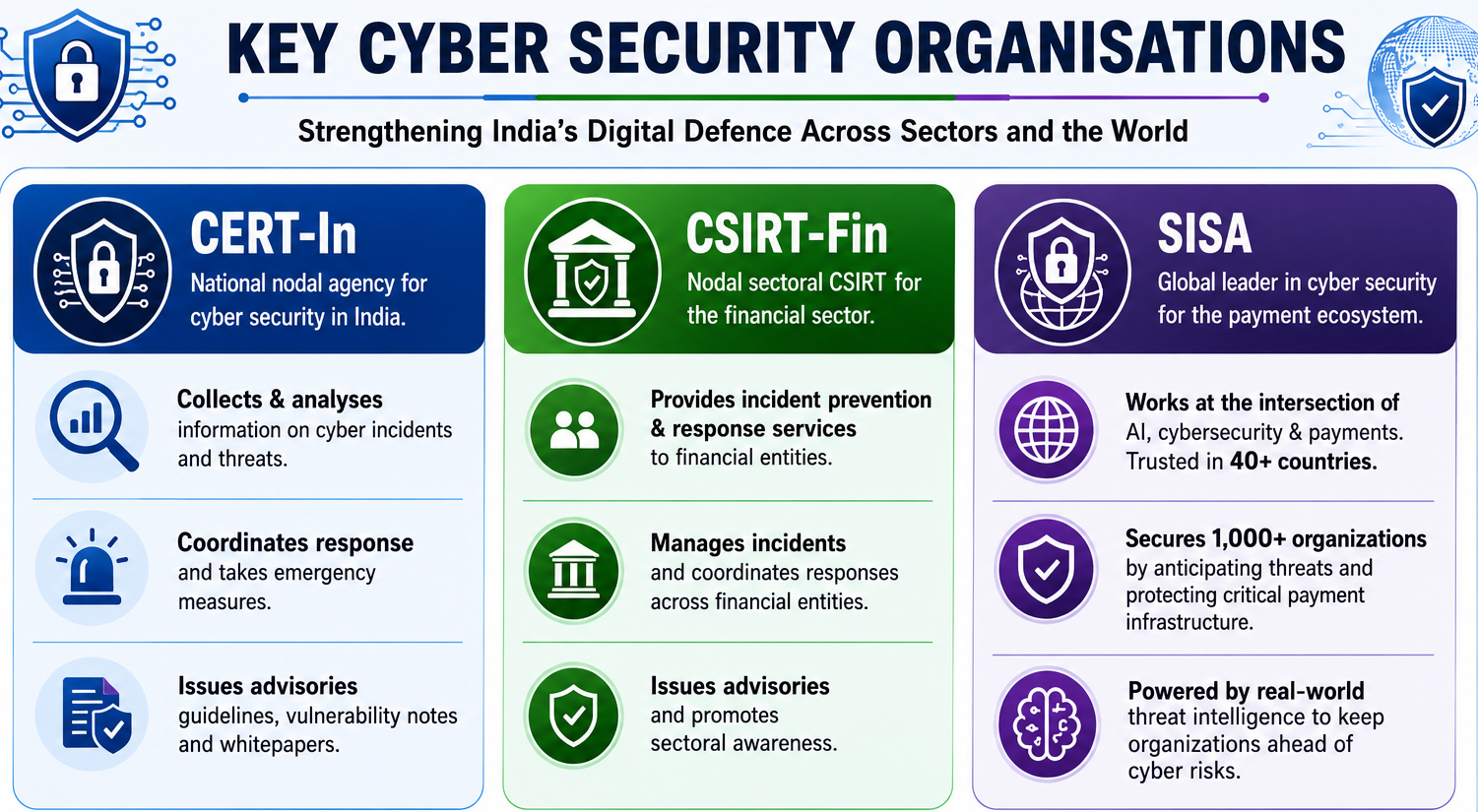
Context: The Ministry of Electronics and Information Technology (MeitY), along with CERT-In, CSIRT-Fin and SISA, released the 2nd edition of the Digital Threat Report 2025–26 for India's Banking, Financial Services and Insurance (BFSI) and digital payments ecosystem.
About the Report
• Released by MeitY, CERT-In, CSIRT-Fin and SISA for the BFSI and digital payments ecosystem.
• Provides an executive assessment of the evolving cyber threat landscape for financial institutions, regulators and cybersecurity leaders.
• Based on Digital Forensics and Incident Response (DFIR) research, CERT-In & CSIRT-Fin observations, and research on adversarial Artificial Intelligence (AI).
• Introduces the "Anatomy of Cyber Failure", a 4-Layer Gap Archetype Framework explaining how modern cyber breaches occur through systemic weaknesses.
• Presents an 18-month roadmap to strengthen foundational controls, build continuous cyber resilience, and develop resilient security architectures.
Key Findings of the Report
• Cyber risks have expanded: Cybersecurity risks have evolved beyond data theft and isolated breaches.
• AI Asymmetry: The report identifies AI asymmetry as the defining risk.
• Predictions realised faster: Six of the seven predictions made in the previous edition have already reached full-scale realisation.
• Emerging threats are now mainstream: Threats such as social engineering, credential theft, supply-chain compromise, cloud exploitation, Business Email Compromise (BEC), session hijacking and deepfake-enabled fraud have become established attack methods.
• Attacks exploit digital trust: Modern attacks increasingly appear as legitimate user sessions, authorised payments, normal workflows and trusted partner interactions.
• Systemic cyber risks: Cyber risks now extend across identity systems, AI models, real-time payment rails, cloud infrastructure, supply chains, APIs, partner platforms, machine identities and agentic AI.
• India's BFSI sector remains highly targeted: Cyberattacks on India's BFSI sector are 1.6 times the global average.
• Supply-chain compromise has become a major systemic cyber risk: A single compromised vendor can simultaneously affect multiple financial institutions.
• Attackers are moving faster than defenders: Zero-day exploitation windows have compressed from weeks or months to hours.
• Shift from static controls to continuous assurance: The report calls for a shift from periodic compliance-based security to continuous risk assessment, coordinated response, stronger information sharing and continuous assurance across the financial ecosystem.
• Anatomy of Cyber Failure: The report introduces the 4-Layer Gap Archetype Framework.
Way Forward / Recommended Priorities
• Phishing-resistant Multi-Factor Authentication (MFA).
• Passwordless authentication.
• Continuous risk assessment.
• Behavioural biometrics and continuous session assurance.
• Stronger identity governance covering human, machine and AI identities.
• Adversarial robustness testing before deploying AI in critical financial decisions.
• Migration towards post-quantum cryptography.
• Enhanced information sharing and coordinated incident response across the financial ecosystem.
Khan Global Studies App
With our training programs, learning online can be a very exciting experience. Take the next step toward achieving your professional and personal objectives.



Course Related Query:
Ask Your DoubtsStore Related Query:[email protected]NEET | JEE | CUET
NCERT Books
Resources
We love learning. Through our innovative solutions, we encourage ourselves, our teams, and our Students to grow. We welcome and look for diverse perspectives and opinions because they enhance our decisions. We strive to understand the big picture and how we contribute to the company’s objectives. We approach challenges with optimism and harness the power of teamwork to accomplish our goals. These aren’t just pretty words to post on the office wall. This is who we are. It’s how we work. And it’s how we approach every interaction with each other and our Students.
Come with an open mind, hungry to learn, and you’ll experience unmatched personal and professional growth, a world of different backgrounds and perspectives, and the freedom to be you—every day. We strive to build and sustain diverse teams and foster a culture of belonging. Creating an inclusive environment where every students feels welcome, appreciated, and heard gives us something to feel (really) good about.