Explore All Exams at KGS


All Exams
Explore All Exams at KGS

Khan Sir Courses
Geography I Polity I History | World Map I Indian Map I Economics I Biology

UPSC & State PSC
UPSC I BPSC I UP-PSC I MP-PSC

State Exams
UP I Bihar I MP | Rajasthan

NEET | JEE | CUET
NEET | JEE | CUET

Defence Exams
NDA I CDS I CAPF I AFCAT I SSB I Agniveer

Police Exams
UP SI | Bihar SI | Delhi Police | UP Constable

SSC Exams
CGL I CPO I CHSL I MTS I SSC GD I Delhi Police

Foundation Courses
Physics I Chemistry I Biology I History I Geography I Polity I NCERT I Math I English | Map I Reasoning

Railway Exams
RRB | RPF

Teaching Exams
TET | Teaching | UGC

Banking Exams
SBI | RBI | IBPS

Engineering Exams
Civil | Electrical | Mechanical
UGC NET
UGC NET/JRF
Current Affairs provides you with the best compilation of the Daily Current Affairs taking place across the globe: National, International, Sports, Science and Technology, Banking, Economy, Agreement, Appointments, Ranks, and Report and General Studies
Current Affairs
SYLLABUS
GS-3: Conservation, environmental pollution and degradation, environmental impact assessment.
Context: India ranked 176th out of 177 countries in the recently released Environmental Performance Index (EPI) 2026, remaining among the world's lowest-performing nations on environmental sustainability.
Global Key Findings of the Index
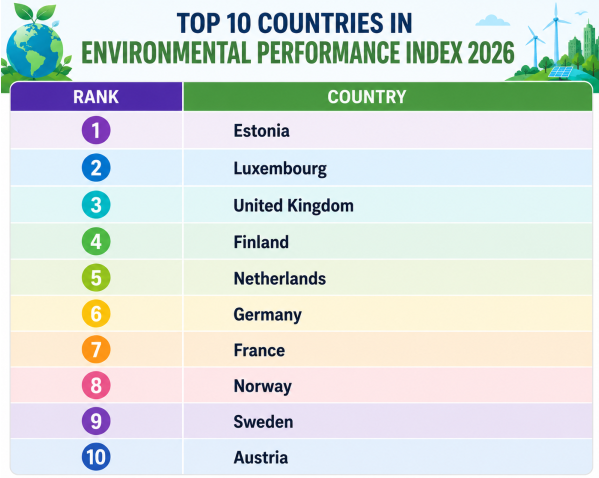
• Estonia topped the Environmental Performance Index 2026 with a score of 74.79, followed by Luxembourg (2nd), the United Kingdom (3rd), Finland (4th), and the Netherlands (5th).
• Germany, France, Norway, Sweden, and Austria completed the top 10 rankings.
• Five European countries occupied the top five positions, highlighting strong environmental governance and sustainability performance.
• Laos ranked 177th with an overall score of 21.78.
• The report found that EPI scores are strongly correlated with national income (correlation coefficient: 0.69), although countries with similar income levels often display significant differences in environmental performance, indicating that policy choices remain important.
• The Index highlights global sustainability challenges related to air quality, biodiversity conservation, climate change, sustainable forestry, water quality, and greenhouse gas reduction, while identifying policy leaders and laggards.
India’s Key Findings of the Index
• Overall Performance: India ranked 176th out of 177 countries, making it the second-lowest performer globally, with an overall EPI score of 22.46, compared to the regional average of 31.81.
• Sector-wise Performance: India performed poorly in Environmental Health, particularly air quality, and in Biodiversity, ranking 174th in both categories.
• Factors Behind India's Low Ranking: The report stated that India's per-capita emissions remain relatively low but are growing rapidly.
• Ranking Trend & Government's Response: India's ranking declined from 141st (2016) to 177th (2018), 168th (2020), 180th (2022), and 176th in both 2024 and 2026.
About the Environmental Performance Index (EPI) 2026
• The EPI is a biennial, data-driven global benchmark developed by the Yale Center for Environmental Law & Policy, the Center for International Earth Science Information Network (CIESIN), Columbia University, and the Yale Center for Geospatial Solutions, with support from the McCall MacBain Foundation.
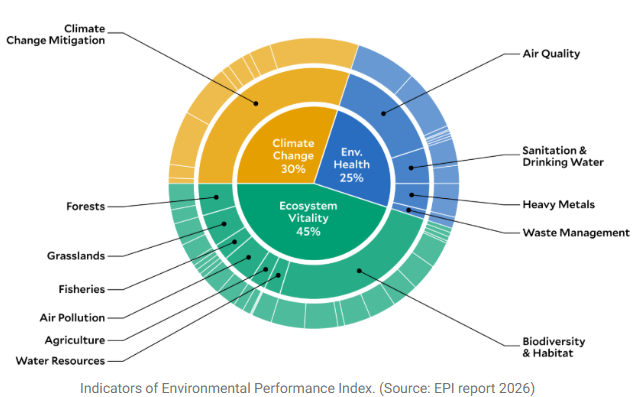
• The 2026 EPI evaluates 177 countries using 47 indicators across 12 issue categories under three policy objectives—Environmental Health, Ecosystem Vitality, and Climate Change.
• The indicators assess national performance across air and water quality, biodiversity, sustainable forestry, fisheries, waste management, sanitation, pesticide pollution, tree cover, and greenhouse gas emissions.
• The Index provides policymakers with an objective scorecard to track sustainability progress, identify ecological vulnerabilities, refine environmental policies, and measure progress towards the United Nations Sustainable Development Goals (SDGs) and the Paris Climate Agreement.
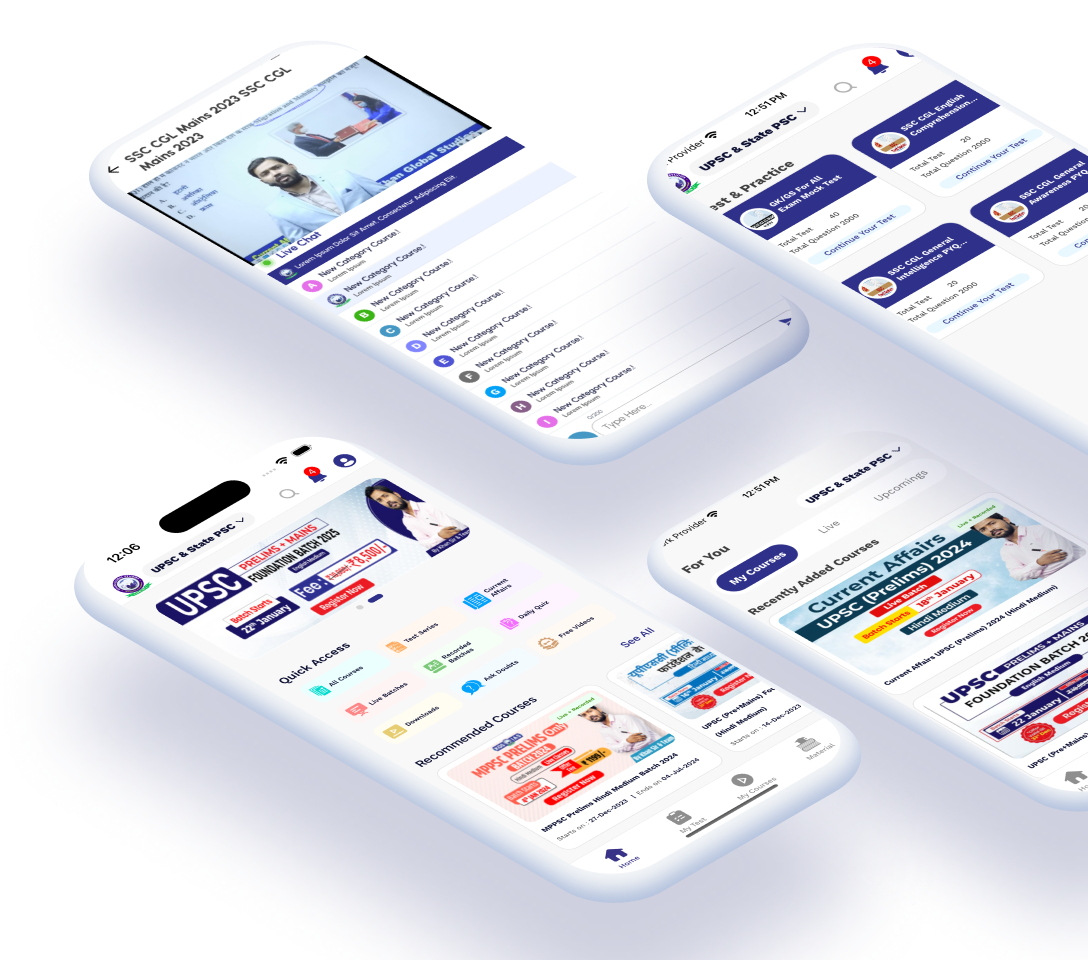
Khan Global Studies App
With our training programs, learning online can be a very exciting experience. Take the next step toward achieving your professional and personal objectives.



Course Related Query:
Ask Your DoubtsStore Related Query:[email protected]NEET | JEE | CUET
NCERT Books
Resources
We love learning. Through our innovative solutions, we encourage ourselves, our teams, and our Students to grow. We welcome and look for diverse perspectives and opinions because they enhance our decisions. We strive to understand the big picture and how we contribute to the company’s objectives. We approach challenges with optimism and harness the power of teamwork to accomplish our goals. These aren’t just pretty words to post on the office wall. This is who we are. It’s how we work. And it’s how we approach every interaction with each other and our Students.
Come with an open mind, hungry to learn, and you’ll experience unmatched personal and professional growth, a world of different backgrounds and perspectives, and the freedom to be you—every day. We strive to build and sustain diverse teams and foster a culture of belonging. Creating an inclusive environment where every students feels welcome, appreciated, and heard gives us something to feel (really) good about.