Explore All Exams at KGS


All Exams
Explore All Exams at KGS

Khan Sir Courses
Geography I Polity I History | World Map I Indian Map I Economics I Biology

UPSC & State PSC
UPSC I BPSC I UP-PSC I MP-PSC

Judiciary
CLAT

State Exams
UP I Bihar I MP | Rajasthan

NEET | JEE | CUET
NEET | JEE | CUET

Defence Exams
NDA I CDS I CAPF I AFCAT I SSB I Agniveer

Police Exams
UP SI | Bihar SI | Delhi Police | UP Constable

SSC Exams
CGL I CPO I CHSL I MTS I SSC GD I Delhi Police

Foundation Courses
Physics I Chemistry I Biology I History I Geography I Polity I NCERT I Math I English | Map I Reasoning

Railway Exams
RRB | RPF

Teaching Exams
TET | Teaching | UGC

Banking Exams
SBI | RBI | IBPS

Engineering Exams
Civil | Electrical | Mechanical
UGC NET
UGC NET/JRF
Current Affairs provides you with the best compilation of the Daily Current Affairs taking place across the globe: National, International, Sports, Science and Technology, Banking, Economy, Agreement, Appointments, Ranks, and Report and General Studies
Current Affairs
SYLLABUS
GS-2: Bilateral, Regional and Global Groupings and Agreements involving India and/or affecting India's Interests.
GS-3: Indian Economy and Issues Relating to Planning, Mobilization of Resources, Growth, Development, and Employment.
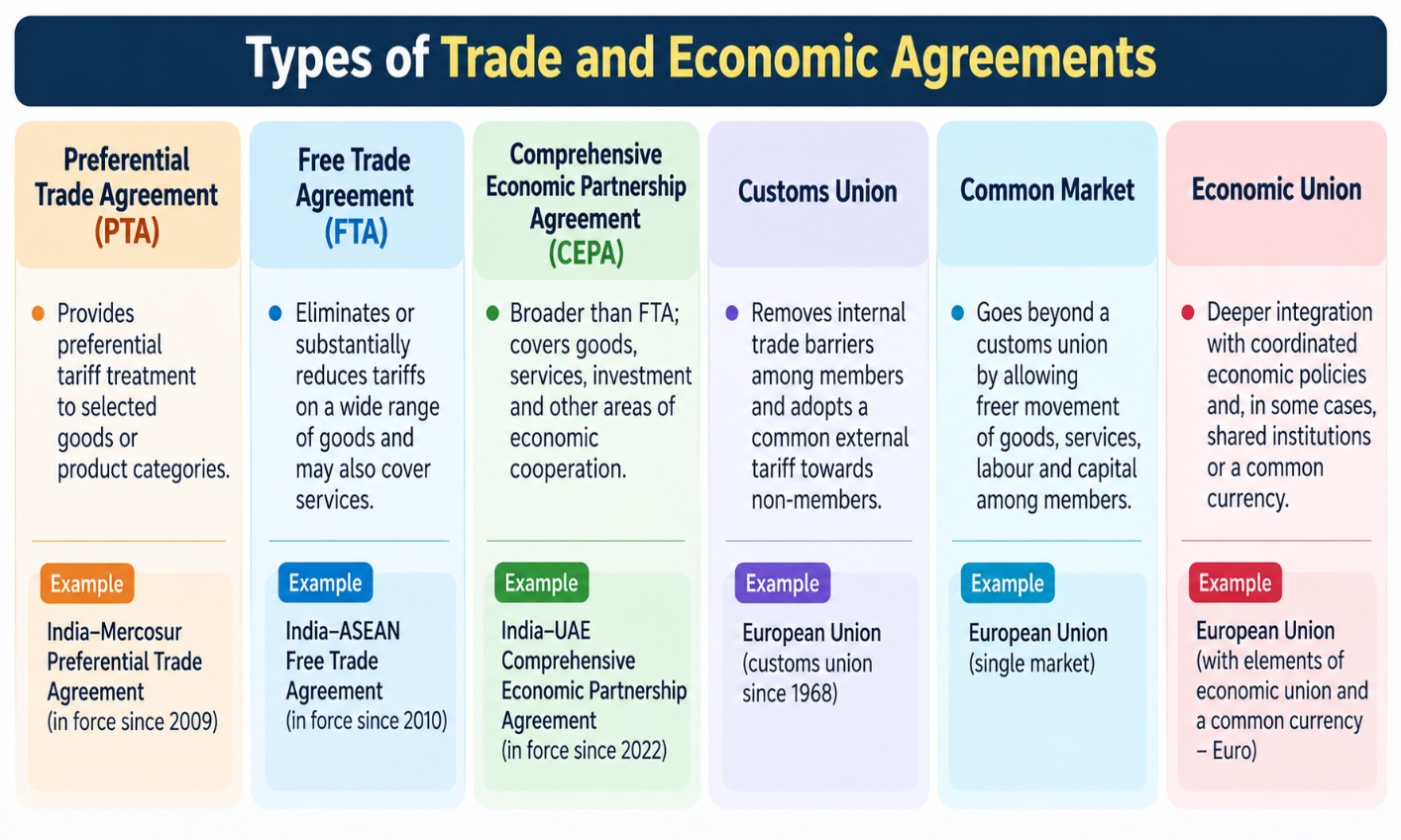
Context: India and Mexico recently signed the Terms of Reference (ToR), formally launching negotiations for a Preferential Trade Agreement (PTA) to expand bilateral trade, investment and economic cooperation.
Key Highlights of the Proposed PTA
• Negotiating framework: The ToR establishes the scope, modalities and roadmap for negotiations.
• Key areas: Market access for goods, rules of origin, customs procedures and trade facilitation, dispute settlement, sanitary and phytosanitary (SPS) measures, technical barriers to trade (TBT) and trade remedies.
• Potential sectors: Automobiles, chemicals, electronics, pharmaceuticals, agri-food, energy, critical minerals, medical devices and advanced manufacturing.
• Background: The initiative follows the understanding reached between Prime Minister Narendra Modi and Mexican President Claudia Sheinbaum at the G7 Summit in Canada in June 2025 to deepen bilateral ties.
India–Mexico Bilateral Relations
|
Historical Relations |
· Mexico was the first Latin American country to establish diplomatic
relations with independent India in 1950; 2025 marked 75 years of relations. · Mexican wheat varieties, particularly Sonora, and scientific
collaboration involving CIMMYT contributed to India’s Green Revolution. |
|
Political and Diplomatic |
· A Privileged Partnership was established in 2007. Both
countries cooperate through the UN, G20 and other multilateral platforms. |
|
Economic and Commercial |
· India is Mexico’s ninth-largest trading partner with a bilateral trade
of US$ 11.09 billion in 2025, with Indian exports of US$ 9.13 billion
to Mexico and imports of US$ 1.969 billion from Mexico. · Indian exports are led by automobiles and auto components,
pharmaceuticals, engineering goods and chemicals. · Imports are dominated by crude oil, which accounts for roughly
three-fourths of Mexico’s shipments to India. |
|
Science and Technology |
· A 2023 MoU between India’s CSIR and Mexico’s AMEXCID supports
cooperation in science, technology and innovation. · Other areas of cooperation include digital governance,
telecommunications and space. |
|
Cultural and Diaspora Relations |
· Cultural links include the writings of Mexican Nobel laureate Octavio
Paz, a former Mexican Ambassador to India, and the Gurudev Tagore Indian
Cultural Centre in Mexico City, established in 2010. · The Indian community in Mexico is estimated at around 12,000,
including professionals, businesspersons and academicians. |
Strategic Significance of India–Mexico Relations
• Export diversification: A PTA could improve market access for Indian goods and help exporters diversify markets amid shifting global trade patterns. Automobiles, pharmaceuticals, engineering goods and chemicals are important areas of opportunity.
• Near-shoring and supply chains: Mexico’s integration into North American value chains and its links with Latin American markets make it a potential manufacturing and investment base for Indian firms. Any preferential access to other markets would, however, depend on the applicable trade rules.
• Balanced economic engagement: The agreement could create opportunities for both Indian exporters and Mexican products in India, while encouraging greater diversification beyond the current concentration of Mexico’s exports to India in crude oil.
• Technology and development cooperation: The legacy of agricultural research associated with the Green Revolution and the CSIR–AMEXCID framework provides a foundation for deeper cooperation in science, technology and innovation.
Challenges and the Way Ahead
• Trade concentration: Indian exports are concentrated in a few major product categories, while crude oil accounts for a large share of Mexico’s shipments to India. Broader product diversification could make bilateral trade more resilient.
• Tariff and regulatory barriers: Negotiations must address market access, rules of origin, customs procedures, technical standards and sanitary and phytosanitary requirements to make trade easier and more predictable.
• Domestic sensitivities: Both sides will need to balance improved market access with the interests of sensitive domestic industries. Appropriate rules of origin and trade remedies can help address concerns about circumvention and injurious import surges.
• Effective implementation: Clear commitments, regular negotiations and business-to-business engagement will be essential to translate the proposed PTA into tangible gains for exporters and investors.
Khan Global Studies App
With our training programs, learning online can be a very exciting experience. Take the next step toward achieving your professional and personal objectives.



Course Related Query:
Ask Your DoubtsStore Related Query:[email protected]NEET | JEE | CUET
NCERT Books
Resources
We love learning. Through our innovative solutions, we encourage ourselves, our teams, and our Students to grow. We welcome and look for diverse perspectives and opinions because they enhance our decisions. We strive to understand the big picture and how we contribute to the company’s objectives. We approach challenges with optimism and harness the power of teamwork to accomplish our goals. These aren’t just pretty words to post on the office wall. This is who we are. It’s how we work. And it’s how we approach every interaction with each other and our Students.
Come with an open mind, hungry to learn, and you’ll experience unmatched personal and professional growth, a world of different backgrounds and perspectives, and the freedom to be you—every day. We strive to build and sustain diverse teams and foster a culture of belonging. Creating an inclusive environment where every students feels welcome, appreciated, and heard gives us something to feel (really) good about.