You're all caught up—no notifications available.
Explore All Exams at KGS


All Exams
Explore All Exams at KGS

Khan Sir Courses
Geography I Polity I History | World Map I Indian Map I Economics I Biology

UPSC & State PSC
UPSC I BPSC I UP-PSC I MP-PSC

State Exams
UP I Bihar I MP | Rajasthan

NEET | JEE | CUET
NEET | JEE | CUET

Defence Exams
NDA I CDS I CAPF I AFCAT I SSB I Agniveer

Police Exams
UP SI | Bihar SI | Delhi Police | UP Constable

SSC Exams
CGL I CPO I CHSL I MTS I SSC GD I Delhi Police

Foundation Courses
Physics I Chemistry I Biology I History I Geography I Polity I NCERT I Math I English | Map I Reasoning

Railway Exams
RRB | RPF

Teaching Exams
TET | Teaching | UGC

Banking Exams
SBI | RBI | IBPS

Engineering Exams
Civil | Electrical | Mechanical
UGC NET
UGC NET/JRF
Current Affairs provides you with the best compilation of the Daily Current Affairs taking place across the globe: National, International, Sports, Science and Technology, Banking, Economy, Agreement, Appointments, Ranks, and Report and General Studies

SYLLABUS
GS-3: Infrastructure: Energy; Achievements of Indians in science & technology; indigenization of technology and developing new technology.
Context: In a major push towards clean energy, Ladakh is set to host India’s first geothermal power project at the high-altitude Puga Valley.
More on the News
• Ladakh’s Lieutenant Governor, Vinai Kumar Saxena, has approved the extension of the Memorandum of Understanding (MoU) for 5 years with Oil and Natural Gas Corporation (ONGC) for setting up India’s first geothermal power project at Puga Valley in Ladakh, at an altitude of over 14,000 ft.
• Under the agreement, ONGC Energy Centre will establish a 1 MWe pilot geothermal power plant at Puga Valley, located at an altitude of over 14,000 feet in Ladakh.
• ONGC will deepen the existing geothermal well to 1,000 metres and drill another geothermal well in the next phase.
• The pilot plant is expected to be tested and commissioned during FY 2026–27.
• The project aims to prepare a Detailed Project Report (DPR) for large-scale commercial exploitation of geothermal energy in Ladakh, particularly in the Puga and Chumathang regions of the Himalayan geothermal belt.
About Geothermal Energy
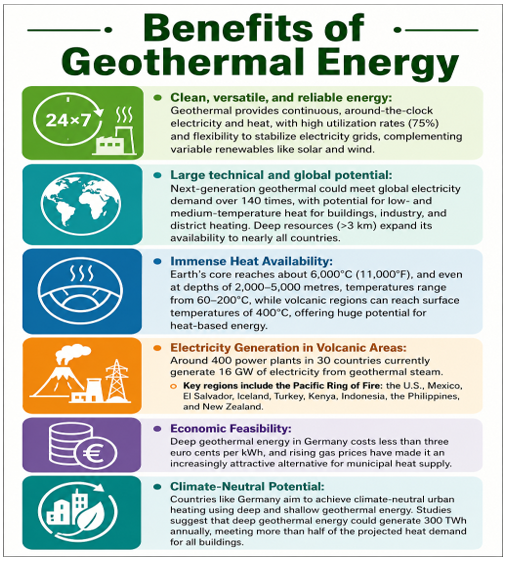
• Geothermal energy is heating energy obtained from beneath the Earth’s crust (“geo” = earth, “thermal” = heat).
• The heat originates from the Earth’s core and naturally warms underground rocks and water reservoirs.
• Wells are drilled into underground geothermal reservoirs to extract steam and hot water for electricity generation and direct heating applications.
• Major Applications:
o Electricity Generation: Steam generated from underground heat drives turbines to produce electricity.
o Heating and Cooling: Geothermal heat pumps are used for space heating, cooling and district heating systems.
o Direct Use Applications: Includes greenhouse heating, aquaculture, food drying, tourism, industrial heating and cold storage facilities.
Sources of Geothermal Energy
• High-temperature geothermal resources are commonly found in volcanic and tectonically active regions with hot springs, geysers and underground steam reservoirs.
• Geothermal systems are generally classified into high, medium and low enthalpy systems based on underground reservoir temperature.
• In India, geothermal potential is concentrated mainly in the Himalayan geothermal belt, Cambay Graben, SONATA region, West Coast, and Andaman & Nicobar Islands.
Potential in India
• India has an estimated geothermal potential of around 10,600 MW, with the Geological Survey of India (GSI) identifying 381 hot springs and 42 promising geothermal sites for power generation and direct-use applications.
• GSI has identified 10 geothermal provinces in India: Himalayan Geothermal Province, Naga-Lusai, Andaman Nicobar Islands, Son-Narmada Tapi (SONATA), West Coast, Cambay Graben, Aravalli, Mahanadi, Godavari, and South Indian Cratonic.
• The IEA projects India’s geothermal market potential at 4.2 GW by 2035 and nearly 100 GW by 2045.
• Globally, less than 17 GW of geothermal capacity is operational, led by the US, Indonesia, and the Philippines.
• The National Policy on Geothermal Energy (2025) aims to make geothermal energy a major pillar of India’s renewable energy transition, supporting energy security and the 2070 Net Zero Goal through international cooperation, technology transfer, and joint R&D.

The most trusted learning platform on your phone
With our training programs, learning online can be a very exciting experience! Take the next step toward achieving your professional and personal objectives



Course Related Query:
Ask Your DoubtsStore Related Query:[email protected]NCERT Books
Resources
We love learning. Through our innovative solutions, we encourage ourselves, our teams, and our Students to grow. We welcome and look for diverse perspectives and opinions because they enhance our decisions. We strive to understand the big picture and how we contribute to the company’s objectives. We approach challenges with optimism and harness the power of teamwork to accomplish our goals. These aren’t just pretty words to post on the office wall. This is who we are. It’s how we work. And it’s how we approach every interaction with each other and our Students.
Come with an open mind, hungry to learn, and you’ll experience unmatched personal and professional growth, a world of different backgrounds and perspectives, and the freedom to be you—every day. We strive to build and sustain diverse teams and foster a culture of belonging. Creating an inclusive environment where every students feels welcome, appreciated, and heard gives us something to feel (really) good about.
Get Free academic Counseling & Course Details