You're all caught up—no notifications available.
Explore All Exams at KGS


All Exams
Explore All Exams at KGS

Khan Sir Courses
Geography I Polity I History | World Map I Indian Map I Economics I Biology

UPSC & State PSC
UPSC I BPSC I UP-PSC I MP-PSC

State Exams
UP I Bihar I MP | Rajasthan

NEET | JEE | CUET
NEET | JEE | CUET

Defence Exams
NDA I CDS I CAPF I AFCAT I SSB I Agniveer

Police Exams
UP SI | Bihar SI | Delhi Police | UP Constable

SSC Exams
CGL I CPO I CHSL I MTS I SSC GD I Delhi Police

Foundation Courses
Physics I Chemistry I Biology I History I Geography I Polity I NCERT I Math I English | Map I Reasoning

Railway Exams
RRB | RPF

Teaching Exams
TET | Teaching | UGC

Banking Exams
SBI | RBI | IBPS

Engineering Exams
Civil | Electrical | Mechanical
UGC NET
UGC NET/JRF
Current Affairs provides you with the best compilation of the Daily Current Affairs taking place across the globe: National, International, Sports, Science and Technology, Banking, Economy, Agreement, Appointments, Ranks, and Report and General Studies

SYLLABUS
GS-3: Indian Economy and issues relating to planning, mobilization of resources, growth, development and employment.
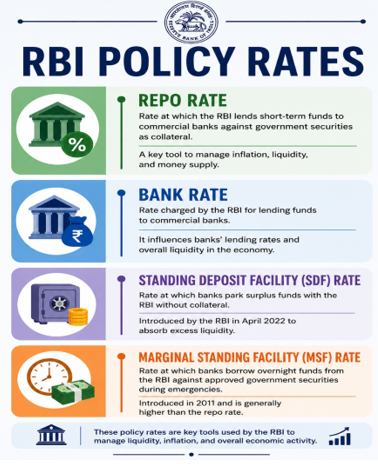
Context: The Reserve Bank of India (RBI) Monetary Policy Committee (MPC), in its June 2026 bi-monthly meeting, unanimously kept the repo rate unchanged at 5.25% and retained a neutral stance.
Key Highlights of the Meeting
• The MPC unanimously kept the Repo Rate unchanged at 5.25%; consequently, the Standing Deposit Facility (SDF) Rate remains at 5.0%, while the Marginal Standing Facility (MSF) Rate and the Bank Rate remain at 5.5%.
• The committee retained its neutral policy stance, emphasizing flexibility and a data-driven approach amid evolving global and domestic conditions.
• This is the third consecutive MPC meeting (February, April and June 2026) in which policy rates have remained unchanged.
• The RBI revised its FY27 Real GDP Growth projection downward to 6.6% from 6.9%.
• Quarterly GDP Growth projections for FY27 are Q1: 6.6%, Q2: 6.3%, Q3: 6.5% and Q4: 6.8%.
• The RBI revised its FY27 CPI Inflation forecast upward to 5.1% from 4.6%.
• Quarterly CPI Inflation projections for FY27 are Q1: 4.2%, Q2: 5.1%, Q3: 5.9% and Q4: 5.4%.
• The MPC highlighted upside risks to inflation and downside risks to growth arising from geopolitical tensions, elevated energy prices and supply-side disruptions.
• The RBI announced measures to attract dollar inflows and strengthen external sector resilience, including:
• The RBI restored the timeline for the realization of export proceeds to nine months.
Factors Influencing the Decision
• West Asia Conflict and Global Uncertainty: Continuing geopolitical tensions have disrupted trade routes and supply chains, increased market volatility and weakened business sentiment.
• Energy Prices and Supply Chain Disruptions: Elevated crude oil and energy prices, along with disruptions in global logistics networks, are weighing on economic activity and growth prospects.
• Inflation Risks: Higher energy prices, food inflation uncertainties, forecasts of a subnormal southwest monsoon and possible El Niño conditions pose upside risks to inflation.
• Growth Concerns: High-frequency indicators suggest moderation in some sectors, while external shocks and supply disruptions present downside risks to growth.
• India’s Macroeconomic Resilience: The MPC noted that India entered the current phase of global turbulence with stronger fundamentals than in previous episodes and remains relatively well-positioned to absorb external shocks.
About the Monetary Policy Committee (MPC)
• It was established in September 2016, under Section 45ZB (1) of the Reserve Bank of India Act, 1934 (RBI Act).
• The Urijit Patel Committee had recommended the setting up of the MPC
• The MPC’s primary role is to set the Policy Rate required to achieve the inflation target.
• According to Section 42B (2) of the RBI Act, the MPC consists of:
• Members appointed by the Central Government hold their positions for a term of four years or until further orders, whichever is earlier.
• According to Section 45ZA of the RBI Act, the inflation target is set at 4%, with an upper tolerance level of 6% and a lower tolerance level of 2%.

The most trusted learning platform on your phone
With our training programs, learning online can be a very exciting experience! Take the next step toward achieving your professional and personal objectives



Course Related Query:
Ask Your DoubtsStore Related Query:[email protected]NEET | JEE | CUET
NCERT Books
Resources
We love learning. Through our innovative solutions, we encourage ourselves, our teams, and our Students to grow. We welcome and look for diverse perspectives and opinions because they enhance our decisions. We strive to understand the big picture and how we contribute to the company’s objectives. We approach challenges with optimism and harness the power of teamwork to accomplish our goals. These aren’t just pretty words to post on the office wall. This is who we are. It’s how we work. And it’s how we approach every interaction with each other and our Students.
Come with an open mind, hungry to learn, and you’ll experience unmatched personal and professional growth, a world of different backgrounds and perspectives, and the freedom to be you—every day. We strive to build and sustain diverse teams and foster a culture of belonging. Creating an inclusive environment where every students feels welcome, appreciated, and heard gives us something to feel (really) good about.
Get Free academic Counseling & Course Details