You're all caught up—no notifications available.
Explore All Exams at KGS


All Exams
Explore All Exams at KGS

Khan Sir Courses
Geography I Polity I History | World Map I Indian Map I Economics I Biology

UPSC & State PSC
UPSC I BPSC I UP-PSC I MP-PSC

State Exams
UP I Bihar I MP | Rajasthan

NEET | JEE | CUET
NEET | JEE | CUET

Defence Exams
NDA I CDS I CAPF I AFCAT I SSB I Agniveer

Police Exams
UP SI | Bihar SI | Delhi Police | UP Constable

SSC Exams
CGL I CPO I CHSL I MTS I SSC GD I Delhi Police

Foundation Courses
Physics I Chemistry I Biology I History I Geography I Polity I NCERT I Math I English | Map I Reasoning

Railway Exams
RRB | RPF

Teaching Exams
TET | Teaching | UGC

Banking Exams
SBI | RBI | IBPS

Engineering Exams
Civil | Electrical | Mechanical
UGC NET
UGC NET/JRF
Current Affairs provides you with the best compilation of the Daily Current Affairs taking place across the globe: National, International, Sports, Science and Technology, Banking, Economy, Agreement, Appointments, Ranks, and Report and General Studies

SYLLABUS
GS-3: Conservation, Environmental Pollution and Degradation, Environmental Impact Assessment.
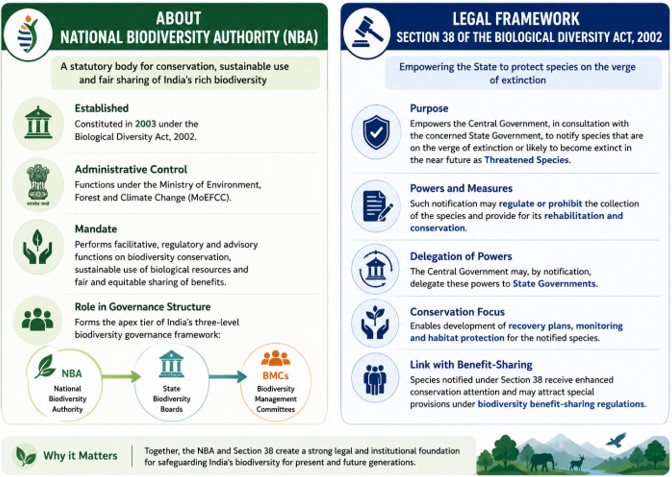
Context: The National Biodiversity Authority (NBA) has released a Standard Operating Procedure (SOP) for the scientific identification and notification of Threatened Species under Section 38 of the Biological Diversity Act, 2002.
More on the News
• The SOP seeks to establish a uniform, transparent and scientifically robust framework for the identification, assessment and notification of threatened species by States and Union Territories.
• India, one of the world's megadiverse countries, is witnessing increasing threats to biodiversity from habitat degradation, overexploitation, pollution, invasive alien species and climate change, necessitating stronger conservation measures.
• Section 38 of the Biological Diversity Act, 2002 empowers the Central Government, in consultation with the concerned State Government, to notify any species that is on the verge of extinction or is likely to become extinct in the near future as a Threatened Species.
• At present, 159 plant species and 173 animal species across 17 States and 3 Union Territories have been notified as threatened species by the Ministry of Environment, Forest and Climate Change (MoEFCC).
• The SOP gains added significance in light of the Biological Diversity Regulations, 2025, which provide differential treatment in benefit-sharing obligations for species notified under Section 38.
• It also supports the implementation of the National Biodiversity Strategy and Action Plan 2024–2030 (Target 4) and aligns with India's commitments under the Kunming–Montreal Global Biodiversity Framework and the Convention on Biological Diversity (CBD).
Key Highlights of the SOP
• Scientific Identification and Assessment: Provides a structured methodology for identifying threatened species through scientific assessment, extinction-risk evaluation, field-based studies and evidence-based decision-making.
• Multi-Stakeholder Consultation: Mandates participation of State Biodiversity Boards, Union Territory Biodiversity Councils, Botanical Survey of India (BSI), Zoological Survey of India (ZSI), academic institutions, subject experts and local communities.
• Integration of Traditional Knowledge: Encourages the use of traditional ecological knowledge alongside scientific evidence to improve species assessment and conservation outcomes.
• Transparent Notification Process: Establishes a clear step-by-step framework covering identification, assessment, stakeholder consultation, validation and recommendation to State Governments for notification.
• Conservation Planning and Periodic Review: Emphasises preparation of species recovery and conservation action plans, supported by regular monitoring and periodic review to assess conservation outcomes and emerging threats.
Significance of the SOP
• Strengthening Scientific Conservation: Introduces a standardised and evidence-based approach for identifying threatened species, ensuring greater consistency and credibility in conservation decisions across States and UTs.
• Strengthening Biodiversity Governance: Enhances the capacity of State Biodiversity Boards and UT Biodiversity Councils by providing a uniform framework for implementing Section 38 of the Biological Diversity Act.
• Promoting Participatory Conservation: Institutionalises the role of local communities, Biodiversity Management Committees and traditional knowledge systems, thereby fostering community-led conservation efforts.
• Improving Species Recovery Efforts: Facilitates timely identification of species facing extinction risks and supports targeted recovery interventions through conservation action plans and continuous monitoring.

The most trusted learning platform on your phone
With our training programs, learning online can be a very exciting experience! Take the next step toward achieving your professional and personal objectives



Course Related Query:
Ask Your DoubtsStore Related Query:[email protected]NEET | JEE | CUET
NCERT Books
Resources
We love learning. Through our innovative solutions, we encourage ourselves, our teams, and our Students to grow. We welcome and look for diverse perspectives and opinions because they enhance our decisions. We strive to understand the big picture and how we contribute to the company’s objectives. We approach challenges with optimism and harness the power of teamwork to accomplish our goals. These aren’t just pretty words to post on the office wall. This is who we are. It’s how we work. And it’s how we approach every interaction with each other and our Students.
Come with an open mind, hungry to learn, and you’ll experience unmatched personal and professional growth, a world of different backgrounds and perspectives, and the freedom to be you—every day. We strive to build and sustain diverse teams and foster a culture of belonging. Creating an inclusive environment where every students feels welcome, appreciated, and heard gives us something to feel (really) good about.
Get Free academic Counseling & Course Details