You're all caught up—no notifications available.
Explore All Exams at KGS


All Exams
Explore All Exams at KGS

Khan Sir Courses
Geography I Polity I History | World Map I Indian Map I Economics I Biology

UPSC & State PSC
UPSC I BPSC I UP-PSC I MP-PSC

State Exams
UP I Bihar I MP | Rajasthan

NEET | JEE | CUET
NEET | JEE | CUET

Defence Exams
NDA I CDS I CAPF I AFCAT I SSB I Agniveer

Police Exams
UP SI | Bihar SI | Delhi Police | UP Constable

SSC Exams
CGL I CPO I CHSL I MTS I SSC GD I Delhi Police

Foundation Courses
Physics I Chemistry I Biology I History I Geography I Polity I NCERT I Math I English | Map I Reasoning

Railway Exams
RRB | RPF
Teaching Exams
TET | Teaching | UGC

Banking Exams
SBI | RBI | IBPS
Engineering Exams
Civil | Electrical | Mechanical
UGC NET
UGC NET/JRF
Current Affairs provides you with the best compilation of the Daily Current Affairs taking place across the globe: National, International, Sports, Science and Technology, Banking, Economy, Agreement, Appointments, Ranks, and Report and General Studies
SYLLABUS
GS-2: Issues Relating to Development and Management of Social Sector/Services relating to Health, Education, Human Resources.
Context: Recently, the National Council of Applied Economic Research (NCAER) released a report highlighting that despite the rapid expansion of digital infrastructure and mobile penetration, significant hidden digital divides persist in access, skills, usage and outcomes of digital technologies across India.
Key Findings of the NCAER Report
• Access Divide: Mobile Penetration High, Advanced Device Ownership Low
• Connectivity Divide: Many Households Remain Offline
• Usage and Skills Divide: Connected but Not Empowered
• Gender, Age and Social Inequalities
Understanding India's Hidden Digital Divide
The report conceptualises digital inequality as a three-layered challenge:
First-Order Divide: Access
Third-Order Divide: Meaningful Outcomes
Implications
• Challenge to Digital India: The findings indicate that digital transformation cannot be measured solely through connectivity indicators but must also consider usage quality and outcomes.
• Risk of Exclusion: Low digital literacy and internet usage among women, rural populations, and the elderly may restrict access to education, financial services, welfare delivery and employment opportunities.
• Human Capital Concerns: Limited use of digital technologies for education and skill development could constrain India's long-term productivity and knowledge economy ambitions.
• Deepening Socio-Economic Inequalities: Without targeted interventions, digitalisation may reinforce existing social, gender and economic disparities rather than bridge them.
Way Forward
• Shift from Access to Meaningful Inclusion: Focus on ensuring that digital technologies translate into tangible benefits in education, livelihoods, finance and public service delivery, rather than merely expanding connectivity.
• Bridge the Digital Skills Gap: Strengthen digital literacy and computer-skilling initiatives, particularly among rural, less-educated and economically weaker households.
• Promote Productive Digital Usage: Encourage greater use of digital platforms for education, e-governance, financial services and skill development beyond entertainment-oriented consumption.
• Address Social and Gender Inequalities: Implement targeted measures for women, children, elderly citizens and other vulnerable groups to ensure equitable digital participation.
• Improve Quality of Digital Access: Expand access to computers, tablets and reliable broadband connectivity to deepen the quality of digital engagement beyond mobile-only access.
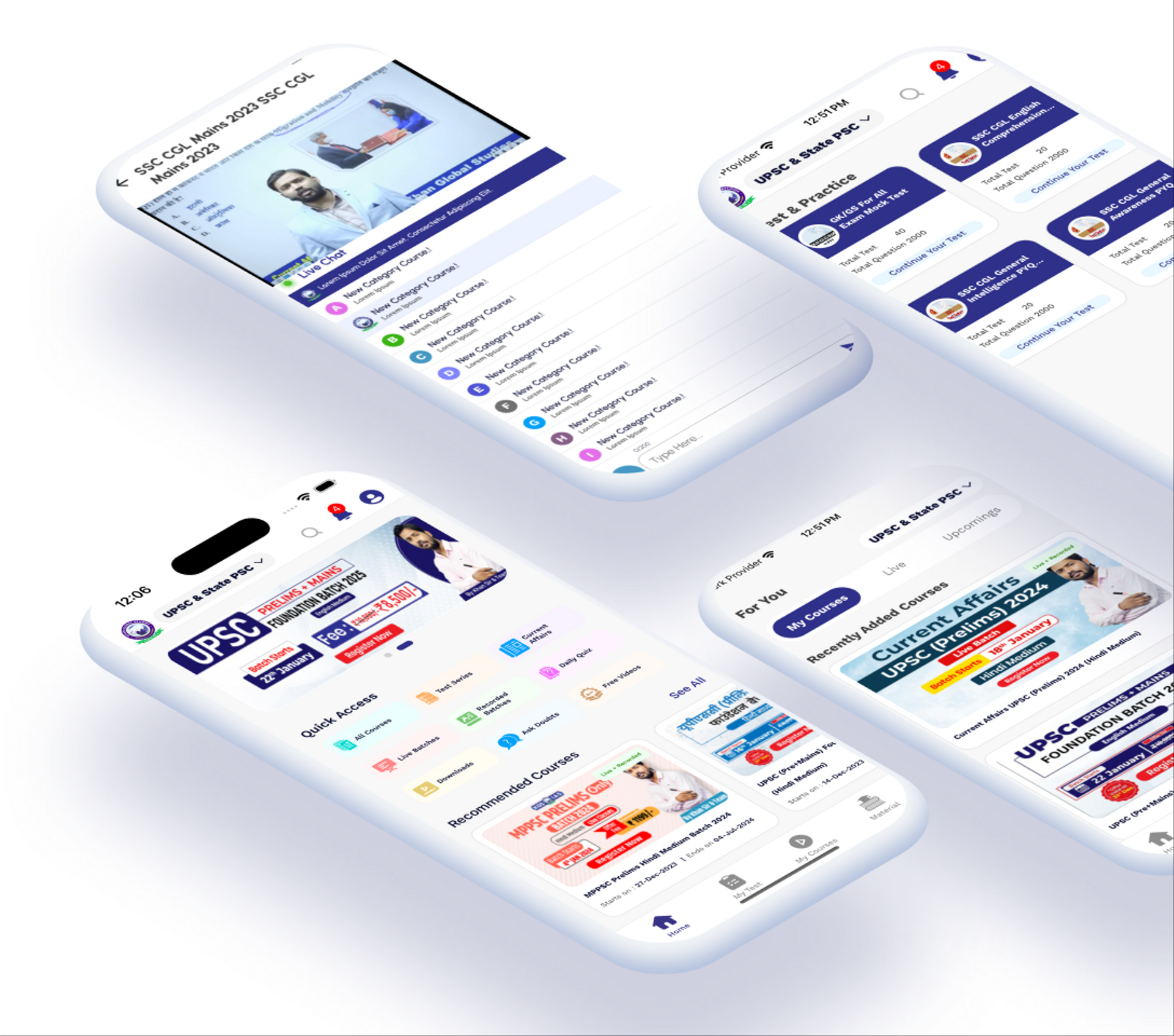
The most trusted learning platform on your phone
With our training programs, learning online can be a very exciting experience! Take the next step toward achieving your professional and personal objectives

Course Related Query:
Ask Your DoubtsStore Related Query:[email protected]NEET | JEE | CUET
NCERT Books
Resources
We love learning. Through our innovative solutions, we encourage ourselves, our teams, and our Students to grow. We welcome and look for diverse perspectives and opinions because they enhance our decisions. We strive to understand the big picture and how we contribute to the company’s objectives. We approach challenges with optimism and harness the power of teamwork to accomplish our goals. These aren’t just pretty words to post on the office wall. This is who we are. It’s how we work. And it’s how we approach every interaction with each other and our Students.
Come with an open mind, hungry to learn, and you’ll experience unmatched personal and professional growth, a world of different backgrounds and perspectives, and the freedom to be you—every day. We strive to build and sustain diverse teams and foster a culture of belonging. Creating an inclusive environment where every students feels welcome, appreciated, and heard gives us something to feel (really) good about.
Get Free academic Counseling & Course Details