Explore All Exams at KGS


All Exams
Explore All Exams at KGS

Khan Sir Courses
Geography I Polity I History | World Map I Indian Map I Economics I Biology

UPSC & State PSC
UPSC I BPSC I UP-PSC I MP-PSC

Judiciary
CLAT

State Exams
UP I Bihar I MP | Rajasthan

NEET | JEE | CUET
NEET | JEE | CUET

Defence Exams
NDA I CDS I CAPF I AFCAT I SSB I Agniveer

Police Exams
UP SI | Bihar SI | Delhi Police | UP Constable

SSC Exams
CGL I CPO I CHSL I MTS I SSC GD I Delhi Police

Foundation Courses
Physics I Chemistry I Biology I History I Geography I Polity I NCERT I Math I English | Map I Reasoning

Railway Exams
RRB | RPF

Teaching Exams
TET | Teaching | UGC

Banking Exams
SBI | RBI | IBPS

Engineering Exams
Civil | Electrical | Mechanical
UGC NET
UGC NET/JRF
Current Affairs provides you with the best compilation of the Daily Current Affairs taking place across the globe: National, International, Sports, Science and Technology, Banking, Economy, Agreement, Appointments, Ranks, and Report and General Studies
Current Affairs
SYLLABUS
GS-3: Issues related to direct and indirect farm subsidies and minimum support prices; issues of buffer stocks and food security.
Context: The Government has extended the Production Linked Incentive (PLI) Scheme for Promoting Domestic Manufacturing of Medical Devices (PLI-MD) up to 2035–36, with approximately ₹2,700 crore available for fresh applications.
Understanding the PLI Scheme for Medical Devices (PLI-MD 1.0)
• Launch and Objective: Launched in 2020–21, the scheme had a financial outlay of ₹3,420 crore for the period 2020–21 to 2027–28. It aimed to promote domestic manufacturing, attract investment and reduce import dependence.
• Original Target Segments: The scheme covered four categories based on the nature and clinical application of medical devices:
• Incentive Mechanism: Selected companies were eligible for incentives at 5% of incremental sales of eligible medical devices manufactured in India, for five years. The original scheme was applicable only to greenfield projects.
• Achievements under PLI-MD 1.0: Enabled domestic manufacturing of over 60 high-end medical devices and components, with production valued at more than ₹16,000 crore.
• Policy Framework: The National Medical Devices Policy, 2023 provides a holistic framework for sectoral growth through six focus areas, including regulation, infrastructure, R&D, investment, skill development and global branding. The PLI scheme complements it by incentivising domestic manufacturing and investment.
Key Highlights of PLI-MD 2.0
• Extension and Outlay: The scheme has been extended up to 2035–36, with approximately ₹2,700 crore available for fresh applications.
• Revised Target Segments: The earlier clinical application-based classification has been replaced by four manufacturing-oriented segments:
• Differentiated Incentives: Tapering incentive rates averaging approximately 5% for TS 1, 9% for TS 2 and TS 3, and 6% for TS 4.
• Relaxed Eligibility: The minimum sales threshold for claiming incentives has been discontinued and the minimum investment requirement reduced. Applicants can submit multiple applications across one or more target segments.
• Implementation Flexibility: Applicants will be allowed three years to establish manufacturing facilities, while the application window will remain continuously open over an extended period.
• Focus on Deep Manufacturing: Priority will be given to critical component manufacturing, value-chain integration and advanced equipment such as 3T MRI, PET-CT, ultrasound probes and consoles, and high-throughput IVD analysers, which are currently not manufactured in India.
Significance of the Extended Scheme
• Reducing Import Dependence: Promotes domestic production of high-end medical equipment and critical components, reducing reliance on overseas suppliers.
• Strengthening Domestic Value Chains: Shifts the focus beyond final assembly towards indigenous component manufacturing and greater domestic value addition.
• Boosting Investment and MSMEs: Encourages fresh investment, creates opportunities for domestic component manufacturers and supports employment generation.
• Affordable Healthcare and Export Competitiveness: Greater domestic availability, improved product quality and economies of scale can help reduce costs and strengthen India's position in global medical-device markets.
India's Medical Device Sector
• Market Size: India's medical-device sector is valued at approximately USD 14 billion and is projected to reach $30-50 billion within this decade, and likely to reach $250 billion by 2047.
• Global Standing: India is the fourth-largest medical-device market in Asia and among the top 20 globally.
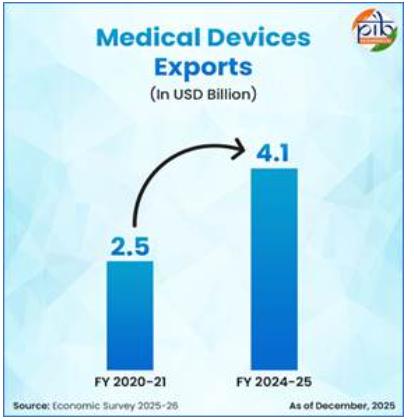
• Export Performance: Medical-device exports increased from USD 2.5 billion in FY 2020–21 to USD 4.1 billion in FY 2024–25, reaching 187 countries.
• Import Dependence: India continues to depend substantially on imports, with hospitals and diagnostic laboratories relying on overseas suppliers for an estimated 70–80% of their equipment requirements.
Khan Global Studies App
With our training programs, learning online can be a very exciting experience. Take the next step toward achieving your professional and personal objectives.



Course Related Query:
Ask Your DoubtsStore Related Query:[email protected]NEET | JEE | CUET
NCERT Books
Resources
We love learning. Through our innovative solutions, we encourage ourselves, our teams, and our Students to grow. We welcome and look for diverse perspectives and opinions because they enhance our decisions. We strive to understand the big picture and how we contribute to the company’s objectives. We approach challenges with optimism and harness the power of teamwork to accomplish our goals. These aren’t just pretty words to post on the office wall. This is who we are. It’s how we work. And it’s how we approach every interaction with each other and our Students.
Come with an open mind, hungry to learn, and you’ll experience unmatched personal and professional growth, a world of different backgrounds and perspectives, and the freedom to be you—every day. We strive to build and sustain diverse teams and foster a culture of belonging. Creating an inclusive environment where every students feels welcome, appreciated, and heard gives us something to feel (really) good about.