KGS

All Exams

Explore All Exams at KGS

All Exams
Home>Current Affairs>Population Assessment of the Great Indian Bustard (GIB)
Current Affairs made simple.

Current Affairs provides you with the best compilation of the Daily Current Affairs taking place across the globe: National, International, Sports, Science and Technology, Banking, Economy, Agreement, Appointments, Ranks, and Report and General Studies

banner-image

Current Affairs

Population Assessment of the Great Indian Bustard (GIB)

SYLLABUS

GS-3: Conservation, environmental pollution and degradation, environmental impact assessment.

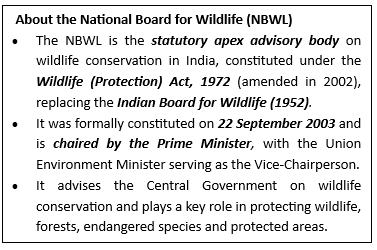
Context: The Wildlife Institute of India (WII) released the first official Great Indian Bustard (GIB) population assessment since 2017-18 and reviewed the progress of Project Great Indian Bustard at the 91st Standing Committee meeting of the National Board for Wildlife.

Key Findings
  • Population Status: Estimated 130 (±21) GIBs remain in the wild.
    • Population has remained broadly stable since the previous estimate of 128 (±19) during 2017-18.
    • Trend analysis showed stable detections, encounter rate, abundance, and occupancy since 2017.
  • Habitat Status: GIB occupies only about 16% of the surveyed landscape, despite the availability of larger suitable habitat.
    • Most birds are confined to relatively undisturbed grasslands around the Desert National Park and Pokhran Field Firing Range.
    • The species prefers flat to slightly undulating grasslands with sparse fallows and generally avoids agriculture and infrastructure.
  • Major Threats: Habitat fragmentation due to expanding power transmission lines, agricultural fencing, roads, water sources, and solar plants.
    • Increasing mortality from collisions with overhead power lines, as GIB has poor frontal vision and limited ability to avoid wires.
    • Other threats include habitat loss, poaching, and egg predation.
    • The report stressed that long-term survival requires stronger habitat protection, threat mitigation, habitat restoration, and conservation breeding.
  • Other Observations: During the survey, 35 GIB flocks, 1,568 Chinkara herds, and 79 Desert foxes were recorded.
    • Non-native species such as Nilgai, pigs, and free-ranging dogs were also observed.
    • The Thar Desert remains the last viable landscape for large-scale recovery because of its extensive contiguous natural habitat.

About Project Great Indian Bustard (GIB)
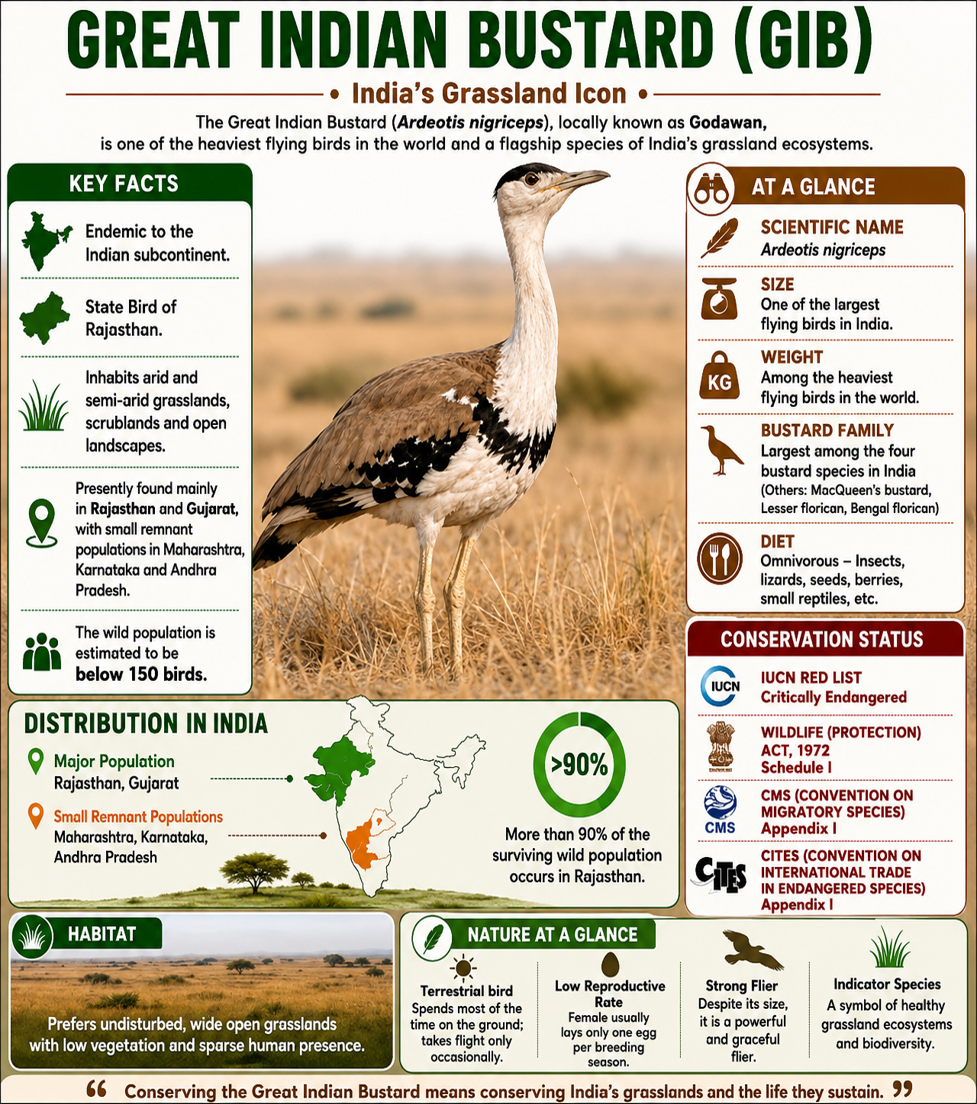
  • Launched by the Government of Rajasthan in 2013.
  • A collaborative conservation programme involving the Government of India, Rajasthan Government, Gujarat Government, Wildlife Institute of India (WII) and international institutional cooperation.
  • Objectives:
    • Improve and restore GIB habitat.
    • Protect eggs and nests.
    • Manage predators.
    • Mitigate threats from power transmission lines.
    • Support captive breeding and rewilding.
  • Captive Breeding Programme:
    • Conservation breeding centres are located at Sam and Ramdevra in Jaisalmer, Rajasthan.
    • 98 chicks have been produced in captivity.
    • Wild eggs are collected, incubated, and chicks are reared under controlled conditions before planned release into the wild.
    • The programme is now preparing to enter the rewilding phase, with infrastructure, monitoring systems, and management protocols being developed.
  • Innovative Conservation Approaches:
    • Artificial Insemination: Has emerged as a major contributor to successful breeding, accounting for the majority of chicks hatched during the current season.
    • Jumpstart Intervention: Eggs are collected from wild nests for captive breeding, encouraging females to lay replacement eggs and thereby increasing both captive and wild populations simultaneously.
    • Power-Line Mitigation: Bird diverters, rerouting, and undergrounding of transmission lines in critical habitats are being pursued to reduce collision-related mortality.

Khan Global Studies App

The most trusted learning platform on your phone

With our training programs, learning online can be a very exciting experience. Take the next step toward achieving your professional and personal objectives.


Download on the App StoreGet it on Google Play
Khan Global Studies mobile app screens
logo
Khan Global Studies Pvt. Ltd. 5th Floor,
A13A, Graphix 1 Tower B, Sector 62,
Noida, Uttar Pradesh 201309

Course Related Query:

Ask Your DoubtsStore Related Query:[email protected]

Get Free Academic Counseling & Course Details

KGS best learning platform

About Khan Global Studies

We love learning. Through our innovative solutions, we encourage ourselves, our teams, and our Students to grow. We welcome and look for diverse perspectives and opinions because they enhance our decisions. We strive to understand the big picture and how we contribute to the company’s objectives. We approach challenges with optimism and harness the power of teamwork to accomplish our goals. These aren’t just pretty words to post on the office wall. This is who we are. It’s how we work. And it’s how we approach every interaction with each other and our Students.


What Makes Us Different

Come with an open mind, hungry to learn, and you’ll experience unmatched personal and professional growth, a world of different backgrounds and perspectives, and the freedom to be you—every day. We strive to build and sustain diverse teams and foster a culture of belonging. Creating an inclusive environment where every students feels welcome, appreciated, and heard gives us something to feel (really) good about.

©Copyright 2026 KhanGlobalStudies