Explore All Exams at KGS


All Exams
Explore All Exams at KGS

Khan Sir Courses
Geography I Polity I History | World Map I Indian Map I Economics I Biology

UPSC & State PSC
UPSC I BPSC I UP-PSC I MP-PSC

Judiciary
CLAT

State Exams
UP I Bihar I MP | Rajasthan

NEET | JEE | CUET
NEET | JEE | CUET

Defence Exams
NDA I CDS I CAPF I AFCAT I SSB I Agniveer

Police Exams
UP SI | Bihar SI | Delhi Police | UP Constable

SSC Exams
CGL I CPO I CHSL I MTS I SSC GD I Delhi Police

Foundation Courses
Physics I Chemistry I Biology I History I Geography I Polity I NCERT I Math I English | Map I Reasoning

Railway Exams
RRB | RPF

Teaching Exams
TET | Teaching | UGC

Banking Exams
SBI | RBI | IBPS

Engineering Exams
Civil | Electrical | Mechanical
UGC NET
UGC NET/JRF
Current Affairs provides you with the best compilation of the Daily Current Affairs taking place across the globe: National, International, Sports, Science and Technology, Banking, Economy, Agreement, Appointments, Ranks, and Report and General Studies
Current Affairs
SYLLABUS
GS-3: Conservation, environmental pollution and degradation, environmental impact assessment.
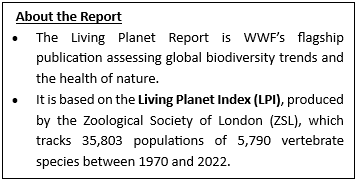
Context: The World-Wide Fund for Nature (WWF) released the Living Planet Report 2026: The Science of Hope, reporting a 73% decline in the average size of monitored wildlife populations globally between 1970 and 2022.
Key Findings of the Report
Global Biodiversity Trends:
• Wildlife population decline: The average size of monitored wildlife populations declined by 73% between 1970 and 2022. This represents the average change in population sizes, not the percentage of individual animals lost.
• Ecosystem-wise decline: Freshwater populations recorded the steepest decline (85%), followed by terrestrial (69%) and marine populations (59%).
• Regional decline: Latin America and the Caribbean recorded a 95% decline, followed by Africa (80%) and Asia-Pacific (49%).
• Signs of recovery: Nearly half of the monitored populations were stable or increasing, demonstrating the potential for wildlife recovery through sustained conservation efforts.
Major Drivers of Biodiversity Loss:
• Habitat loss and degradation: The most frequently reported threat, driven largely by agricultural expansion.
• Other threats: Overexploitation, climate change, pollution, invasive species and disease.
• Systemic drivers: Unsustainable food production and consumption, energy systems dependent on fossil fuels, and financial flows supporting activities that damage nature.
• Harmful financial flows: In 2023, approximately US$7.3 trillion flowed into activities harmful to nature, compared with US$220 billion for nature protection and restoration.
India’s Conservation Achievements and Challenges
• Tigers: India’s tiger population was estimated at 3,682 in the 2022 All India Tiger Estimation.
• Greater one-horned rhinoceroses: The population exceeded 3,300.
• Asiatic lions: Their population increased from 674 in 2020 to 891 in 2025.
• Snow leopards: India’s first nationwide assessment estimated 718 individuals.
• Common leopards: Their estimated population was 13,874.
• Ganges river dolphins: The first range-wide assessment estimated 6,324 dolphins across the surveyed range.
• Challenges: Species such as the Great Indian Bustard and Indian wolf need stronger conservation strategies, particularly outside protected areas.
Positive Tipping Points and Nature Recovery:
• A positive tipping point occurs when a system crosses a critical threshold, triggering self-reinforcing changes towards a healthier state.
• Energy: A positive tipping point has been reached, with solar power becoming the cheapest source of new electricity generation in most countries.
• Food and agriculture: Early signs of transformation include nature-positive production, sustainable consumption, healthier diets and reduced food loss and waste.
• Finance: Financial systems need to redirect investments away from harmful activities, recognise nature-related risks and close the annual biodiversity finance gap.
• Conservation success: Recoveries among tigers, green turtles, bluefin tuna and some southern African elephant populations demonstrate that sustained conservation can deliver results.
Key Recommendations
• Transform food systems: Promote nature-positive agriculture, sustainable diets and reduced food loss and waste.
• Accelerate clean energy: Expand renewable energy and speed up the transition away from fossil fuels.
• Reform financial systems: Redirect investments from nature-damaging activities towards conservation and ecosystem restoration.
• Strengthen wildlife conservation: Protect and restore habitats, tackle poaching and develop strategies for threatened species, including those outside protected areas.
• Promote community-led conservation: Involve local communities in wildlife management and enable them to benefit from sustainable natural resource use.
• Address human–wildlife conflict: Develop effective coexistence strategies that protect both wildlife and communities.
• Implement international commitments: Translate the goals of the Kunming–Montreal Global Biodiversity Framework and the Paris Agreement into concrete action.
Khan Global Studies App
With our training programs, learning online can be a very exciting experience. Take the next step toward achieving your professional and personal objectives.



Course Related Query:
Ask Your DoubtsStore Related Query:[email protected]NEET | JEE | CUET
NCERT Books
Resources
We love learning. Through our innovative solutions, we encourage ourselves, our teams, and our Students to grow. We welcome and look for diverse perspectives and opinions because they enhance our decisions. We strive to understand the big picture and how we contribute to the company’s objectives. We approach challenges with optimism and harness the power of teamwork to accomplish our goals. These aren’t just pretty words to post on the office wall. This is who we are. It’s how we work. And it’s how we approach every interaction with each other and our Students.
Come with an open mind, hungry to learn, and you’ll experience unmatched personal and professional growth, a world of different backgrounds and perspectives, and the freedom to be you—every day. We strive to build and sustain diverse teams and foster a culture of belonging. Creating an inclusive environment where every students feels welcome, appreciated, and heard gives us something to feel (really) good about.