Explore All Exams at KGS


All Exams
Explore All Exams at KGS

Khan Sir Courses
Geography I Polity I History | World Map I Indian Map I Economics I Biology

UPSC & State PSC
UPSC I BPSC I UP-PSC I MP-PSC

Judiciary
CLAT

State Exams
UP I Bihar I MP | Rajasthan

NEET | JEE | CUET
NEET | JEE | CUET

Defence Exams
NDA I CDS I CAPF I AFCAT I SSB I Agniveer

Police Exams
UP SI | Bihar SI | Delhi Police | UP Constable

SSC Exams
CGL I CPO I CHSL I MTS I SSC GD I Delhi Police

Foundation Courses
Physics I Chemistry I Biology I History I Geography I Polity I NCERT I Math I English | Map I Reasoning

Railway Exams
RRB | RPF

Teaching Exams
TET | Teaching | UGC

Banking Exams
SBI | RBI | IBPS

Engineering Exams
Civil | Electrical | Mechanical
UGC NET
UGC NET/JRF
Current Affairs provides you with the best compilation of the Daily Current Affairs taking place across the globe: National, International, Sports, Science and Technology, Banking, Economy, Agreement, Appointments, Ranks, and Report and General Studies
Current Affairs
Defence Acquisition Council (DAC) Approves Capital Procurement Proposals Worth ₹2.12 Lakh Crore
Context: The Defence Acquisition Council (DAC), chaired by Defence Minister Rajnath Singh, approved capital acquisition proposals worth approximately ₹2.12 lakh crore for the Armed Forces.
More on the News
• The DAC accorded Acceptance of Necessity (AoN), an in-principle administrative approval, for various defence procurement proposals.
• Nearly 82% of the total procurement value will be sourced from Indian industry, boosting indigenous defence manufacturing.
• Indian Army: Approvals include High Mobility Vehicles, Self-Propelled Tracked Gun Systems, Gun Shot Response Systems, Light Multi-Role Helicopters, Very Short-Range Air Defence Systems, counter-drone systems, surveillance systems and long-range drones.
• Indian Navy and Air Force: The Navy received approval for Active Offboard Decoy Systems and major naval platforms, while the Air Force received approvals for helicopters, air defence systems, weapons and Mobile X-Band Doppler Weather Radar Systems.
About the Defence Acquisition Council (DAC)
• It is the highest decision-making body of the Ministry of Defence for capital acquisition proposals of the Armed Forces.
• Establishment: Constituted in 2001 following the recommendations of the Group of Ministers on reforming the national security system.
• Chairperson: Union Minister of Defence.
• Composition: Includes the Chief of Defence Staff, Service Chiefs, Defence Secretary, Defence Finance Secretary and other senior defence officials.
• Key Functions: Grants Acceptance of Necessity (AoN), provides in-principle approval for long-term capability development plans, and categorises procurement under Buy, Buy and Make, and Make routes.
Harry Kane Wins 2026 Ballon d’Or
Context: England captain and Bayern Munich striker Harry Kane won the 2026 men’s Ballon d’Or, becoming the first Englishman in 25 years to win the award.
More on the News
• Kane scored 73 goals in 65 appearances for club and country during the 2025–26 season, helping Bayern Munich win the Bundesliga and DFB-Pokal.
• Spain’s Alexia Putellas won the Women’s Ballon d’Or for the third time, ending Aitana Bonmatí’s hold on the award.
About the Ballon d’Or
• The Ballon d’Or is presented by France Football, a French football magazine, to recognise outstanding individual performances in football.
• Selection Process: An international jury of 100 journalists votes for players shortlisted for the award.
• Global Eligibility: Established in 1956, the award initially recognised European players.
• Most Wins: Lionel Messi holds the record with eight Ballon d’Or wins, followed by Cristiano Ronaldo with five.
• English Winners: Before Kane, the English winners were Stanley Matthews (1956), Bobby Charlton (1966), Kevin Keegan (1978 and 1979) and Michael Owen (2001).
• Bayern Munich Record: Kane became the first non-German Bayern Munich player to win the award and the club’s first winner since Karl-Heinz Rummenigge in 1981.
Special Leave Petitions (SLPs)
Context: The Supreme Court of India faces a growing case backlog, with Special Leave Petitions (SLPs) accounting for around 80% of fresh filings, contributing significantly to its workload and pending cases.
About Special Leave Petitions (SLPs)
• Article 136 of the Indian Constitution empowers the Supreme Court to grant Special Leave to Appeal against a judgment, decree, determination, sentence or order passed by any court or tribunal in India.
• An SLP is a discretionary remedy, not a matter of right. The Supreme Court may accept or reject a petition depending on the circumstances of the case.
• Purpose: It provides an extraordinary remedy to address serious injustice and ensure that exceptional cases receive judicial scrutiny.
• Scope: It can be invoked in civil, criminal and other matters, subject to constitutional provisions and judicial principles.
In Which Cases Are SLPs Used?
• The Supreme Court may entertain an SLP in exceptional circumstances involving violation of natural justice, denial of a fair hearing, substantial questions of law, legal errors, or grave miscarriage of justice.
• It may also intervene when a lower court’s decision raises serious concerns about the administration of justice or when intervention is necessary to protect the interests of justice, even outside the ordinary appeal process.
Major Cases
• Pritam Singh v. State (1950): The Supreme Court emphasised that Article 136 is an extraordinary discretionary power and should be exercised sparingly, in exceptional cases.
• Mathai @ Joby v. George (2010): The Supreme Court considered whether guidelines could restrict the exercise of its powers under Article 136, highlighting the broad discretionary nature of the provision.
Siang Upper Multipurpose Project (SUMP)
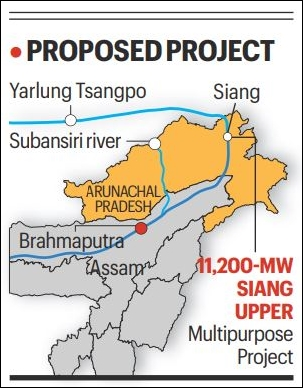
Context: Protests have erupted in Arunachal Pradesh against the proposed Siang Upper Multipurpose Project (SUMP), which the government considers a strategic response to China’s proposed 60,000-MW hydropower project on the Yarlung Tsangpo River.
More on the News
• On October 23, 2026, protests against SUMP turned violent in Pasighat, Arunachal Pradesh, resulting in arson, vandalism and clashes with security personnel.
• Indigenous Adi communities and youth groups oppose the project over fears of displacement, loss of ancestral land and livelihoods, environmental damage, and the deployment of security forces for feasibility surveys.
About the Siang Upper Multipurpose Project (SUMP)
• SUMP is a proposed 11,200-MW hydropower and water-storage project on the Siang River in Arunachal Pradesh, developed by NHPC Limited. Some reports cite its capacity as 11,500 MW.
• Background: Dam plans date back to 1982. The Centre declared the Upper Siang project a National Project in 2008.
• Water Storage: Its estimated live storage capacity is around 9.2 billion cubic metres (BCM), compared with approximately 5.5 BCM for China’s proposed Medog project.
• Current Status: The project remains at the feasibility and preliminary assessment stage. Construction has not received final approval.
• Strategic Significance: China’s proposed 60,000-MW Medog hydropower project raises concerns about downstream water security.
• Concerns: Experts question its flood-control effectiveness because hydropower generation may require high reservoir levels.
13th ASEAN Defence Ministers’ Meeting (ADMM)-Plus
Context: Defence Minister Rajnath Singh will lead the Indian delegation at the 13th ASEAN Defence Ministers’ Meeting (ADMM)-Plus in Cebu, Philippines, from October 28 to 29, 2026, to discuss regional and international security issues.
About the Association of Southeast Asian Nations (ASEAN)
• Established: August 8, 1967, through the Bangkok Declaration.
• Founding Members: Indonesia, Malaysia, the Philippines, Singapore and Thailand.
• Members (11): Brunei Darussalam, Cambodia, Indonesia, Lao PDR, Malaysia, Myanmar, the Philippines, Singapore, Thailand, Timor-Leste and Vietnam.
• Latest Member: Timor-Leste joined ASEAN on October 26, 2025.
• Objectives: To promote regional peace and stability, economic growth, social progress and cultural development through cooperation among member states.
• India is not an ASEAN member; it became a Sectoral Dialogue Partner in 1992, a full Dialogue Partner in 1995, and its relationship with ASEAN was elevated to a Comprehensive Strategic Partnership in 2022.
• Treaty of Amity and Cooperation (TAC): Signed in 1976, it provides the framework for peaceful relations among ASEAN members.
• Fundamental Principles: Mutual respect for sovereignty, non-interference in internal affairs, peaceful settlement of disputes and effective cooperation.
About the ASEAN Defence Ministers’ Meeting (ADMM)-Plus
• ADMM: Established in 2006, it is ASEAN’s highest defence consultative and cooperative mechanism.
• ADMM-Plus: Launched in 2010, it brings together 11 ASEAN member states and eight Dialogue Partners—India, the United States, China, Russia, Japan, South Korea, Australia and New Zealand—to strengthen defence and security cooperation.
• First Meeting: Held in Hanoi, Vietnam, on October 12, 2010.
• Annual Meetings: Defence Ministers have met annually since 2017 to strengthen regional defence cooperation.
• 2026 Chair: The Philippines is chairing ADMM-Plus in 2026 under the theme “Navigating Our Future, Together.”
• India’s Role: India became an ASEAN Dialogue Partner in 1992 and is co-chairing the Experts Working Group on Counter-Terrorism with Malaysia for the 2024–2027 cycle.
India–Indonesia Joint Special Forces Exercise GARUDA SHAKTI
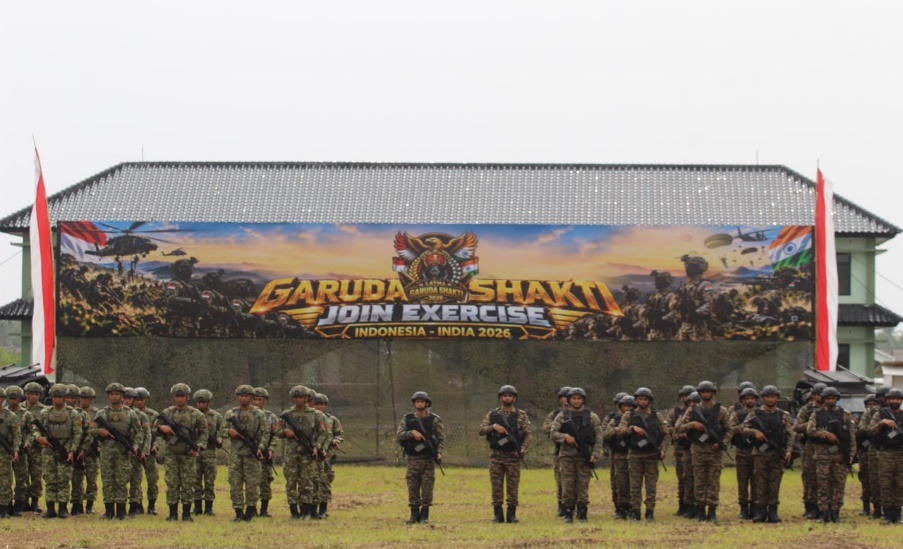
Context: The 11th edition of the India–Indonesia Joint Special Forces Exercise GARUDA SHAKTI commenced at Banyuwangi, Indonesia, on 27 October 2026 and will continue until 6 November 2026.
About GARUDA SHAKTI
• Conduct: It is a bilateral military exercise conducted alternately in India and Indonesia as part of military diplomacy.
• Participants: The Indian contingent comprises troops from the Parachute Regiment (Special Forces), while the Indonesian contingent comprises personnel from the Indonesian Special Forces.
• Objective: To promote positive relations, mutual understanding, cooperation and interoperability between the two countries' Special Forces.
• First Edition: Held in India in 2012.
• Last Edition (10th): Held from 3–12 December 2025 at the Special Forces Training School, Bakloh, Himachal Pradesh, India
• Training Focus: Jungle warfare, obstacle crossing, combat marksmanship, mountaineering, air assault training, weapons and equipment familiarisation, and exchange of tactics, techniques and procedures.
• Validation Exercise: The exercise culminates in realistic operational scenarios to assess coordination, endurance and combat readiness.
Khan Global Studies App
With our training programs, learning online can be a very exciting experience. Take the next step toward achieving your professional and personal objectives.


Course Related Query:
Ask Your DoubtsStore Related Query:[email protected]NEET | JEE | CUET
NCERT Books
Resources
We love learning. Through our innovative solutions, we encourage ourselves, our teams, and our Students to grow. We welcome and look for diverse perspectives and opinions because they enhance our decisions. We strive to understand the big picture and how we contribute to the company’s objectives. We approach challenges with optimism and harness the power of teamwork to accomplish our goals. These aren’t just pretty words to post on the office wall. This is who we are. It’s how we work. And it’s how we approach every interaction with each other and our Students.
Come with an open mind, hungry to learn, and you’ll experience unmatched personal and professional growth, a world of different backgrounds and perspectives, and the freedom to be you—every day. We strive to build and sustain diverse teams and foster a culture of belonging. Creating an inclusive environment where every students feels welcome, appreciated, and heard gives us something to feel (really) good about.