You're all caught up—no notifications available.
Explore All Exams at KGS


All Exams
Explore All Exams at KGS

Khan Sir Courses
Geography I Polity I History | World Map I Indian Map I Economics I Biology

UPSC & State PSC
UPSC I BPSC I UP-PSC I MP-PSC

State Exams
UP I Bihar I MP | Rajasthan

NEET | JEE | CUET
NEET | JEE | CUET

Defence Exams
NDA I CDS I CAPF I AFCAT I SSB I Agniveer

Police Exams
UP SI | Bihar SI | Delhi Police | UP Constable

SSC Exams
CGL I CPO I CHSL I MTS I SSC GD I Delhi Police

Foundation Courses
Physics I Chemistry I Biology I History I Geography I Polity I NCERT I Math I English | Map I Reasoning

Railway Exams
RRB | RPF

Teaching Exams
TET | Teaching | UGC

Banking Exams
SBI | RBI | IBPS

Engineering Exams
Civil | Electrical | Mechanical
UGC NET
UGC NET/JRF
Current Affairs provides you with the best compilation of the Daily Current Affairs taking place across the globe: National, International, Sports, Science and Technology, Banking, Economy, Agreement, Appointments, Ranks, and Report and General Studies

SYLLABUS
GS-3: Infrastructure: Energy and Achievements of Indians in science & technology; indigenization of technology and developing new technology.
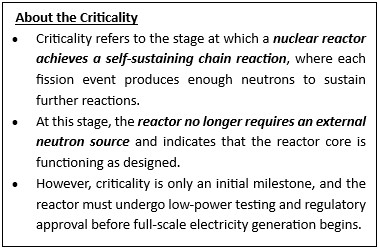
Context: India has achieved a major milestone in its nuclear energy programme with the 500 MWe Prototype Fast Breeder Reactor (PFBR) at Kalpakkam, attaining first criticality, marking the start of a controlled nuclear chain reaction.
More on the News
• PM described it as a “defining step in India’s civil nuclear journey”, marking progress in the second stage of the three-stage nuclear programme.
• The achievement signifies India’s advancement towards long-term energy security, nuclear fuel self-reliance, and clean energy transition.
About the Kalpakkam PFBR Project
• The PFBR is a 500 MWe sodium-cooled, pool-type fast breeder reactor designed by the Indira Gandhi Centre for Atomic Research (IGCAR) and built by Bharatiya Nabhikiya Vidyut Nigam Limited (BHAVINI), both operating under the Department of Atomic Energy (DAE).
• The reactor achieved criticality after meeting all safety requirements and obtaining clearance from the Atomic Energy Regulatory Board.
• Approved in 2003 and started in 2004, the project took over two decades to reach criticality due to technological complexities, achieving it in April 2026 after core (March 2024) and fuel loading (October 2025).
• The cost rose from about ₹3,492 crore to nearly ₹7,600 crore due to delays and technical issues, with procurement inefficiencies also flagged by the Comptroller and Auditor General of India.
• Global Context: With PFBR, India is expected to become only the second country after Russia to operate a commercial fast breeder reactor.
o Fast breeder reactor programmes in countries like Japan, France, and the United States have been scaled back due to safety and economic concerns.
About the Prototype Fast Breeder Reactor (PFBR)
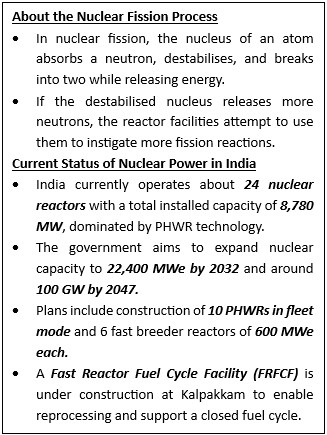
• The PFBR is a nuclear reactor that produces more fuel than it consumes.
• It is a fast breeder reactor, meaning it generates additional fissile material during operation.
• Its core-loading marks a milestone because it initiates Stage II of India’s three-stage nuclear programme.
• The Department of Atomic Energy (DAE) set up a special-purpose vehicle in 2003 called BHAVINI to implement Stage II of the nuclear programme.
Role in India’s Three-Stage Nuclear Programme:
• The three-stage programme was designed by Homi J Bhabha because India hosts roughly a quarter of the world’s thorium.
• Stage I – PHWRs: India used pressurised heavy water reactors (PHWRs) and natural uranium-238 (U-238), which contains small amounts of U-235, as the fissile material.
o The heavy water in PHWR slows neutrons enough to be captured by U-238 and U-235 nuclei and cause new fission.
o These reactions produce Plutonium-239 (Pu-239) and energy.
• Stage II – PFBR: Only U-235, not U-238, can sustain a chain reaction, and it is consumed in Stage I.
o In Stage II, India uses Pu-239 together with U-238 in the PFBR to produce energy, Uranium-233, and more Pu-239.
• Stage III – Thorium-Based Reactors: In Stage III, Pu-239 is combined with Thorium-232 (Th-232) in reactors to produce energy and Uranium-233.
o The three stages are expected to allow the country complete self-sufficiency in nuclear energy.
How PFBR Works:
• Fuel and Core Design: PHWRs use natural or low-enriched U-238 and produce Pu-239 as a by-product.
o This Pu-239 is combined with more U-238 into a mixed oxide and loaded into the core of a new reactor together with a blanket.
• Breeding Mechanism: The blanket is a material that reacts with fission products in the core to produce more Pu-239.
o The PFBR is designed to produce more Pu-239 than it consumes.
• Fast Neutron System: In a fast breeder reactor, neutrons are not slowed, allowing them to trigger specific fission reactions efficiently.
Coolant and Energy Transfer System:
• The PFBR uses liquid sodium, a highly reactive substance, as coolant in two circuits:
o Coolant in the first circuit enters the reactor and leaves with heat energy and radioactivity. Through heat exchangers, it transfers only the heat to the coolant in a secondary circuit.
o The secondary circuit transfers the heat to generators to produce electricity.
• This design ensures efficient heat transfer while maintaining separation between radioactive and non-radioactive systems.
Significance
• Energy Security: The PFBR enables the extraction of 60–100 times more energy from a given quantity of uranium, significantly improving resource efficiency and reducing India’s dependence on imported nuclear fuel.
• Clean Energy Transition: Nuclear energy from PFBR provides reliable, low-carbon base-load power, complementing renewables and supporting India’s carbon reduction and climate goals.
• Technological Capability: The PFBR demonstrates India’s indigenous strength in advanced nuclear engineering, reactor design, and expertise in fuel cycle technologies, materials, and reactor physics.
• Strategic Importance: The PFBR acts as a bridge between uranium-based and thorium-based systems, positioning India among a select group of countries with advanced fast breeder technology.
• Industrial Development: The project involved over 200 Indian industries, including MSMEs, strengthening domestic manufacturing and supporting the Atmanirbhar Bharat initiative.

The most trusted learning platform on your phone
With our training programs, learning online can be a very exciting experience! Take the next step toward achieving your professional and personal objectives



Course Related Query:
Ask Your DoubtsStore Related Query:[email protected]NCERT Books
Resources
We love learning. Through our innovative solutions, we encourage ourselves, our teams, and our Students to grow. We welcome and look for diverse perspectives and opinions because they enhance our decisions. We strive to understand the big picture and how we contribute to the company’s objectives. We approach challenges with optimism and harness the power of teamwork to accomplish our goals. These aren’t just pretty words to post on the office wall. This is who we are. It’s how we work. And it’s how we approach every interaction with each other and our Students.
Come with an open mind, hungry to learn, and you’ll experience unmatched personal and professional growth, a world of different backgrounds and perspectives, and the freedom to be you—every day. We strive to build and sustain diverse teams and foster a culture of belonging. Creating an inclusive environment where every students feels welcome, appreciated, and heard gives us something to feel (really) good about.
Get Free academic Counseling & Course Details