KGS

All Exams

Explore All Exams at KGS

All Exams
Current Affairs made simple.

Current Affairs provides you with the best compilation of the Daily Current Affairs taking place across the globe: National, International, Sports, Science and Technology, Banking, Economy, Agreement, Appointments, Ranks, and Report and General Studies

Current Affairs

National Animal Disease Control Programme (NADCP)

SYLLABUS

GS-3: Economics of animal-rearing. 

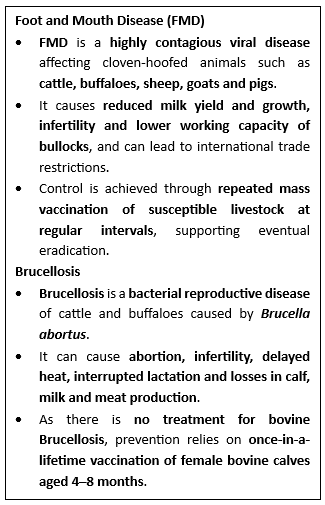
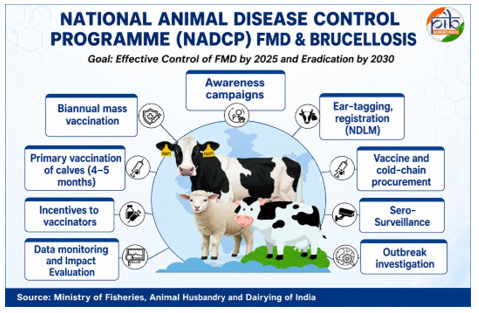
Context: National Animal Disease Control Programme (NADCP) is one of India’s largest livestock health initiatives, aimed at controlling and eventually eradicating Foot and Mouth Disease (FMD) and Brucellosis through nationwide vaccination, surveillance and digital livestock management.

About the National Animal Disease Control Programme (NADCP)
  • NADCP was launched in September 2019 as a Central Sector Scheme with an initial outlay of ₹13,343 crore for 2019–20 to 2023–24, with 100% central funding to States/UTs.
  • It aims to control FMD through vaccination and eventually eradicate it by 2030, while strengthening Brucellosis control in animals and reducing associated risks to humans.
  • The programme targets 100% vaccination of cattle, buffaloes, sheep, goats and pigs against FMD every six months, while female bovine calves aged 4–8 months receive one-time Brucellosis vaccination during their lifetime.
  • Under the revised framework, NADCP, the Livestock Health and Disease Control (LH&DC) component and Pashu Aushadhi have been subsumed under the Livestock Health and Disease Control Programme (LHDCP), which has an outlay of ₹2,010 crore for 2026–27.
  • As per the 20th Livestock Census 2019, India has 535.78 million livestock, including 302.79 million bovines, making animal health critical for rural livelihoods, productivity and food security.

Key Interventions under NADCP

  • Mass vaccination and surveillance: FMD vaccination is undertaken at six-monthly intervals, supported by vaccine procurement, cold-chain infrastructure and pre- and post-vaccination testing.
    • Sero-surveillance and sero-monitoring, outbreak investigation, virus isolation and typing help assess immunity and disease circulation.
  • Animal identification and digital monitoring: Livestock are ear-tagged and registered, with vaccination and health information integrated through the Bharat Pashudhan Portal using a unique 12-digit Tag ID.
    • More than 39 crore livestock had been registered by July 2026.
  • Veterinary and migratory livestock coverage: 4,019 Mobile Veterinary Units (MVUs)  across 29 States/UTs provide doorstep services through 1962.
    • Since 2024, FMD vaccination has also covered pastoral sheep and goats in Haryana, Himachal Pradesh, Uttarakhand, Jammu & Kashmir and Ladakh.
  • Research and human-resource support: ICAR institutions receive support for vaccine research, quality testing, surveillance and disease modelling, while 39,810 MAITRIs have been trained to strengthen doorstep livestock services.

Major Outcomes and Significance

  • Declining Disease Burden: Cumulative FMD vaccination has reached 147.16 crore doses, benefiting 8.04 crore farmers.
    • FMD outbreaks declined from 132 in 2019 to 40 in 2025, while Brucellosis outbreaks fell from 22 to 15; there has been no Asia-1 FMD outbreak for the last three years.
  • Stronger Disease Immunity: Protective immunity against FMD serotypes O, A and Asia1 reached 78.1%, 71.7% and 77.6%, respectively.
    • Brucellosis seroconversion in 2025 was 75.63% in cattle calves and 67.17% in buffalo calves, while NSP antibody prevalence declined from 20.8% to 8.1% between 2019 and 2025.
  • Improved Veterinary Access and Traceability: MVUs have provided doorstep services to 136 lakh farmers and treated 276 lakh animals.
    • The Bharat Pashudhan Portal enables real-time monitoring and traceability, strengthening data-driven disease control and livestock programme implementation.
  • Higher Livestock Productivity: Indigenous and non-descript cattle productivity increased 44.89%, while buffalo productivity rose 25.80% between 2014–15 and 2024–25.
    • Milk production increased 69.4%, from 146.31 million tonnes to 247.87 million tonnes, with a target of 3,000 kg average milk productivity per animal per year by 2030.
  • One Health and Pandemic Preparedness: NADCP strengthens the One Health approach through early disease detection and reduced zoonotic risks.
    • The US$25 million Pandemic Fund Project, supported by the G20 Pandemic Fund, strengthens genomic surveillance, laboratories and pandemic preparedness with the ADB, FAO and World Bank.

Khan Global Studies App

The most trusted learning platform on your phone

With our training programs, learning online can be a very exciting experience. Take the next step toward achieving your professional and personal objectives.


Download on the App StoreGet it on Google Play
KGS learning dashboard and mobile application
logo
Khan Global Studies Pvt. Ltd. 5th Floor,
A13A, Graphix 1 Tower B, Sector 62,
Noida, Uttar Pradesh 201309

Course Related Query:

Ask Your DoubtsStore Related Query:[email protected]

Get Free Academic Counseling & Course Details

KGS best learning platform

About Khan Global Studies

We love learning. Through our innovative solutions, we encourage ourselves, our teams, and our Students to grow. We welcome and look for diverse perspectives and opinions because they enhance our decisions. We strive to understand the big picture and how we contribute to the company’s objectives. We approach challenges with optimism and harness the power of teamwork to accomplish our goals. These aren’t just pretty words to post on the office wall. This is who we are. It’s how we work. And it’s how we approach every interaction with each other and our Students.


What Makes Us Different

Come with an open mind, hungry to learn, and you’ll experience unmatched personal and professional growth, a world of different backgrounds and perspectives, and the freedom to be you—every day. We strive to build and sustain diverse teams and foster a culture of belonging. Creating an inclusive environment where every students feels welcome, appreciated, and heard gives us something to feel (really) good about.

©Copyright 2026 KhanGlobalStudies