You're all caught up—no notifications available.
Explore All Exams at KGS


All Exams
Explore All Exams at KGS

Khan Sir Courses
Geography I Polity I History | World Map I Indian Map I Economics I Biology

UPSC & State PSC
UPSC I BPSC I UP-PSC I MP-PSC

State Exams
UP I Bihar I MP | Rajasthan

NEET | JEE | CUET
NEET | JEE | CUET

Defence Exams
NDA I CDS I CAPF I AFCAT I SSB I Agniveer

Police Exams
UP SI | Bihar SI | Delhi Police | UP Constable

SSC Exams
CGL I CPO I CHSL I MTS I SSC GD I Delhi Police

Foundation Courses
Physics I Chemistry I Biology I History I Geography I Polity I NCERT I Math I English | Map I Reasoning

Railway Exams
RRB | RPF

Teaching Exams
TET | Teaching | UGC

Banking Exams
SBI | RBI | IBPS

Engineering Exams
Civil | Electrical | Mechanical
UGC NET
UGC NET/JRF
Current Affairs provides you with the best compilation of the Daily Current Affairs taking place across the globe: National, International, Sports, Science and Technology, Banking, Economy, Agreement, Appointments, Ranks, and Report and General Studies

SYLLABUS
GS-2: Salient features of the Representation of People’s Act. Appointment to various Constitutional posts, powers, functions and responsibilities of various Constitutional Bodies.
Context: The Election Commission of India has announced the schedule for Phase-III of the Special Intensive Revision (SIR) of electoral rolls across 16 States and 3 Union Territories to ensure updated and accurate voter lists ahead of future elections.
More on the News
• Phase-III of the SIR will cover 16 States and 3 UTs, including Delhi, Maharashtra, Karnataka, Telangana, Odisha, Punjab, and Uttarakhand.
• Over 3.94 lakh Booth Level Officers (BLOs) will conduct house-to-house verification for nearly 36.73 crore electors, assisted by 3.42 lakh Booth Level Agents (BLAs) appointed by political parties.
• Electors will have to submit Enumeration Forms during the verification process, while documents may be sought later only in doubtful cases.
• The final electoral rolls under Phase-III will be published between September and December 2026.
• With this phase, the SIR exercise will cover the entire country except Himachal Pradesh, Jammu & Kashmir, and Ladakh.
• The SIR exercise has been criticised by Opposition parties as a possible “backdoor NRC”, and the matter is currently under challenge before the Supreme Court.
About Special Intensive Revision (SIR)
• The electoral rolls are prepared by the Election Commission of India under the Representation of the People Act, 1950.
• Under the Registration of Electors Rules, 1960, electoral rolls may be revised intensively or summarily as directed by the ECI.
• In an intensive revision, electoral rolls are prepared afresh through field verification, while summary revision involves updating the existing rolls.
• India had not conducted a nationwide intensive revision since the early 2000s after the digitisation of electoral rolls.
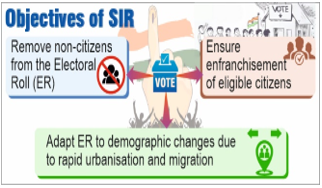
• The ECI cited rapid urbanisation, migration, duplication, and demographic changes as reasons for conducting the SIR.
• Constitutional Provisions:
• Statutory Provisions:
Need for SIR
• Remove Ineligible Voters: The exercise seeks to identify and remove duplicate, deceased, shifted, and non-citizen voters from electoral rolls.
• Uphold “One Person, One Vote”: By correcting duplication and inaccuracies, the SIR strengthens political equality and electoral integrity.
• Improve Accuracy of Electoral Rolls: The revision helps address demographic changes caused by migration, urbanisation, and newly eligible young voters.
• Strengthen Electoral Credibility: Updated and verified voter lists enhance public confidence in the electoral process.
Concerns and Challenges
• Risk of Exclusion: Migrants, elderly citizens, Persons with Disabilities (PwDs), and economically weaker sections may face difficulties in documentation and verification.
• Alleged NRC Linkage: Critics argue that the SIR could become a “backdoor NRC” due to emphasis on citizenship verification.
• Aadhaar-Related Concerns: Since Aadhaar is accepted only as proof of identity and not citizenship, many vulnerable citizens may face difficulties.
• Politicisation of the Exercise: Opposition parties have raised concerns regarding possible misuse of state machinery and arbitrary deletion of voters.
Way Forward
• Build Political Consensus: Wider consultation with political parties can improve trust, transparency, and acceptance of the SIR process.
• Leverage Technology: AI-enabled verification systems, multilingual platforms, and voter helplines can reduce exclusion errors and improve accessibility.
• Relax Documentation Norms: Flexible documentation requirements and provisional certifications can help vulnerable groups participate effectively.
• Institutionalise Periodic SIRs: Conducting SIR exercises regularly in a phased manner can improve preparedness and reduce politicisation.
• Strengthen Voter Awareness: Public awareness campaigns should educate citizens regarding eligibility, documentation, and timelines of the revision process.
The most trusted learning platform on your phone
With our training programs, learning online can be a very exciting experience! Take the next step toward achieving your professional and personal objectives



Course Related Query:
Ask Your DoubtsStore Related Query:[email protected]NCERT Books
Resources
We love learning. Through our innovative solutions, we encourage ourselves, our teams, and our Students to grow. We welcome and look for diverse perspectives and opinions because they enhance our decisions. We strive to understand the big picture and how we contribute to the company’s objectives. We approach challenges with optimism and harness the power of teamwork to accomplish our goals. These aren’t just pretty words to post on the office wall. This is who we are. It’s how we work. And it’s how we approach every interaction with each other and our Students.
Come with an open mind, hungry to learn, and you’ll experience unmatched personal and professional growth, a world of different backgrounds and perspectives, and the freedom to be you—every day. We strive to build and sustain diverse teams and foster a culture of belonging. Creating an inclusive environment where every students feels welcome, appreciated, and heard gives us something to feel (really) good about.
Get Free academic Counseling & Course Details