You're all caught up—no notifications available.
Explore All Exams at KGS


All Exams
Explore All Exams at KGS

Khan Sir Courses
Geography I Polity I History | World Map I Indian Map I Economics I Biology

UPSC & State PSC
UPSC I BPSC I UP-PSC I MP-PSC

State Exams
UP I Bihar I MP | Rajasthan

NEET | JEE | CUET
NEET | JEE | CUET

Defence Exams
NDA I CDS I CAPF I AFCAT I SSB I Agniveer

Police Exams
UP SI | Bihar SI | Delhi Police | UP Constable

SSC Exams
CGL I CPO I CHSL I MTS I SSC GD I Delhi Police

Foundation Courses
Physics I Chemistry I Biology I History I Geography I Polity I NCERT I Math I English | Map I Reasoning

Railway Exams
RRB | RPF

Teaching Exams
TET | Teaching | UGC

Banking Exams
SBI | RBI | IBPS

Engineering Exams
Civil | Electrical | Mechanical
UGC NET
UGC NET/JRF
Current Affairs provides you with the best compilation of the Daily Current Affairs taking place across the globe: National, International, Sports, Science and Technology, Banking, Economy, Agreement, Appointments, Ranks, and Report and General Studies

SYLLABUS
GS 2: Indian Constitution – historical underpinnings, evolution, features, amendments, significant provisions and basic structure; Key features of delimitation.
Context: Recently, the government signalled its intention to introduce an amendment bill proposing a delimitation process based on the 2011 Census, to implement the “Women's Reservation Act, 2023” before the 2029 general elections.
More on the News
• The proposed amendments will increase the number of Lok Sabha seats from 543 to 816, with 273 seats (33% of the total) reserved for women.
• The amendment will ensure that the existing proportion of seats among States is maintained, addressing concerns that States which successfully controlled population growth may otherwise lose representation compared to more populous States.
• Under the amendments, the basis for the selection of seats will be the Census data of 2011, after which each state is likely to see a 50% rise in seats, but the pro rata basis would be maintained.
About Delimitation
• Delimitation refers to the exercise of determining the number of seats and redrawing the boundaries of territorial constituencies for the Lok Sabha and State Legislative Assemblies.
• This task is carried out by an independent high-powered authority called the Delimitation Commission (also known as the Boundary Commission).
• Delimitation also includes the reservation for Scheduled Castes (SC) and Scheduled Tribes (ST) in the houses of the legislature.
• In India, Delimitation Commissions have been set up four times so far—1952, 1963, 1973, and 2002.
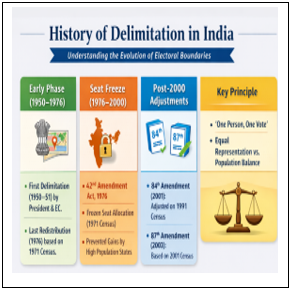
Constitutional Provisions for Delimitation
• Articles 82 and 170: Empower Parliament to enact laws for the readjustment of constituencies. Accordingly, each State is to be divided into territorial constituencies for the Lok Sabha and the State Legislative Assemblies in such manner and by such authority as may be determined by Parliament.
• Articles 330 and 332: These articles provide for the periodic revision of seats reserved for Scheduled Castes (SCs) and Scheduled Tribes (STs) in the Lok Sabha and State Legislative Assemblies, in accordance with changes in their population.
Significance of Delimitation
• Equality of Representation: It gives practical shape to the democratic ideal of "One Person, One Vote, One Value" by ensuring that the boundaries of constituencies are redrawn periodically, so that each elected representative represents an approximately equal population.
• Fair Demarcation of Constituencies: A fair and transparent delimitation exercise minimises the scope for arbitrary boundary manipulation aimed at electoral advantage, thereby safeguarding the credibility of the electoral process.
• Promoting Cooperative Federalism: By deciding the allocation of seats among States in Parliament and within State legislatures, delimitation influences the balance of representation across the federal structure.
• Demographic Redistribution: Over time, delimitation has helped realign the distribution of seats in Parliament, State Assemblies, and local bodies in accordance with shifts in population patterns, ensuring equitable representation.
• Effective Governance: Well-demarcated constituencies that reflect demographic realities enable representatives to more effectively identify and respond to the needs and aspirations of their constituents.
Challenges before Delimitation in India
• Population Imbalance Across States: Wide variations in population growth may lead to unequal gains in representation, favouring high-growth States.
• North–South Political Divide: Southern States fear loss of parliamentary strength compared to northern States, creating federal tensions.
• Post-2026 Delimitation Sensitivity: Lifting the freeze on delimitation could drastically alter seat distribution, making political consensus difficult.
• Equity vs Population Control Dilemma: States that successfully controlled their population may be disadvantaged, raising concerns of fairness.
• Reservation Re-adjustment (SC/ST Seats): Changes in reserved constituencies can trigger political and social contestation.
Way Forward
• Ensuring a Balanced Formula for Representation: A balanced approach should align population-based representation with incentives for population control, using measures like weighted representation or maintaining inter-state seat proportions to ensure equity.
• Building Political Consensus: Given its sensitivity, especially post-2026, delimitation requires broad consultation with States and stakeholders to uphold cooperative federalism and prevent regional tensions.
• Reliable Census Data: Conducting a credible and up-to-date Census is crucial. Robust demographic data will ensure that delimitation reflects ground realities and avoids distortions in representation.
• Rationalising Reservation Policy: Reservation of seats for SCs and STs should be periodically reviewed with sensitivity to demographic changes while ensuring social justice and political inclusion.
• Phased Implementation: A gradual or phased approach to seat expansion and boundary changes can reduce political shocks and allow smoother adaptation by institutions and stakeholders.
The most trusted learning platform on your phone
With our training programs, learning online can be a very exciting experience! Take the next step toward achieving your professional and personal objectives



Course Related Query:
Ask Your DoubtsStore Related Query:[email protected]NCERT Books
Resources
We love learning. Through our innovative solutions, we encourage ourselves, our teams, and our Students to grow. We welcome and look for diverse perspectives and opinions because they enhance our decisions. We strive to understand the big picture and how we contribute to the company’s objectives. We approach challenges with optimism and harness the power of teamwork to accomplish our goals. These aren’t just pretty words to post on the office wall. This is who we are. It’s how we work. And it’s how we approach every interaction with each other and our Students.
Come with an open mind, hungry to learn, and you’ll experience unmatched personal and professional growth, a world of different backgrounds and perspectives, and the freedom to be you—every day. We strive to build and sustain diverse teams and foster a culture of belonging. Creating an inclusive environment where every students feels welcome, appreciated, and heard gives us something to feel (really) good about.
Get Free academic Counseling & Course Details