You're all caught up—no notifications available.
Explore All Exams at KGS


All Exams
Explore All Exams at KGS

Khan Sir Courses
Geography I Polity I History | World Map I Indian Map I Economics I Biology

UPSC & State PSC
UPSC I BPSC I UP-PSC I MP-PSC

State Exams
UP I Bihar I MP | Rajasthan

NEET | JEE | CUET
NEET | JEE | CUET

Defence Exams
NDA I CDS I CAPF I AFCAT I SSB I Agniveer

Police Exams
UP SI | Bihar SI | Delhi Police | UP Constable

SSC Exams
CGL I CPO I CHSL I MTS I SSC GD I Delhi Police

Foundation Courses
Physics I Chemistry I Biology I History I Geography I Polity I NCERT I Math I English | Map I Reasoning

Railway Exams
RRB | RPF

Teaching Exams
TET | Teaching | UGC

Banking Exams
SBI | RBI | IBPS

Engineering Exams
Civil | Electrical | Mechanical
UGC NET
UGC NET/JRF
Current Affairs provides you with the best compilation of the Daily Current Affairs taking place across the globe: National, International, Sports, Science and Technology, Banking, Economy, Agreement, Appointments, Ranks, and Report and General Studies

SYLLABUS
GS 3: Science & Technology – achievements of Indians in science & technology; indigenization of technology and development of new technology; awareness in the fields of IT, space
Context: Recently, Indian Space Research Organisation successfully conducted the second Integrated Air Drop Test (IADT-02) at the Satish Dhawan Space Centre as part of the Gaganyaan mission.
About Integrated Air Drop Test (IADT-02)
• Simulated Crew Module (~5.7 tonnes, equivalent to Gaganyaan G1) was lifted by an Indian Air Force Chinook helicopter to ~3 km and released over a sea drop zone near Sriharikota coast .
• 10 parachutes of 4 types deployed in a precise sequence during descent.
• Parachutes ensured gradual velocity reduction for safe touchdown.
• Module successfully recovered with Indian Navy; IADT-02 validated parachute-based deceleration system.
• The test is crucial for ensuring the safe recovery of the crew module, which carries astronauts during human spaceflight.
• The first test was conducted on August 24, 2025 at the Satish Dhawan Space Centre.
• A 4.8-tonne dummy Crew Module was dropped from a height of 3 km using a helicopter.
About Gaganyaan Mission
• The Gaganyaan mission envisages demonstration of human spaceflight capability by launching a crew of 3 members to an orbit of 400 km for a 3 days mission and bringing them back safely to earth by landing in Indian sea waters.
• Pre-requisites of the Gaganyaan mission include development of critical technologies such as:
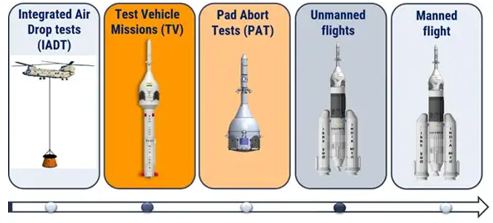
• Various precursor missions are planned to demonstrate Technology Preparedness Levels:
• Safety and reliability of all systems will be proven through unmanned missions before the final manned mission.
Gaganyaan Mission – Key Components and Features
|
Component |
Details |
|
HLVM3 (Human
Rated LVM3) |
LVM3 rocket of
Indian Space Research Organisation identified for Gaganyaan mission; consists
of solid, liquid and cryogenic stages; re-configured for human rating;
capable of placing Orbital Module in 400 km orbit; includes Crew Escape
System (CES) with high burn rate motors for emergency escape |
|
Orbital
Module (OM) |
Comprises Crew
Module (CM) and Service Module (SM); equipped with advanced avionics systems
with redundancy for human safety |
|
Crew Module
(CM) |
Habitable
module with Earth-like environment; double-walled structure with pressurized
inner and unpressurized outer structure with Thermal Protection System;
includes life support, avionics, crew interfaces and deceleration systems;
designed for safe re-entry and landing |
|
Service
Module (SM) |
Provides
support to CM in orbit; contains thermal, propulsion, power, avionics systems
and deployment mechanisms; unpressurized structure |
|
New
Technologies |
Development of
engineering systems and human-centric systems with focus on crew safety |
Significance of IADT-02
• Marks a key milestone in the Gaganyaan mission, advancing readiness for India’s first human spaceflight.
• Successfully validates the Crew Module’s parachute-based deceleration system, crucial for safe re-entry and landing.
• Demonstrates effective coordination between Indian Space Research Organisation, Indian Air Force, Indian Navy, and Defence Research and Development Organisation.
• Strengthens confidence in crew safety systems, including controlled descent and sea recovery operations.
• Builds on earlier tests (IADT-01) and contributes to technology validation before uncrewed (G1) and eventual crewed missions.

The most trusted learning platform on your phone
With our training programs, learning online can be a very exciting experience! Take the next step toward achieving your professional and personal objectives


Course Related Query:
Ask Your DoubtsStore Related Query:[email protected]NCERT Books
Resources
We love learning. Through our innovative solutions, we encourage ourselves, our teams, and our Students to grow. We welcome and look for diverse perspectives and opinions because they enhance our decisions. We strive to understand the big picture and how we contribute to the company’s objectives. We approach challenges with optimism and harness the power of teamwork to accomplish our goals. These aren’t just pretty words to post on the office wall. This is who we are. It’s how we work. And it’s how we approach every interaction with each other and our Students.
Come with an open mind, hungry to learn, and you’ll experience unmatched personal and professional growth, a world of different backgrounds and perspectives, and the freedom to be you—every day. We strive to build and sustain diverse teams and foster a culture of belonging. Creating an inclusive environment where every students feels welcome, appreciated, and heard gives us something to feel (really) good about.
Get Free academic Counseling & Course Details