You're all caught up—no notifications available.
Explore All Exams at KGS


All Exams
Explore All Exams at KGS

Khan Sir Courses
Geography I Polity I History | World Map I Indian Map I Economics I Biology

UPSC & State PSC
UPSC I BPSC I UP-PSC I MP-PSC

State Exams
UP I Bihar I MP | Rajasthan

NEET | JEE | CUET
NEET | JEE | CUET

Defence Exams
NDA I CDS I CAPF I AFCAT I SSB I Agniveer

Police Exams
UP SI | Bihar SI | Delhi Police | UP Constable

SSC Exams
CGL I CPO I CHSL I MTS I SSC GD I Delhi Police

Foundation Courses
Physics I Chemistry I Biology I History I Geography I Polity I NCERT I Math I English | Map I Reasoning

Railway Exams
RRB | RPF

Teaching Exams
TET | Teaching | UGC

Banking Exams
SBI | RBI | IBPS

Engineering Exams
Civil | Electrical | Mechanical
UGC NET
UGC NET/JRF
Current Affairs provides you with the best compilation of the Daily Current Affairs taking place across the globe: National, International, Sports, Science and Technology, Banking, Economy, Agreement, Appointments, Ranks, and Report and General Studies

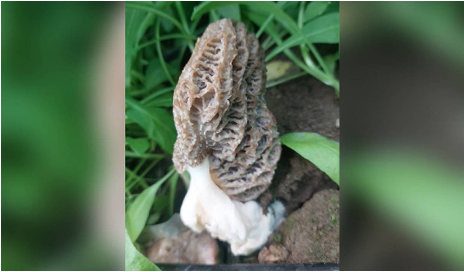
Cultivation of Gucchi (Morels) in Kashmir
Context: Recently, Sher-e-Kashmir University of Agricultural Sciences and Technology has successfully cultivated Gucchi (Morels) under controlled and open-field conditions for the first time.
About Morels (Morchella / Gucchi / Kangaech)
• Gucchi (Morchella esculenta) is a highly prized wild edible mushroom belonging to the genus Morchella (family Morchellaceae).
• It is one of the most expensive mushrooms in the world.
• It is locally known as Gucchi in Jammu & Kashmir and Kangaech.
• It grows naturally in high-altitude forest ecosystems.
• Climatic Conditions for Growth: It grows in cold, moist environments at high altitudes (2500–3500 m) on humus-rich soils. Fruiting generally occurs after rainfall or snowmelt, mainly from March–June (or winter in warmer regions).
• Habitat and Distribution: It is mainly found in the North-Western Himalayas, especially Jammu & Kashmir, Himachal Pradesh, and Uttarakhand.
• Appearance and Biological Features: The mushroom develops from underground mycelium and produces a visible fruiting body (ascocarp) above the soil.
• Economic and Nutritional Value:
Significance of the Breakthrough
• The innovation enables commercial cultivation of a wild species.
• It provides new income opportunities for farmers and rural youth.
• It promotes diversification into high-value agriculture.
• It supports export-oriented bioeconomy development in J&K.
• It reduces ecological pressure on fragile Himalayan ecosystems.
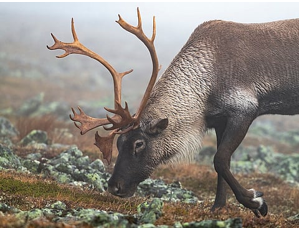
Caribou Survival Threatened by Declining Lichen in the Arctic
Context: A study by researchers at the State University of New York College of Environmental Science and Forestry highlights that declining lichen availability may threaten the winter survival of caribou in the Arctic.
About Caribou (Reindeer)
• Caribou, scientifically known as Rangifer tarandus, belong to the deer family (Cervidae).
• The terms “Caribou” (used in North America) and “Reindeer” (used in Eurasia and for domesticated populations) refer to the same species.
• Key Biological Features:
• Diet and Ecological Role:
• Habitat and Distribution: Caribou are found across Greenland, Scandinavia, Russia, Alaska, and Canada. They inhabit Arctic tundra regions as well as boreal forest ecosystems.
• Conservation Status: Listed as Vulnerable on the IUCN Red List
• Major Threats: Include climate change, habitat disturbance, hunting, and predation by wolves, bears, and lynx.
First Edition of the Indian Navy’s Biannual Commanders’ Conference 2026
Context: The first edition of the Indian Navy’s biannual Commanders’ Conference 2026 will be held from 14–16 April 2026 at Nausena Bhawan, New Delhi.
About the Commanders’ Conference
• It is an apex-level forum of the Indian Navy for reviewing operational posture, capability development, and strategic alignment with national security objectives.
• Objective: To ensure the Indian Navy remains a combat-ready, technology-driven force and emerges as a ‘Preferred Security Partner’ in the Indian Ocean Region (IOR) and Indo-Pacific.
• The conference gains importance due to swift naval deployments to safeguard India’s energy security amid the ongoing West Asia conflict and the presence of Multi-National Forces (MNFs) in the Indian Ocean Region.
• It also assumes significance in reaffirming operational doctrine, inter-services coordination, and technology-driven responses in the aftermath of ‘Op Sindoor’.
• Core Areas of Deliberation:
• Strategic Orientation:
Jallianwala Bagh massacre
Context: On the 107th martyrdom day of the 1919 Jallianwala Bagh massacre at Jallianwala Bagh, the nation pays homage to the innocent victims whose sacrifice became a turning point in India’s freedom struggle.
The Jallianwala Bagh Massacre (April 13, 1919)
• The Jallianwala Bagh Massacre occurred in Amritsar, Punjab, on April 13, 1919.
• It was a tragic culmination of the tensions stirred by the Rowlatt Act.
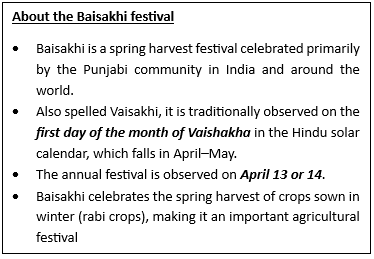
• A large crowd of about 20,000 people had gathered at Jallianwala Bagh to celebrate Baisakhi, a religious festival, and to protest the arrest of local leaders Saifuddin Kitchlew and Dr Satyapal.
• The crowd was unaware of the martial law orders, including a ban on public gatherings.
• Brigadier-General Reginald Dyer, in charge of enforcing martial law, arrived at the scene with his troops, surrounded the gathering, and opened fire without warning.
• Official British records claimed 379 dead and over 1,100 wounded, while Indian sources and other estimates suggest much higher casualties.
• It marked a decisive turning point in India’s freedom struggle, destroying faith in British rule and pushing Mahatma Gandhi toward mass mobilisation through the Non-Cooperation Movement (1920–22).
• Rabindranath Tagore renounced his knighthood in protest, while revolutionary sentiment also deepened—later influencing figures like Udham Singh, who assassinated Michael O'Dwyer in 1940.
• The British-appointed Hunter Commission censured Dyer and forced his resignation, though reactions in Britain were divided, with some praising him.
Significance
• Marked a decisive shift from moderate politics to mass nationalism
• Strengthened Gandhi’s leadership in the freedom struggle
• Exposed the brutal nature of colonial rule
• Became a symbol of sacrifice and resistance in India’s independence movement

The most trusted learning platform on your phone
With our training programs, learning online can be a very exciting experience! Take the next step toward achieving your professional and personal objectives



Course Related Query:
Ask Your DoubtsStore Related Query:[email protected]NCERT Books
Resources
We love learning. Through our innovative solutions, we encourage ourselves, our teams, and our Students to grow. We welcome and look for diverse perspectives and opinions because they enhance our decisions. We strive to understand the big picture and how we contribute to the company’s objectives. We approach challenges with optimism and harness the power of teamwork to accomplish our goals. These aren’t just pretty words to post on the office wall. This is who we are. It’s how we work. And it’s how we approach every interaction with each other and our Students.
Come with an open mind, hungry to learn, and you’ll experience unmatched personal and professional growth, a world of different backgrounds and perspectives, and the freedom to be you—every day. We strive to build and sustain diverse teams and foster a culture of belonging. Creating an inclusive environment where every students feels welcome, appreciated, and heard gives us something to feel (really) good about.
Get Free academic Counseling & Course Details