You're all caught up—no notifications available.
Explore All Exams at KGS


All Exams
Explore All Exams at KGS

Khan Sir Courses
Geography I Polity I History | World Map I Indian Map I Economics I Biology

UPSC & State PSC
UPSC I BPSC I UP-PSC I MP-PSC

State Exams
UP I Bihar I MP | Rajasthan

NEET | JEE | CUET
NEET | JEE | CUET

Defence Exams
NDA I CDS I CAPF I AFCAT I SSB I Agniveer

Police Exams
UP SI | Bihar SI | Delhi Police | UP Constable

SSC Exams
CGL I CPO I CHSL I MTS I SSC GD I Delhi Police

Foundation Courses
Physics I Chemistry I Biology I History I Geography I Polity I NCERT I Math I English | Map I Reasoning

Railway Exams
RRB | RPF

Teaching Exams
TET | Teaching | UGC

Banking Exams
SBI | RBI | IBPS

Engineering Exams
Civil | Electrical | Mechanical
UGC NET
UGC NET/JRF
Current Affairs provides you with the best compilation of the Daily Current Affairs taking place across the globe: National, International, Sports, Science and Technology, Banking, Economy, Agreement, Appointments, Ranks, and Report and General Studies

Green Hydrogen Certification Portal of India (GHCI)
Context: Recently, the Ministry of New and Renewable Energy (MNRE) launched the Green Hydrogen Certification Portal of India (GHCI) during the National Workshop on Strengthening the National Green Hydrogen Mission: Through State Policies, Hubs & Infrastructure.
More on the News
• The portal has been developed by MNRE to facilitate transparent certification and regulatory compliance under the Green Hydrogen Certification Scheme of India.
• Six States have notified dedicated Green Hydrogen Policies, while seven others have integrated hydrogen into their existing industrial and renewable energy policy frameworks
About the Green Hydrogen Certification Portal (GHCI)
• Nodal Ministry: Ministry of New and Renewable Energy (MNRE).
• Purpose: To provide a transparent, credible and standardised mechanism for certifying Green Hydrogen production in India.
• Objective: To ensure compliance with the Green Hydrogen Certification Scheme of India and establish confidence among producers, consumers and international buyers.
• Key Functions:
• Significance:

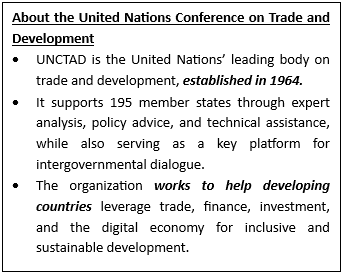
Developing Countries Could Save $500 Billion Annually Through Affordable Borrowing: UNCTAD Report
Context: Recently, a new report by the United Nations Conference on Trade and Development highlighted that developing countries face inadequate, volatile, and expensive external financing, which is constraining progress towards the Sustainable Development Goals (SDGs).
Key Findings of the Report
• Potential Savings: Developing countries could save nearly $500 billion annually if they borrowed at the same average interest rates as developed economies.
• Shrinking External Finance: Between 2014 and 2024, external financial inflows to developing countries declined by 18%, while domestic financing increased by 60%.
• Rising Debt Burden: Government interest payments in developing countries increased by 102% during 2014–2024, whereas government revenues grew by only 39%.
• Higher Borrowing Costs: Developing countries paid significantly higher financing costs, with portfolio investment liabilities costing an average 5.2% annually, more than double the 2.5% paid by developed economies.
• Regional Disparities: Despite accounting for 22% of the developing world’s population, Africa received only 10% of total external financial inflows, while Asia-Pacific attracted more than 70%.
• SDG Financing Gap: Developing countries face an annual SDG financing gap of $4.3 trillion, requiring both domestic and external financing to increase by about one-third to meet development goals.
International Tribunal for the Law of the Sea (ITLOS)
Context: Recently, India’s candidate, Bimal N. Patel, was elected as a Judge of the International Tribunal for the Law of the Sea for the 2026–2035 term, ensuring India’s continued representation in the Hamburg-based maritime court.
More on the News
• He secured 115 votes out of 168 valid votes cast and will assume office on 1 October 2026, succeeding Neeru Chadha, whose nine-year term ends in September 2026.
• Patel is currently a Member of the International Law Commission, Vice-Chancellor of Rashtriya Raksha University, and a member of India’s National Security Advisory Board.
About the International Tribunal for the Law of the Sea (ITLOS)
• Establishment: Created under the 1982 United Nations Convention on the Law of the Sea (UNCLOS).
• Headquarters: Hamburg.
• Nature: An independent international judicial body for the peaceful settlement of maritime disputes.
• Composition: Consists of 21 independent judges elected by States Parties to UNCLOS through secret ballot, ensuring equitable geographical representation.
• Tenure of Judges: 9 years, with one-third of the members elected every three years.
• Jurisdiction: Deals with disputes concerning the interpretation and application of UNCLOS and other agreements that confer jurisdiction on the Tribunal.
• Key Areas of Disputes Handled by ITLOS
India Elected as Vice-President of Financial Action Task Force (FATF) for the First Time
Context: India has achieved a significant milestone in global financial governance with the election of Shri Vivek Aggarwal as Vice-President of the Financial Action Task Force (FATF), marking the first time India will hold this position.
More on the News
• Shri Vivek Aggarwal, a 1994-batch IAS officer of the Madhya Pradesh cadre and currently Secretary, Ministry of Culture, has been elected FATF Vice-President by the FATF Plenary.
• He will serve from July 2026 to June 2027 and assist the FATF President in steering the organisation’s work on combating money laundering, terrorist financing, and proliferation financing.
• India’s elevation reflects the credibility gained through its strong Mutual Evaluation performance, leadership in digital payments, and contributions to global discussions on virtual asset service providers and emerging financial risks.
About the Financial Action Task Force (FATF)
• FATF is an intergovernmental body established in 1989 by the G7 nations in Paris.
• It sets global standards and promotes effective implementation of measures to combat money laundering, terrorist financing and the financing of the proliferation of weapons of mass destruction.
• FATF sets global standards and promotes effective implementation of legal, regulatory and operational measures through its 40 Recommendations.
• It currently has 40 members and, through FATF-Style Regional Bodies (FSRBs), its standards are applied across more than 200 jurisdictions.
• Countries are assessed through a rigorous Mutual Evaluation process that examines both technical compliance and effectiveness.
• FATF maintains the Grey List (Jurisdictions under Increased Monitoring) and the Black List (High-Risk Jurisdictions Subject to a Call for Action).
• India became a full member of FATF in 2010.

News in Short
Pradhan Mantri Viksit Bharat Rozgar Yojana
International Day of Yoga (IDY) 2026
The most trusted learning platform on your phone
With our training programs, learning online can be a very exciting experience! Take the next step toward achieving your professional and personal objectives



Course Related Query:
Ask Your DoubtsStore Related Query:[email protected]NEET | JEE | CUET
NCERT Books
Resources
We love learning. Through our innovative solutions, we encourage ourselves, our teams, and our Students to grow. We welcome and look for diverse perspectives and opinions because they enhance our decisions. We strive to understand the big picture and how we contribute to the company’s objectives. We approach challenges with optimism and harness the power of teamwork to accomplish our goals. These aren’t just pretty words to post on the office wall. This is who we are. It’s how we work. And it’s how we approach every interaction with each other and our Students.
Come with an open mind, hungry to learn, and you’ll experience unmatched personal and professional growth, a world of different backgrounds and perspectives, and the freedom to be you—every day. We strive to build and sustain diverse teams and foster a culture of belonging. Creating an inclusive environment where every students feels welcome, appreciated, and heard gives us something to feel (really) good about.
Get Free academic Counseling & Course Details