Explore All Exams at KGS


All Exams
Explore All Exams at KGS

Khan Sir Courses
Geography I Polity I History | World Map I Indian Map I Economics I Biology

UPSC & State PSC
UPSC I BPSC I UP-PSC I MP-PSC

Judiciary
CLAT

State Exams
UP I Bihar I MP | Rajasthan

NEET | JEE | CUET
NEET | JEE | CUET

Defence Exams
NDA I CDS I CAPF I AFCAT I SSB I Agniveer

Police Exams
UP SI | Bihar SI | Delhi Police | UP Constable

SSC Exams
CGL I CPO I CHSL I MTS I SSC GD I Delhi Police

Foundation Courses
Physics I Chemistry I Biology I History I Geography I Polity I NCERT I Math I English | Map I Reasoning

Railway Exams
RRB | RPF

Teaching Exams
TET | Teaching | UGC

Banking Exams
SBI | RBI | IBPS

Engineering Exams
Civil | Electrical | Mechanical
UGC NET
UGC NET/JRF
Current Affairs provides you with the best compilation of the Daily Current Affairs taking place across the globe: National, International, Sports, Science and Technology, Banking, Economy, Agreement, Appointments, Ranks, and Report and General Studies
Current Affairs
SYLLABUS
GS-3: Science and Technology- developments and their applications and effects in everyday life; Awareness in the fields of IT, Space, Computers, robotics.
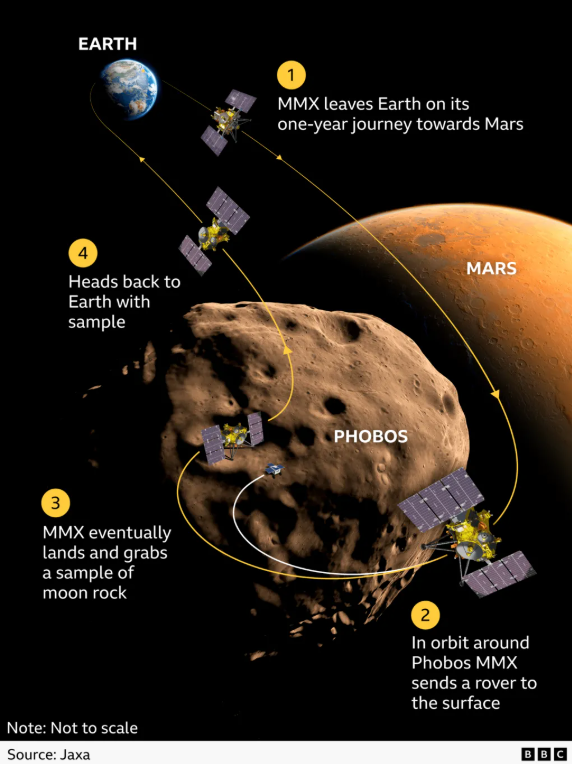
Context: Japan Aerospace Exploration Agency (JAXA) recently launched the Martian Moons Exploration (MMX) spacecraft to investigate Mars’s moons and return a sample from Phobos to Earth.
About the MMX Mission
• Objectives: Investigate the origin of Mars’s moons Phobos and Deimos and understand the evolution of the Martian system and the early Solar System.
• Mission timeline: The spacecraft is expected to reach Mars in 2027, study Phobos and Deimos, collect samples from Phobos, and return them to Earth in 2031.
• Spacecraft and instruments: It comprises three main modules—propulsion, exploration and sample return—and carries 13 mission instruments, including cameras, spectrometers, sampling equipment and the IDEFIX rover.
• Sample collection: MMX aims to return at least 10 grams of material from Phobos. It will enter a quasi-satellite orbit around Phobos to map its surface and select a landing site. The IDEFIX rover will be deployed first, followed by the main spacecraft’s sampling operation.
• International collaboration: Led by JAXA, the mission involves NASA, the European Space Agency (ESA), France’s CNES and Germany’s DLR.
Understanding Mars’s Moons: Phobos and Deimos
• Uncertain origin: Mars has two moons, Phobos and Deimos. The leading hypotheses suggest that the moons are either asteroids captured by Mars’s gravity or formed from debris following a giant impact on Mars.
• Phobos: The larger and closer of Mars’s two natural satellites, orbiting the planet in approximately 7 hours and 39 minutes. It is the primary target for sample collection.
• Deimos: The smaller and more distant moon, which MMX will study through remote observations and a flyby; samples will not be collected from it.
Scientific Significance
• Origin of the moons: Analysis of returned samples could help distinguish between the asteroid-capture and giant-impact hypotheses.
• Clues about Mars: Phobos may contain material ejected from Mars by ancient impacts, potentially offering indirect evidence about the planet’s geological history.
• Planetary evolution: Samples and observations may provide insights into the movement of water-bearing and organic materials through the early Solar System and the evolution of the Martian system.
• Future exploration: MMX will advance technologies for deep-space communication, autonomous navigation, landing and sample collection in extremely weak gravity. It will also help assess whether Phobos could serve as a potential staging point for future crewed missions to Mars.
Khan Global Studies App
With our training programs, learning online can be a very exciting experience. Take the next step toward achieving your professional and personal objectives.



Course Related Query:
Ask Your DoubtsStore Related Query:[email protected]NEET | JEE | CUET
NCERT Books
Resources
We love learning. Through our innovative solutions, we encourage ourselves, our teams, and our Students to grow. We welcome and look for diverse perspectives and opinions because they enhance our decisions. We strive to understand the big picture and how we contribute to the company’s objectives. We approach challenges with optimism and harness the power of teamwork to accomplish our goals. These aren’t just pretty words to post on the office wall. This is who we are. It’s how we work. And it’s how we approach every interaction with each other and our Students.
Come with an open mind, hungry to learn, and you’ll experience unmatched personal and professional growth, a world of different backgrounds and perspectives, and the freedom to be you—every day. We strive to build and sustain diverse teams and foster a culture of belonging. Creating an inclusive environment where every students feels welcome, appreciated, and heard gives us something to feel (really) good about.