Explore All Exams at KGS


All Exams
Explore All Exams at KGS

Khan Sir Courses
Geography I Polity I History | World Map I Indian Map I Economics I Biology

UPSC & State PSC
UPSC I BPSC I UP-PSC I MP-PSC

State Exams
UP I Bihar I MP | Rajasthan

NEET | JEE | CUET
NEET | JEE | CUET

Defence Exams
NDA I CDS I CAPF I AFCAT I SSB I Agniveer

Police Exams
UP SI | Bihar SI | Delhi Police | UP Constable

SSC Exams
CGL I CPO I CHSL I MTS I SSC GD I Delhi Police

Foundation Courses
Physics I Chemistry I Biology I History I Geography I Polity I NCERT I Math I English | Map I Reasoning

Railway Exams
RRB | RPF

Teaching Exams
TET | Teaching | UGC

Banking Exams
SBI | RBI | IBPS

Engineering Exams
Civil | Electrical | Mechanical
UGC NET
UGC NET/JRF
Current Affairs provides you with the best compilation of the Daily Current Affairs taking place across the globe: National, International, Sports, Science and Technology, Banking, Economy, Agreement, Appointments, Ranks, and Report and General Studies
Current Affairs
SYLLABUS
GS-2: Welfare Schemes for Vulnerable Sections of the population by the Centre and States and the Performance of these Schemes.
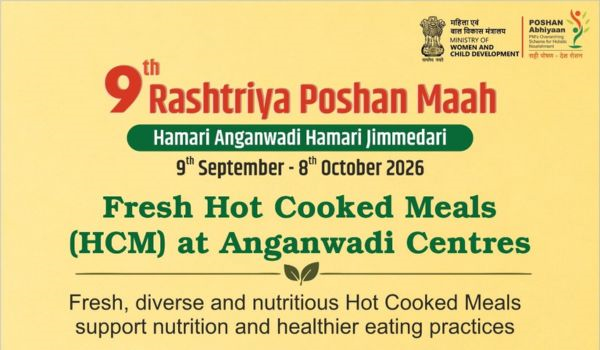
Context: The 9th Rashtriya Poshan Maah (National Nutrition Month) 2026 will be launched on 9 September 2026 at the Rudraksh International Cooperation and Convention Centre, Varanasi, Uttar Pradesh.
More on the News:
• Theme: “Hamari Anganwadi, Hamari Jimmedari”: Places Anganwadi Centres at the centre of community-led action for nutrition, care and early childhood development.
• Revised SNP Guidelines: Campaign draws momentum from the revised Supplementary Nutrition Programme (SNP) Guidelines under Mission Saksham Anganwadi and Poshan 2.0.
• Key New Provisions: For the first time, the revised guidelines define Hot Cooked Meals, mandate SNP Menu Boards, and provide guidelines for establishing Anganwadi Management Committees.
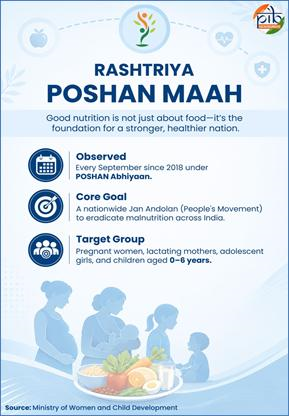
• Rashtriya Poshan Maah: Observed every September, it has evolved into a Jan Andolan, mobilising communities to strengthen nutrition, health and caregiving behaviours among women, children and adolescents.
From POSHAN Abhiyaan to Mission Poshan 2.0
• POSHAN Abhiyaan: Launched in March 2018, POSHAN Abhiyaan adopted a convergence-based approach to address malnutrition. It combined technology-driven monitoring with community mobilisation and behavioural change.
• Mission Poshan 2.0: In the Union Budget 2021–22, major nutrition interventions were consolidated under Mission Poshan 2.0, anchored by the Ministry of Women and Child Development.
• Poshan 2.0 consolidates three core schemes into one framework:
About 9th Rashtriya Poshan Maah
• It seeks to place Anganwadi Centres at the heart of community-led action for nutrition, care and early childhood development, while strengthening collective ownership and accountability for Poshan.
• Its five priorities (Themes) are closely interconnected and reflect a shift towards a more holistic understanding of nutrition.
The revised Home Visit Scheduler, with 34 developmental milestones for children aged 0–3 years, helps Anganwadi Workers strengthen caregiver counselling and promote early stimulation.
Poshan Maah 2026 provides an opportunity to expand coverage, strengthen awareness and celebrate a decade of progress in maternal and child health.
About Poshan Pakhwada (April 2026)
• Observed annually since 2018: A two-week intensive outreach campaign conducted in April to strengthen community mobilisation and reinforce key nutrition behaviours under POSHAN Abhiyaan.
• 8th Poshan Pakhwada: Held from 9th to 23rd April 2026.
• Central Theme: “Maximizing Brain Development in the First Six Years of Life.”
• Focus: More than 85% of brain development occurs by the age of six years, with the most rapid growth during the first 1,000 days, making this period crucial for brain growth, physical development and holistic well-being.
• Key Objective: To deepen the Jan Andolan by strengthening awareness among families and communities about practices supporting healthy growth and brain development.
• Approach: Shift the narrative from “nutrition for health” to “nutrition and early childhood stimulation for optimal brain development.”
The Poshan Tracker: A Digital Platform for Nutrition Governance
• Launched on 1 March 2021, Poshan Tracker enables near real-time monitoring of Anganwadi infrastructure and service delivery, including attendance, ECCE activities and growth monitoring.
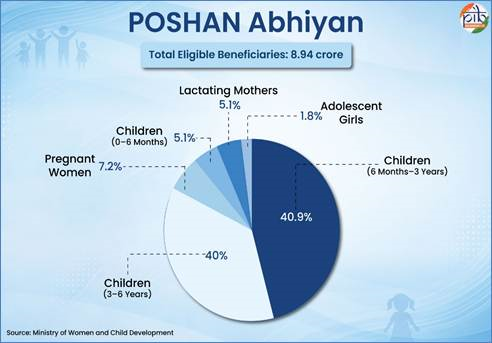
• As of 31 July 2026: Nearly 13.99 lakh Anganwadi Centres, 13.30 lakh Anganwadi Workers and almost 8.94 crore beneficiaries.
Significance
• Human Capital: Improves physical growth, cognitive development, learning and productivity.
• First 1,000 Days: Emphasises maternal nutrition, infant feeding, complementary feeding and responsive caregiving.
• Grassroots Institutions: Strengthens Anganwadi Centres as platforms for nutrition and early childhood services.
• Community Accountability: Engages AMCs, Panchayats, SHGs and families in monitoring service delivery.
• Digital Governance: Poshan Tracker supports service monitoring and evidence-based decision-making.
• Convergence: Addresses malnutrition as a multidimensional challenge requiring coordinated action across sectors.
Key Challenges
• Multiple Malnutrition Burdens: Undernutrition, micronutrient deficiencies, overweight and obesity remain concerns.
• Service Quality: Effective Anganwadi services require quality and regularity, beyond infrastructure.
• Behavioural Barriers: Food, breastfeeding, complementary feeding and childcare practices are shaped by social norms, income, availability and awareness.
• Data-to-Action Gap: Poshan Tracker data needs to translate into timely, targeted interventions.
• Convergence Gap: Sustainable nutrition outcomes require sustained cross-sectoral coordination.
Way Forward
• Outcome-Oriented Governance: Shift from coverage-oriented welfare delivery to outcome-oriented nutrition governance.
• Strengthen AWCs: Develop AWCs as centres for nutrition, ECCE, developmental monitoring and caregiver counselling.
• Prioritise First 1,000 Days: Focus on maternal-child nutrition, dietary diversity and affordable local nutritious foods.
• Targeted Technology: Use digital data to identify vulnerable beneficiaries and enable timely interventions.
• Community Participation: Empower AMCs, Panchayats, SHGs and parents in service monitoring.
• Outcome Measurement: Assess progress through child growth, dietary diversity, maternal nutrition, developmental outcomes and reduced malnutrition, rather than activity numbers alone.
Khan Global Studies App
With our training programs, learning online can be a very exciting experience. Take the next step toward achieving your professional and personal objectives.


Course Related Query:
Ask Your DoubtsStore Related Query:[email protected]NEET | JEE | CUET
NCERT Books
Resources
We love learning. Through our innovative solutions, we encourage ourselves, our teams, and our Students to grow. We welcome and look for diverse perspectives and opinions because they enhance our decisions. We strive to understand the big picture and how we contribute to the company’s objectives. We approach challenges with optimism and harness the power of teamwork to accomplish our goals. These aren’t just pretty words to post on the office wall. This is who we are. It’s how we work. And it’s how we approach every interaction with each other and our Students.
Come with an open mind, hungry to learn, and you’ll experience unmatched personal and professional growth, a world of different backgrounds and perspectives, and the freedom to be you—every day. We strive to build and sustain diverse teams and foster a culture of belonging. Creating an inclusive environment where every students feels welcome, appreciated, and heard gives us something to feel (really) good about.