Explore All Exams at KGS


All Exams
Explore All Exams at KGS

Khan Sir Courses
Geography I Polity I History | World Map I Indian Map I Economics I Biology

UPSC & State PSC
UPSC I BPSC I UP-PSC I MP-PSC

State Exams
UP I Bihar I MP | Rajasthan

NEET | JEE | CUET
NEET | JEE | CUET

Defence Exams
NDA I CDS I CAPF I AFCAT I SSB I Agniveer

Police Exams
UP SI | Bihar SI | Delhi Police | UP Constable

SSC Exams
CGL I CPO I CHSL I MTS I SSC GD I Delhi Police

Foundation Courses
Physics I Chemistry I Biology I History I Geography I Polity I NCERT I Math I English | Map I Reasoning

Railway Exams
RRB | RPF

Teaching Exams
TET | Teaching | UGC

Banking Exams
SBI | RBI | IBPS

Engineering Exams
Civil | Electrical | Mechanical
UGC NET
UGC NET/JRF
Current Affairs provides you with the best compilation of the Daily Current Affairs taking place across the globe: National, International, Sports, Science and Technology, Banking, Economy, Agreement, Appointments, Ranks, and Report and General Studies
Current Affairs
SYLLABUS
GS-2: Bilateral, regional and global groupings and agreements involving India and/or affecting India’s interests.
Context: India hosted the 18th BRICS Summit in New Delhi on 12–13 September 2026, culminating in the adoption of the New Delhi Declaration.
More on the News
• Theme: “Building for Resilience, Innovation, Cooperation and Sustainability.”
• Consensus amid divergences: The summit adopted a joint declaration despite the BRICS Foreign Ministers’ meeting in May 2026 failing to issue a joint statement, highlighting India’s consensus-building role amid differences, particularly over the Iran–UAE conflict.
• Next Chair: China will assume the BRICS Chairship in 2027 and host the 19th BRICS Summit.
New Delhi Declaration: Key Outcomes
• The New Delhi Declaration covers political, security, economic, technological, environmental and developmental issues. Key outcomes include:
|
Area |
Key
Outcomes |
|
Global Governance |
Called for reform of the UN and UN Security Council (UNSC) and
greater representation of Emerging Markets and Developing Countries (EMDCs). China
and Russia reiterated support for the aspirations of Brazil and India to play
a greater role in the UN, including the UNSC. |
|
Trade & WTO |
Opposed unilateral tariff and non-tariff measures inconsistent with
WTO rules; stressed resilient supply chains and called for restoration of a fully
functioning two-tier WTO dispute-settlement mechanism. |
|
Finance & Payments |
Supported greater use of BRICS local currencies,
interoperability of cross-border payment and messaging systems, and continued
work through the BRICS Payment Task Force. No common BRICS currency
was proposed. |
|
Terrorism |
Strongly condemned terrorism in all its forms and specifically
condemned the 22 April 2025 Pahalgam terrorist attack, while stressing
action against terrorist financing, cross-border terrorism and safe havens. |
|
West Asia & Palestine |
Called for maximum restraint, protection of civilians and
civilian infrastructure, humanitarian access and peaceful resolution of
conflicts; reaffirmed support for Palestinian statehood, full UN membership
and the two-state solution. |
|
Russia–Ukraine Conflict |
Reiterated that international disputes should be addressed through dialogue,
consultation and diplomacy, without adopting a strongly partisan
formulation. |
|
AI & Emerging Technologies |
Emphasised safe, secure, inclusive and trustworthy AI,
equitable access to AI capabilities and greater participation of developing
countries in global AI governance. |
|
Climate, Energy & Critical Minerals |
Reaffirmed the Paris Agreement and CBDR-RC; opposed
discriminatory carbon-border measures and called for resilient, diversified
and sustainable critical-mineral supply chains. |
|
Space & Science |
Welcomed progress on the BRICS Remote Sensing Satellite
Constellation and work towards a BRICS Space Council, alongside
cooperation in science, research and emerging technologies. |
India’s BRICS Chairship: Key Initiatives
• Digital Public Infrastructure: Proposed a BRICS Digital Public Infrastructure (DPI) Repository and pilot projects to facilitate knowledge-sharing and adoption of DPI solutions among members.
• Health & Human Development: Advanced the BRICS Integrated Early Warning System for mass infectious diseases and the BRICS Mission for Healthy Lifestyle (2026–2029). A BRICS Network of Centres of Excellence on Mental Wellness was also supported, with NIMHANS as the coordinating centre.
• Industry, MSMEs & Skilling: Established the India Centre for BRICS Industrial Competencies (ICBIC) for Industry 4.0 and advanced digital-production technologies, alongside initiatives on MSME cooperation and skilling.
• Finance & Development: Advanced the proposed BRICS Risk Lab at GIFT City, the BRICS Task Force on Growth and Development and the BRICS–NDB Knowledge Portal.
• Development-oriented agenda: India pursued more than 50 tangible outcomes, including frameworks, action plans, guidelines, principles, forums and networks across the four priority areas of resilience, innovation, cooperation and sustainability.
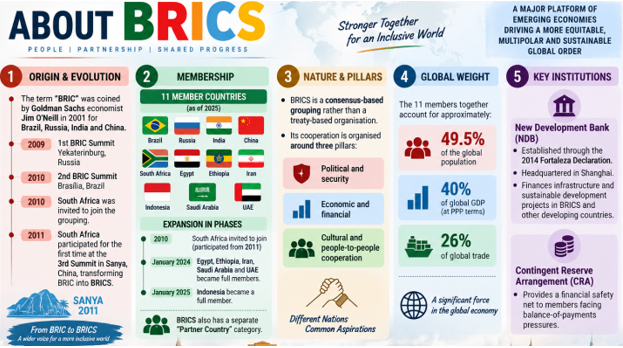
Significance for India and the Global South
• Strategic Autonomy: BRICS enables India to engage major powers and emerging economies simultaneously, expanding its diplomatic space amid growing geopolitical fragmentation.
• Global South Leadership: The expanded grouping strengthens India’s platform to articulate developing-country concerns on finance, trade, technology, climate and development and share India's development experience.
• Reformed Multilateralism: BRICS reinforces India’s demand for greater representation of developing countries in global institutions, including the UN, IMF, World Bank and WTO.
• Economic & Technological Resilience: Cooperation in local-currency payments, resilient supply chains, critical minerals, DPI, AI, health and advanced industries can strengthen South-South economic and technological cooperation.
• Development-oriented Cooperation: India’s Chairship sought to reposition BRICS as a complementary, development-oriented platform focused on practical and scalable solutions for the Global South rather than merely a geopolitical grouping.
Khan Global Studies App
With our training programs, learning online can be a very exciting experience. Take the next step toward achieving your professional and personal objectives.


Course Related Query:
Ask Your DoubtsStore Related Query:[email protected]NEET | JEE | CUET
NCERT Books
Resources
We love learning. Through our innovative solutions, we encourage ourselves, our teams, and our Students to grow. We welcome and look for diverse perspectives and opinions because they enhance our decisions. We strive to understand the big picture and how we contribute to the company’s objectives. We approach challenges with optimism and harness the power of teamwork to accomplish our goals. These aren’t just pretty words to post on the office wall. This is who we are. It’s how we work. And it’s how we approach every interaction with each other and our Students.
Come with an open mind, hungry to learn, and you’ll experience unmatched personal and professional growth, a world of different backgrounds and perspectives, and the freedom to be you—every day. We strive to build and sustain diverse teams and foster a culture of belonging. Creating an inclusive environment where every students feels welcome, appreciated, and heard gives us something to feel (really) good about.