You're all caught up—no notifications available.
Explore All Exams at KGS


All Exams
Explore All Exams at KGS

Khan Sir Courses
Geography I Polity I History | World Map I Indian Map I Economics I Biology

UPSC & State PSC
UPSC I BPSC I UP-PSC I MP-PSC

State Exams
UP I Bihar I MP | Rajasthan

NEET | JEE | CUET
NEET | JEE | CUET

Defence Exams
NDA I CDS I CAPF I AFCAT I SSB I Agniveer

Police Exams
UP SI | Bihar SI | Delhi Police | UP Constable

SSC Exams
CGL I CPO I CHSL I MTS I SSC GD I Delhi Police

Foundation Courses
Physics I Chemistry I Biology I History I Geography I Polity I NCERT I Math I English | Map I Reasoning

Railway Exams
RRB | RPF

Teaching Exams
TET | Teaching | UGC

Banking Exams
SBI | RBI | IBPS

Engineering Exams
Civil | Electrical | Mechanical
UGC NET
UGC NET/JRF
Current Affairs provides you with the best compilation of the Daily Current Affairs taking place across the globe: National, International, Sports, Science and Technology, Banking, Economy, Agreement, Appointments, Ranks, and Report and General Studies

SYLLABUS
GS 2: Indian Constitution—Historical Underpinnings, Evolution, Features, Amendments, Significant Provisions and Basic Structure.
Context: The Constitution (One Hundred and Thirty-First Amendment) Bill, 2026, was introduced in the Lok Sabha on April 16, 2026, and aims to amend the Constitution with regard to delimitation.
More on the News
• Along with the Constitution (131st Amendment) Bill, 2026, the Delimitation Bill, 2026, and the Union Territories Laws (Amendment) Bill, 2026 were also introduced in the Lok Sabha.
• These Bills increase the size of Lok Sabha, seek to enable delimitation based on the 2011 census, and enable reservation for women to be based on this delimitation.
• The Union Territories (UTs) Laws Bill gives effect to similar provisions in cases of Puducherry, Delhi, and Jammu & Kashmir.
About the Constitution (131st Amendment) Bill, 2026
• A Much Larger Lok Sabha: The present strength of the Lok Sabha, as laid out in Article 81, is capped at 550 (530 seats from states and 20 from Union Territories).
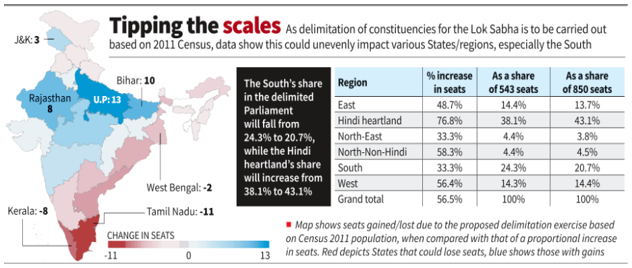
• Redefining “Population”: Article 81 defines “population” as per the latest published Census, but until the first Census after 2026, it uses the 1971 Census for seat allocation and the 2001 Census for constituency delimitation.
• Delinking Delimitation from the Census: One of the more significant changes is to Article 82, which currently requires that parliamentary constituencies be readjusted after each census. The Bill makes three changes.
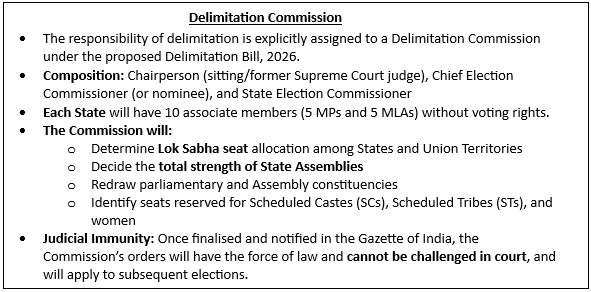
• Delimitation Commission Given Constitutional Status: The Bill amends Articles 82 and 170 to name the Delimitation Commission as the constitutionally mandated body for delimitation, replacing the existing formulation, which leaves the designation of the authority to Parliament by law.
• Women’s Reservation: The Bill substitutes the entire Article 334A, as introduced by the 106th Amendment and the Nari Shakti Vandan Adhiniyam, 2023, marking a major shift in the implementation of women’s reservation.
• Safeguards for Tribal Representation: Amendments to Article 332 ensure that the Scheduled Tribe representation is not diluted, particularly in Arunachal Pradesh, Meghalaya, Mizoram, Tripura, and Nagaland.
Challenges
• Federal Structure Concerns: Since the Bill’s circulation, public debate over its timing and intent has been swift and sharp, with Opposition leaders calling it a threat to India’s federal structure.
• Gerrymandering Concerns: A similar pushback was mounted during delimitation in Jammu and Kashmir (2022), which saw allegations of gerrymandering. With the new Bill, these concerns are magnified, as a nationwide exercise based on incomplete and uneven census data (with the 2021 Census still pending) carries risks at a much larger scale.
• Redistribution of Political Power: While the stated objective is to implement women’s reservation before the 2029 general elections, the underlying consequence may be a fundamental redistribution of political power across states.
Significance
• More representative Lok Sabha: Raising Lok Sabha strength to 850 improves the population–representation ratio, bringing the system closer to the “one person, one vote” principle.
• Faster women’s reservation: Removing earlier delays enables 33% women’s reservation to be implemented in the next general election, instead of waiting until the 2030s.
• Updated seat allocation: Redrawing constituencies on current data corrects the outdated 1971-based seat distribution and reflects present-day demographic shifts.

The most trusted learning platform on your phone
With our training programs, learning online can be a very exciting experience! Take the next step toward achieving your professional and personal objectives



Course Related Query:
Ask Your DoubtsStore Related Query:[email protected]NCERT Books
Resources
We love learning. Through our innovative solutions, we encourage ourselves, our teams, and our Students to grow. We welcome and look for diverse perspectives and opinions because they enhance our decisions. We strive to understand the big picture and how we contribute to the company’s objectives. We approach challenges with optimism and harness the power of teamwork to accomplish our goals. These aren’t just pretty words to post on the office wall. This is who we are. It’s how we work. And it’s how we approach every interaction with each other and our Students.
Come with an open mind, hungry to learn, and you’ll experience unmatched personal and professional growth, a world of different backgrounds and perspectives, and the freedom to be you—every day. We strive to build and sustain diverse teams and foster a culture of belonging. Creating an inclusive environment where every students feels welcome, appreciated, and heard gives us something to feel (really) good about.
Get Free academic Counseling & Course Details