You're all caught up—no notifications available.
Explore All Exams at KGS


All Exams
Explore All Exams at KGS

Khan Sir Courses
Geography I Polity I History | World Map I Indian Map I Economics I Biology

UPSC & State PSC
UPSC I BPSC I UP-PSC I MP-PSC

State Exams
UP I Bihar I MP | Rajasthan

NEET | JEE | CUET | Boards
NEET | JEE | CUET | Boards

Defence Exams
NDA I CDS I CAPF I AFCAT I SSB I Agniveer

Police Exams
UP SI | Bihar SI | Delhi Police | UP Constable

SSC Exams
CGL I CPO I CHSL I MTS I SSC GD I Delhi Police

Foundation Courses
Physics I Chemistry I Biology I History I Geography I Polity I NCERT I Math I English | Map I Reasoning

Railway Exams
RRB | RPF

Teaching Exams
TET | Teaching | UGC

Banking Exams
SBI | RBI | IBPS

Engineering Exams
Civil | Electrical | Mechanical
UGC NET
UGC NET/JRF
Current Affairs provides you with the best compilation of the Daily Current Affairs taking place across the globe: National, International, Sports, Science and Technology, Banking, Economy, Agreement, Appointments, Ranks, and Report and General Studies

SYLLABUS
GS-3: Conservation, environmental pollution and degradation, environmental impact assessment
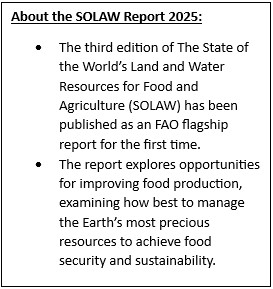
Context: The third edition, with the theme, The potential to produce more and better, focuses on the hidden and untapped potential of land, soil and water resources to enhance sustainable agricultural production.
Key Findings of the Report
• Current Challenges in Natural Resource Management:
o In order to meet the demands of a growing global population, Agriculture must produce 50% more food, feed and fibre by 2050 as compared to 2012.
o Over 1.6 billion hectares or 10% of global land area is degraded, mostly agricultural land.
o Over 60% of land degradation affects agricultural lands, including croplands and pastures, putting immense pressure on global food systems.
o Urban areas have more than doubled between 1992 and 2015, expanding from 33 million hectares to 71 million hectares.
o This urban growth has consumed 24 million hectares of highly fertile cropland, along with significant forestland and shrubland areas, reducing available productive land.
o Conflicts and social instability impacted 40% of agricultural land in 2023.
o With 95% of food produced on land, the combined threats of land degradation, water scarcity and extreme weather pose significant challenges to agrifood systems, livelihoods and biodiversity.
• Climate change Impact on agriculture:
o Climate change intensifies risks to agrifood systems through rising temperatures, altered precipitation, droughts, and floods.
o Extreme weather causes annual losses of about USD 123 billion which is 5% of global agriculture GDP affecting food production severely.
• Environmental Impacts of Agriculture:
o Agriculture uses one-third of Earth’s land and 72% of freshwater resources, leading to overexploitation.
o Intensive farming has caused soil depletion, pollution, and loss of biodiversity.
o 64% of agricultural land faces pesticide pollution, impairing resilience to pests and climate impacts.
o Land degradation affects productivity and water availability, creating a vicious cycle.
• Agricultural Production Trends:
o From 1964 to 2023, agricultural output rose mainly through intensification, not land expansion.
o Irrigated croplands are 3.2 times more productive than rainfed lands.
o Global fertilizer use has increased over four-fold since 1964.
o Central and Northern America and Southern Europe recorded a net reduction in arable land between 2001 and 2023.
• Water Scarcity & Land Degradation:
o Unsustainable farming and management practices have led to the degradation of 996 Mha of agricultural lands which is equivalent 60% of human-induced land degradation.
o 1.2 billion people or about one-sixth of the global population live in agricultural areas with severe water constraints.
• Constraints on Further Expansion
o Cropland may increase from 1.6 to 1.9 billion hectares by 2050, still far less than available prime land.
o Further cropland expansion threatens ecosystems like forests and wetlands, critical for biodiversity and climate.
o Africa and South America have more expansion scope than Asia, which is near its limits.
• Intensification and Yield Gap:
o Closing the yield gap—the difference between current and potential yields—is key to increasing production sustainably.
o For example, Sub-Saharan Africa produces only 24% of potential yield on rainfed crops.
o Sustainable intensification involves adopting adapted crop varieties, improved nutrient and water management, and agroecological practices.
Way Ahead According to the Report
• Adopt Holistic Management of Natural Resources: Managing land, soil, water, forests, and fisheries in an integrated manner is crucial to achieving sustainable agricultural productivity and environmental balance.
• Promote Sustainable Agricultural Practices: Techniques such as agroforestry, conservation tillage, addition of organic matter, combined crop-livestock systems, rice-fish farming, and integrated aquaculture enhance ecosystem health and productivity.
• Modernize Water and Grazing Systems: Implement fish-friendly irrigation systems, multifunctional farm ponds, precision grazing methods, and cultivate drought-tolerant forage species to optimize water use and improve pasture management.
• Encourage Urban and Peri-Urban Farming Innovations: Utilize technologies like hydroponics, vertical farming, and rooftop agriculture to boost food production in urban areas sustainably.
• Leverage Technology: Use climate forecasting, early warning tools, remote sensing, and information technologies to monitor natural resources and guide sustainable farming decisions effectively.
• Integrated land-use planning (ILUP): It is essential to balance food production, ecosystem conservation, and competing demands.
Sources:
DowntoEarth
Open Knowledge
FAO

The most trusted learning platform on your phone
With our training programs, learning online can be a very exciting experience! Take the next step toward achieving your professional and personal objectives


NCERT Books
Resources
We love learning. Through our innovative solutions, we encourage ourselves, our teams, and our Students to grow. We welcome and look for diverse perspectives and opinions because they enhance our decisions. We strive to understand the big picture and how we contribute to the company’s objectives. We approach challenges with optimism and harness the power of teamwork to accomplish our goals. These aren’t just pretty words to post on the office wall. This is who we are. It’s how we work. And it’s how we approach every interaction with each other and our Students.
Come with an open mind, hungry to learn, and you’ll experience unmatched personal and professional growth, a world of different backgrounds and perspectives, and the freedom to be you—every day. We strive to build and sustain diverse teams and foster a culture of belonging. Creating an inclusive environment where every students feels welcome, appreciated, and heard gives us something to feel (really) good about.
Get Free academic Counseling & Course Details