You're all caught up—no notifications available.
Explore All Exams at KGS


All Exams
Explore All Exams at KGS

Khan Sir Courses
Geography I Polity I History | World Map I Indian Map I Economics I Biology

UPSC & State PSC
UPSC I BPSC I UP-PSC I MP-PSC

State Exams
UP I Bihar I MP | Rajasthan

NEET | JEE | CUET
NEET | JEE | CUET

Defence Exams
NDA I CDS I CAPF I AFCAT I SSB I Agniveer

Police Exams
UP SI | Bihar SI | Delhi Police | UP Constable

SSC Exams
CGL I CPO I CHSL I MTS I SSC GD I Delhi Police

Foundation Courses
Physics I Chemistry I Biology I History I Geography I Polity I NCERT I Math I English | Map I Reasoning

Railway Exams
RRB | RPF

Teaching Exams
TET | Teaching | UGC

Banking Exams
SBI | RBI | IBPS

Engineering Exams
Civil | Electrical | Mechanical
UGC NET
UGC NET/JRF
Current Affairs provides you with the best compilation of the Daily Current Affairs taking place across the globe: National, International, Sports, Science and Technology, Banking, Economy, Agreement, Appointments, Ranks, and Report and General Studies

SYLLABUS
GS-1: Population and associated issues, poverty and developmental issues, urbanization, their problems and their remedies.
GS-2: Government Policies and Interventions for Development in various sectors and Issues arising out of their Design and Implementation.
Context: The Government of India has commenced the first phase of Census 2027, the world’s largest population census exercise, with a first-ever digital approach.
More on the News
• The first phase of Census 2027 began on April 1, 2026, with the Houselisting and Housing Census (HLO).
• The exercise starts with a self-enumeration window of 15 days, followed by door-to-door houselisting operations by enumerators.
• Self-enumeration has been rolled out in select States and Union Territories, including Andaman and Nicobar Islands, Goa, Karnataka, Lakshadweep, Mizoram, Odisha, Sikkim, and areas under NDMC and Delhi Cantonment Board.
• President Droupadi Murmu became the first citizen to complete self-enumeration, continuing the tradition of initiating the Census with the Head of State.
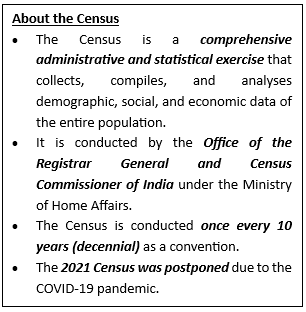
About the Census of India 2027
• Census 2027 will be the 16th Census of India and the 8th after Independence.
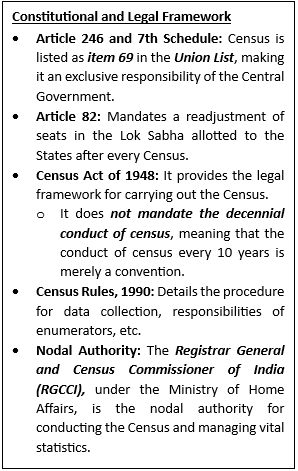
• Conducted under the Census Act, 1948, and Census Rules, 1990
• The Census will be conducted in two phases:
• Digital and Technological Innovations: Census 2027 will be India’s first fully digital census, with the following initiatives:
• Inclusion of Caste Enumeration: As decided by the Cabinet Committee on Political Affairs (April 2025), caste enumeration will be included.
• Implementation Strategy: Door-to-door household visits with separate questionnaires for HLHC and PE.
• Unlike 2019, the government statement does not mention a separate budgetary allocation for updating the National Population Register (NPR).
Historical Overview of Census in India
Pre-Independence:
• For the first time, a census was conducted in the towns of Allahabad (1824) and Banaras (1827-28) by James Prinsep.
• The first complete census of an Indian city was conducted in 1830 in Dacca by Henry Walter.
• The first nationwide census was undertaken in 1872 under Lord Mayo.
• The first modern synchronous census covering all of British India (except Kashmir) was undertaken in 1881 by W.C. Plowden, initiating the decennial census followed to the present day.
• The 1931 census was the last to record comprehensive caste data. This caste data was used by the Mandal Commission to recommend 27% reservations for Backward Classes.
Post-Independence:
• The 1951 census was the first to be conducted under the Census Act, 1948. It excluded caste enumeration for the general population except for SC and ST population. Now, the focus shifted to socio-economic parameters like education, literacy, and employment status.
• The National Population Register (NPR), launched in 2010 and updated in 2015, was designed to build a detailed identity database of all usual residents.
• The Socio-Economic and Caste Census (SECC) 2011 was a one-off exercise conducted separately from the main Census.
Sources:
Indian Express
PIB
Indian Express
The Hindu
Money Control

Income Tax Act, 2025
NEWS IN SHORT
Phase I of Census 2027
Mahi Banswara Rajasthan Atomic Power Project (MBRAPP)
The most trusted learning platform on your phone
With our training programs, learning online can be a very exciting experience! Take the next step toward achieving your professional and personal objectives



Course Related Query:
Ask Your DoubtsStore Related Query:[email protected]NCERT Books
Resources
We love learning. Through our innovative solutions, we encourage ourselves, our teams, and our Students to grow. We welcome and look for diverse perspectives and opinions because they enhance our decisions. We strive to understand the big picture and how we contribute to the company’s objectives. We approach challenges with optimism and harness the power of teamwork to accomplish our goals. These aren’t just pretty words to post on the office wall. This is who we are. It’s how we work. And it’s how we approach every interaction with each other and our Students.
Come with an open mind, hungry to learn, and you’ll experience unmatched personal and professional growth, a world of different backgrounds and perspectives, and the freedom to be you—every day. We strive to build and sustain diverse teams and foster a culture of belonging. Creating an inclusive environment where every students feels welcome, appreciated, and heard gives us something to feel (really) good about.
Get Free academic Counseling & Course Details