Current Affairs provides you with the best compilation of the Daily Current Affairs taking place across the globe: National, International, Sports, Science and Technology, Banking, Economy, Agreement, Appointments, Ranks, and Report and General Studies
Iran’s War with Israel and the United States
SYLLABUS
GS-2: Effect of policies and politics of developed and developing countries on India’s interests, Indian diaspora.
Context: The United States and Israel launched coordinated military strikes against Iran, amid escalating tensions over Tehran’s nuclear programme and regional influence, triggering a wider geopolitical and economic crisis across West Asia.
More on the News
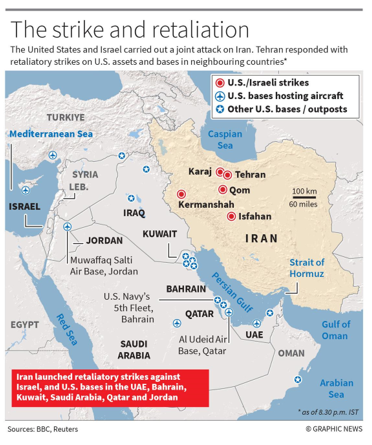
On 28 February 2026, the United States and Israel launched a coordinated military offensive against Iran, code-named Operation Epic Fury (US) and Operation Lion’s Roar (Israel), targeting nuclear facilities, missile launchers, military bases, and command centres across several Iranian cities.
In retaliation, Iran launched Operation True Promise 4, firing ballistic missiles and drones at Israel and US military bases across the Gulf, including Al Udeid Air Base in Qatar, the US Fifth Fleet headquarters in Bahrain, and installations in Kuwait, Saudi Arabia, and the UAE.
The conflict expanded to the Indian Ocean, where a US submarine reportedly sank the Iranian frigate IRIS Dena near Sri Lanka, marking a significant escalation beyond the traditional West Asian theatre.
The conflict has disrupted global trade and energy flows, with Iran’s Islamic Revolutionary Guard Corps (IRGC) threatening and partially closing the Strait of Hormuz, a critical chokepoint for 20–25% of global oil and large LNG shipments.
This follows the 2025 Israel–Iran war, when Operation Rising Lion struck over 100 targets, led to a 12-day conflict ending with a US-backed ceasefire, and highlights the influence of the ‘Axis of Resistance’, a coalition of Iranian-backed groups such as Hezbollah, Hamas, PIJ, and Houthis, in shaping regional dynamics.
Reasons / Factors Behind the Conflict
Iran’s Nuclear Programme: Iran has pursued nuclear technology since 1957, sparking fears that it may develop nuclear weapons. The 2015 Joint Comprehensive Plan of Action (JCPOA) restricted Iran’s nuclear activities, but the United States’ withdrawal in 2018 and reimposition of sanctions, followed by the IAEA declaring Iran non-compliant in June 2025, significantly intensified regional tensions.
Israel’s Begin Doctrine: Israel follows the Begin Doctrine, which allows it to carry out preventive strikes against states suspected of developing weapons of mass destruction. This doctrine provides a strategic justification for potential military action against Iran to prevent a nuclear threat.
Iran’s Regional Influence and Proxy Network: Iran exerts influence in the region through its network of allied groups known as the “Axis of Resistance,” which includes Hezbollah in Lebanon, Hamas in Gaza, Palestinian Islamic Jihad, and the Houthis in Yemen. These groups have repeatedly carried out attacks against Israel and US interests, making Iran a central actor in regional conflicts.
Historical Rivalry Since the 1979 Iranian Revolution: Before 1979, Iran and Israel maintained cooperative relations under the Shah. After the Islamic Revolution, Iran became an adversary of Israel, pledging support for Palestinian resistance and positioning itself in opposition to Israeli regional interests.
Escalation After the Gaza War (2023): The Hamas attack on Israel in October 2023 and Israel’s subsequent military response in Gaza escalated confrontations with Iran-backed groups. This event deepened hostilities and reinforced Iran’s involvement in regional proxy conflicts.
Collapse of Diplomacy: Diplomatic efforts, particularly nuclear negotiations between Iran and the United States, broke down in early 2026. The failure of diplomacy removed peaceful options and paved the way for the US–Israel military operation against Iran-related threats.
Global Implications
Energy Market Instability: Oil prices surged due to fears of disruption in Middle Eastern supplies, with Brent crude rising sharply. Analysts warn that prices could exceed $100 per barrel if the conflict continues.
Threat to Global Shipping: Shipping through the Strait of Hormuz slowed dramatically, causing marine insurance premiums to surge. Many shipping companies rerouted vessels around the Cape of Good Hope, increasing transit times and freight costs.
Global Economic Volatility: Financial markets reacted negatively, with major stock indices declining and energy markets experiencing volatility. Increased shipping costs and supply chain disruptions added further strain on global trade.
Risk of Wider Regional War: The conflict has spread to Lebanon, Iraq, the Gulf states, and parts of the eastern Mediterranean, raising fears of a broader Middle East war that could destabilize the region further.
Implications for India
Energy Security Risks: The Middle East supplies about 55% of India’s crude oil imports, with 2.5–2.7 million barrels per day passing through the Strait of Hormuz. Rising oil prices could widen India’s current account deficit, increase inflation, and slow economic growth.
Impact on Trade and Supply Chains: Disruptions in shipping routes could affect India’s imports of oil, gas, fertilisers, and petrochemical inputs, as well as exports to Europe and the United States.
Impact on Indian Businesses: Companies with major exposure to the Middle East, such as Larsen & Toubro, Dabur, and Titan, may face operational and financial challenges. The aviation and tourism sectors could also suffer losses due to higher fuel costs and flight disruptions.
Risks to Connectivity Projects: The conflict threatens India’s regional connectivity initiatives, including the International North–South Transport Corridor (INSTC) and Chabahar Port, which provides access to Afghanistan and Central Asia while bypassing Pakistan.
Impact on Indian Diaspora: Nearly 10 million Indians live in the Gulf region, and escalating conflict or economic disruption could affect remittances, which are a major source of foreign exchange for India.
Impact on Indian Markets: Rising geopolitical tensions led to declines in Indian stock markets, weakening of the rupee, and higher bond yields, reflecting investor concerns over economic stability.
Way Forward
Reviving diplomatic engagement: Renewed negotiations on Iran’s nuclear programme are necessary to prevent further escalation.
Strengthening global non-proliferation mechanisms: Institutions such as the IAEA and the United Nations must strengthen monitoring and diplomatic efforts.
Regional de-escalation: Major global and regional powers must prioritise diplomacy to prevent the conflict from expanding into a broader regional war.
Energy diversification: Countries heavily dependent on Middle Eastern oil, including India, should accelerate efforts to diversify energy sources and strengthen strategic reserves.
With our training programs, learning online can be a very exciting experience! Take the next step toward achieving your professional and personal objectives
We love learning. Through our innovative solutions, we encourage ourselves, our teams, and our Students to grow. We welcome and look for diverse perspectives and opinions because they enhance our decisions. We strive to understand the big picture and how we contribute to the company’s objectives. We approach challenges with optimism and harness the power of teamwork to accomplish our goals. These aren’t just pretty words to post on the office wall. This is who we are. It’s how we work. And it’s how we approach every interaction with each other and our Students.
What Makes Us Different
Come with an open mind, hungry to learn, and you’ll experience unmatched personal and professional growth, a world of different backgrounds and perspectives, and the freedom to be you—every day. We strive to build and sustain diverse teams and foster a culture of belonging. Creating an inclusive environment where every students feels welcome, appreciated, and heard gives us something to feel (really) good about.