Explore All Exams at KGS


All Exams
Explore All Exams at KGS

Khan Sir Courses
Geography I Polity I History | World Map I Indian Map I Economics I Biology

UPSC & State PSC
UPSC I BPSC I UP-PSC I MP-PSC

State Exams
UP I Bihar I MP | Rajasthan

NEET | JEE | CUET
NEET | JEE | CUET

Defence Exams
NDA I CDS I CAPF I AFCAT I SSB I Agniveer

Police Exams
UP SI | Bihar SI | Delhi Police | UP Constable

SSC Exams
CGL I CPO I CHSL I MTS I SSC GD I Delhi Police

Foundation Courses
Physics I Chemistry I Biology I History I Geography I Polity I NCERT I Math I English | Map I Reasoning

Railway Exams
RRB | RPF

Teaching Exams
TET | Teaching | UGC

Banking Exams
SBI | RBI | IBPS

Engineering Exams
Civil | Electrical | Mechanical
UGC NET
UGC NET/JRF
Current Affairs provides you with the best compilation of the Daily Current Affairs taking place across the globe: National, International, Sports, Science and Technology, Banking, Economy, Agreement, Appointments, Ranks, and Report and General Studies
Current Affairs
SYLLABUS
GS-2: Government Policies and Interventions for Development in Various Sectors and Issues Arising out of Their Design and Implementation.
GS-3: Conservation, Environmental Pollution and Degradation, Environmental Impact Assessment.
Context: Four years after the launch of Project Cheetah, India’s cheetah population has risen to 56, including 36 cheetahs born in the country, reflecting the programme’s transition from initial reintroduction towards establishing a breeding population in India.
More on the News
• Kuno National Park remains the principal cheetah habitat, with 53 cheetahs, while three are housed at Gandhi Sagar Wildlife Sanctuary, marking the expansion of the programme beyond its original reintroduction site.
• The increasing share of India-born cheetahs, including successive generations born in the country, indicates a shift from dependence on translocated animals towards natural breeding and population establishment within Indian landscapes.
• The programme is consequently entering a new phase focused on expanding suitable habitats, strengthening a long-term cheetah metapopulation and ensuring the survival and breeding of India-born generations.
Understanding Project Cheetah
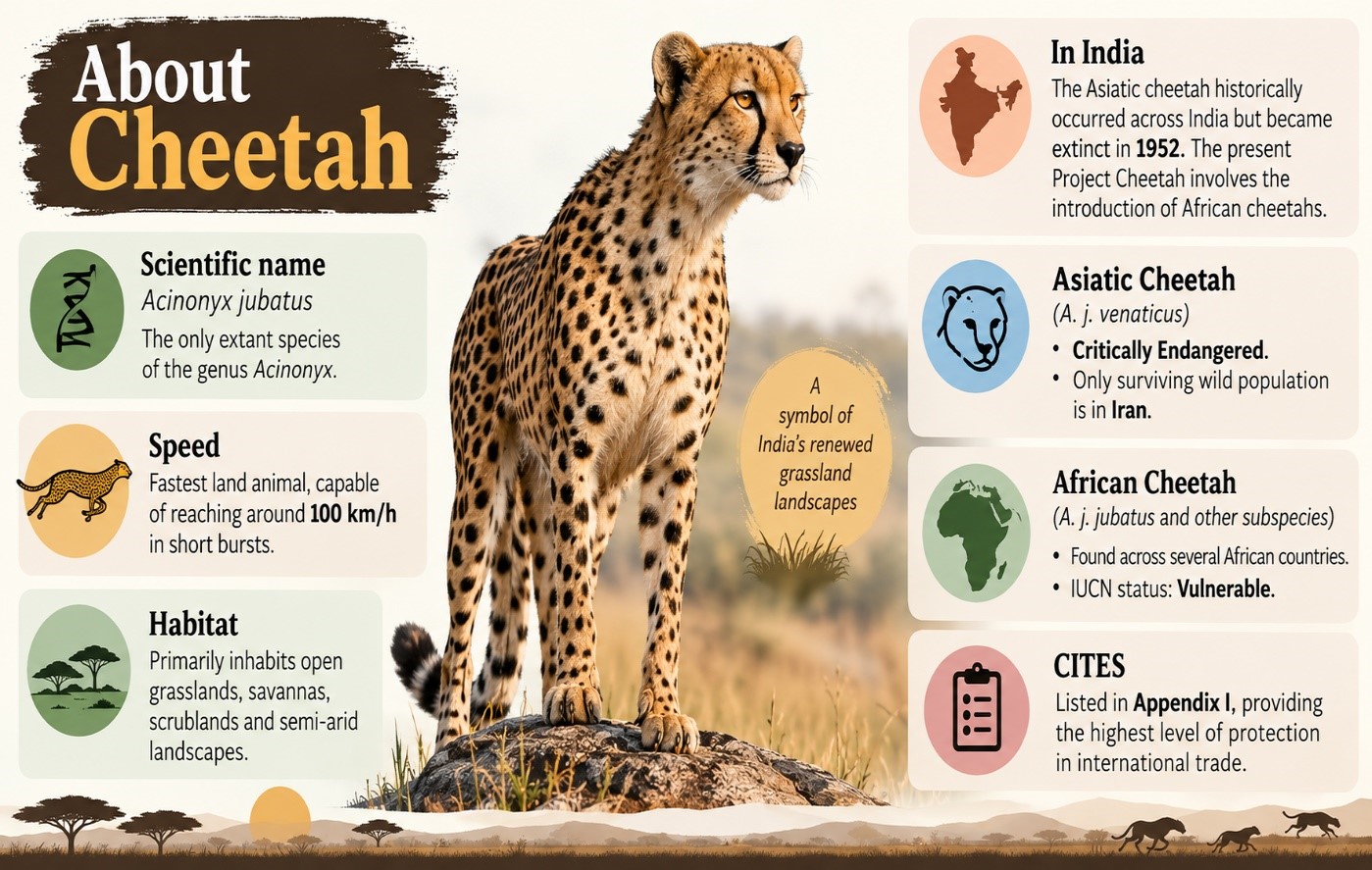
• Background: The cheetah was declared extinct in India in 1952, with habitat loss, prey decline and hunting among the major causes. In 2020, the Supreme Court permitted the introduction of a limited number of African cheetahs on an experimental basis. Project Cheetah was launched on 17 September 2022 at Kuno National Park.
• Translocation: The first batch of eight cheetahs from Namibia arrived in September 2022, followed by 12 from South Africa in February 2023 and nine from Botswana in February 2026. This constitutes the world’s first intercontinental translocation of a large wild carnivore.
• Core Objective: The programme seeks to establish a viable, self-sustaining cheetah population managed as a metapopulation, while restoring the species’ ecological role in suitable open ecosystems.
• Institutional Framework: The programme is under the Ministry of Environment, Forest and Climate Change (MoEFCC) and is spearheaded by the National Tiger Conservation Authority (NTCA), with the Wildlife Institute of India and State Forest Departments playing key roles.
Habitat Expansion and Landscape-level Conservation
• Kuno National Park: Kuno was selected as the first reintroduction site because of its suitable habitat, abundant prey and relatively low human disturbance.
• Gandhi Sagar Wildlife Sanctuary: Located in the Malwa region along the Chambal River, Gandhi Sagar became India’s second cheetah habitat. Prey animals were relocated from other tiger reserves to strengthen its prey base before reintroduction.
• Landscape-level Approach: The programme is moving beyond a single-site model towards management of multiple populations, habitat, prey base and ecological connectivity across a wider landscape. The strategic framework envisages a viable metapopulation of 60–70 cheetahs across about 17,000 sq km in the Kuno–Gandhi Sagar landscape.
• Future Sites: Nauradehi Wildlife Sanctuary and Banni Grasslands have been identified as potential additional habitats, subject to ecological suitability and preparedness.
Significance of Project Cheetah
• Restoration of a Lost Species: The project seeks to restore the cheetah to India after its extinction in the country in 1952.
• Grassland and Open-forest Conservation: As a flagship and umbrella species, the cheetah can draw conservation attention towards historically neglected grasslands, scrublands and open forests.
• Biodiversity and Ecosystem Services: Conservation of these habitats can benefit prey species, other threatened fauna and associated ecosystem services.
• Community Benefits: The project framework incorporates eco-development, ecotourism, awareness and conflict mitigation, creating potential livelihood benefits for communities around conservation landscapes.
Key Challenges
• Population Viability: Reaching a self-sustaining population requires sustained breeding, survival of young animals and successful establishment of multiple populations.
• Genetic Diversity: A viable metapopulation requires genetic management and periodic supplementation, where scientifically necessary, to avoid loss of genetic diversity.
• Habitat and Prey Base: Expansion requires adequate habitat, prey availability and ecological connectivity across multiple landscapes.
• Safety and Human–Wildlife Interface: As cheetahs disperse beyond protected areas, risks such as poaching, snares, electrocution, poisoning, road accidents and livestock-related conflict require effective management.
Way Ahead
• Develop a Metapopulation: Establish multiple viable populations and manage them as an interconnected metapopulation, with the Kuno–Gandhi Sagar landscape forming the core of the long-term strategy.
• Expand Suitable Habitats: Progressively develop Nauradehi and Banni and other suitable landscapes after ensuring adequate prey, habitat and management infrastructure.
• Maintain Genetic Health: Use scientifically planned translocations and supplementation where required to maintain genetic diversity and population viability.
• Strengthen Scientific Management: Continue telemetry-based monitoring, health and prey-base assessment, adaptive management and community participation as the population expands.
Khan Global Studies App
With our training programs, learning online can be a very exciting experience. Take the next step toward achieving your professional and personal objectives.



Course Related Query:
Ask Your DoubtsStore Related Query:[email protected]NEET | JEE | CUET
NCERT Books
Resources
We love learning. Through our innovative solutions, we encourage ourselves, our teams, and our Students to grow. We welcome and look for diverse perspectives and opinions because they enhance our decisions. We strive to understand the big picture and how we contribute to the company’s objectives. We approach challenges with optimism and harness the power of teamwork to accomplish our goals. These aren’t just pretty words to post on the office wall. This is who we are. It’s how we work. And it’s how we approach every interaction with each other and our Students.
Come with an open mind, hungry to learn, and you’ll experience unmatched personal and professional growth, a world of different backgrounds and perspectives, and the freedom to be you—every day. We strive to build and sustain diverse teams and foster a culture of belonging. Creating an inclusive environment where every students feels welcome, appreciated, and heard gives us something to feel (really) good about.