You're all caught up—no notifications available.
Explore All Exams at KGS


All Exams
Explore All Exams at KGS

Khan Sir Courses
Geography I Polity I History | World Map I Indian Map I Economics I Biology

UPSC & State PSC
UPSC I BPSC I UP-PSC I MP-PSC

State Exams
UP I Bihar I MP | Rajasthan

NEET | JEE | CUET
NEET | JEE | CUET

Defence Exams
NDA I CDS I CAPF I AFCAT I SSB I Agniveer

Police Exams
UP SI | Bihar SI | Delhi Police | UP Constable

SSC Exams
CGL I CPO I CHSL I MTS I SSC GD I Delhi Police

Foundation Courses
Physics I Chemistry I Biology I History I Geography I Polity I NCERT I Math I English | Map I Reasoning

Railway Exams
RRB | RPF

Teaching Exams
TET | Teaching | UGC

Banking Exams
SBI | RBI | IBPS

Engineering Exams
Civil | Electrical | Mechanical
UGC NET
UGC NET/JRF
Current Affairs provides you with the best compilation of the Daily Current Affairs taking place across the globe: National, International, Sports, Science and Technology, Banking, Economy, Agreement, Appointments, Ranks, and Report and General Studies

SYLLABUS
GS-3: Issues related to direct and indirect farm subsidies and minimum support prices.
Context: Recently, the Union Cabinet has approved the Nutrient-Based Subsidy (NBS) rates for the Kharif Season 2026 (1 April 2026 – 30 September 2026) on Phosphatic and Potassic (P&K) fertilizers.
More on the News
• The government has increased subsidy rates by around 12% for Kharif 2026 to offset rising international fertilizer prices driven by geopolitical disruptions such as the West Asia crisis.
• Revised per kg subsidy rates are ₹47.32 for Nitrogen (N), ₹52.76 for Phosphorus (P), ₹2.38 for Potash (K) (unchanged), and ₹3.16 for Sulphur (S), applicable to P&K fertilizers including DAP, MOP, and NPKS complexes.
Rationale for Revision of NBS Rates
• Global Price Volatility: Rising international prices of key inputs such as DAP, MOP, urea, and sulphur, coupled with supply disruptions due to geopolitical tensions, necessitated subsidy revision.
• Farmer Protection: The government acts as a price shock absorber to shield farmers from fluctuations in global fertilizer markets.
• Balanced Fertilization Imperative: The revision aims to address declining crop productivity and correct soil nutrient imbalance caused by excessive urea usage.
• Food Security Concerns: Ensuring adequate and stable fertilizer availability is essential to sustain agricultural output and national food security.
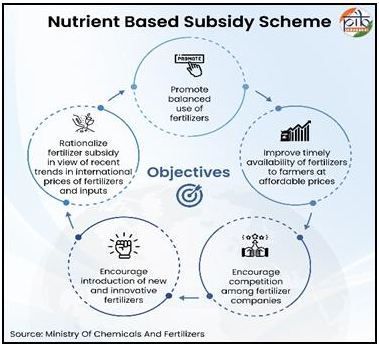
• Subsidy Rationalisation: The adjustment aligns subsidy levels with global trends while maintaining fiscal prudence.
Key Benefits of NBS Revision
• Affordable Access: Ensures fertilizers are available to farmers at subsidized and reasonable prices.
• Balanced Nutrient Use: Promotes the application of Nitrogen (N), Phosphorus (P), Potash (K), and Sulphur (S) in appropriate proportions.
• Soil Health Improvement: Encourages the use of secondary and micronutrient-enriched fertilizers to restore soil fertility.
• Farmer Empowerment: Enables farmers to make informed choices based on crop needs and soil conditions.
• Market Efficiency: Fosters competition among fertilizer companies while promoting innovation and product diversification.
• Supply Stability: Ensures the timely availability of fertilizers during the critical Kharif season.
About the Nutrient-Based Subsidy (NBS) Scheme
• The Government of India introduced the Nutrient-Based Subsidy (NBS) Scheme on 1 April 2010 for phosphatic and potassic (P&K) fertilizers.
• Under NBS, a fixed subsidy is provided based on nutrient content (per kg of Nitrogen (N), Phosphorus (P), Potassium (K), and Sulphur (S)), covering fertilizers like DAP and NPKS grades.
• Subsidy rates are revised annually or biannually.
• Coverage and Scope: The scheme covers 28 grades of P&K fertilizers, including DAP, MAP, MOP, TSP, SSP, complex fertilizers, and micronutrient-fortified variants.
• Pricing and Market Structure: It operates under a decontrolled regime where companies fix MRP (market-linked pricing) while the government monitors prices to prevent excessive increases.
• Subsidy Mechanism: Subsidy is paid to manufacturers and importers, which is then passed on to farmers through reduced retail prices.
• Institutional Mechanism: Subsidy rates are determined by the Department of Fertilizers based on recommendations of the Inter-Ministerial Committee (IMC).
• Distribution and Regulation: Fertilizer movement is tracked through the Fertilizer Monitoring System, with partial control under the Essential Commodities Act, 1955, and imports allowed under the Open General License.
About the Fertilizers
• Fertilizers are concentrated plant nutrients made from inorganic chemicals, used to supply essential elements required for proper plant growth.
• They contain nutrients in higher concentrations than organic manure, are applied in smaller quantities, and are readily available for plant uptake, though some may be lost through leaching or runoff.
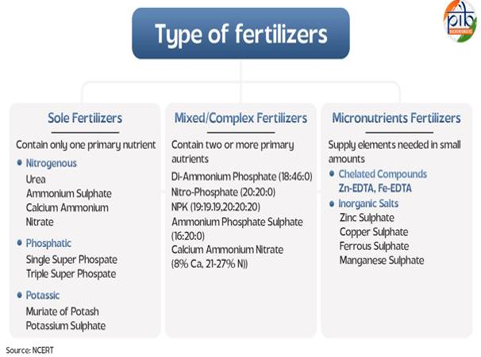
• Based on composition, fertilizers are classified as sole fertilizers, mixed fertilizers, and micronutrient fertilizers.
• Current Fertilizer Scenario in India:
About the Balanced Fertilization
• Balanced fertilization refers to the application of all essential plant nutrients, macronutrients and micronutrients, in appropriate proportions, quantities, timing, and methods based on crop needs, soil fertility, and climatic conditions.
• It aims to enhance fertilizer use efficiency, improve crop productivity, sustain soil health, and reduce environmental impacts such as nutrient losses and emissions.
• The concept is guided by Justus von Liebig’s Law of the Minimum and goes beyond the traditional NPK-focused approach to a holistic nutrient management system.


The most trusted learning platform on your phone
With our training programs, learning online can be a very exciting experience! Take the next step toward achieving your professional and personal objectives



Course Related Query:
Ask Your DoubtsStore Related Query:[email protected]NCERT Books
Resources
We love learning. Through our innovative solutions, we encourage ourselves, our teams, and our Students to grow. We welcome and look for diverse perspectives and opinions because they enhance our decisions. We strive to understand the big picture and how we contribute to the company’s objectives. We approach challenges with optimism and harness the power of teamwork to accomplish our goals. These aren’t just pretty words to post on the office wall. This is who we are. It’s how we work. And it’s how we approach every interaction with each other and our Students.
Come with an open mind, hungry to learn, and you’ll experience unmatched personal and professional growth, a world of different backgrounds and perspectives, and the freedom to be you—every day. We strive to build and sustain diverse teams and foster a culture of belonging. Creating an inclusive environment where every students feels welcome, appreciated, and heard gives us something to feel (really) good about.
Get Free academic Counseling & Course Details