logo

All Exams

Notifications

All Exams

Explore All Exams at KGS

All Exams
Home>Current Affairs>State and Trends of Carbon Pricing 2026
Current Affairs made simple.

Current Affairs provides you with the best compilation of the Daily Current Affairs taking place across the globe: National, International, Sports, Science and Technology, Banking, Economy, Agreement, Appointments, Ranks, and Report and General Studies

banner-image

State and Trends of Carbon Pricing 2026

SYLLABUS

GS-2: Government Policies and Interventions for Development in various sectors and Issues arising out of their Design and Implementation.

GS-3: Conservation, Environmental Pollution and Degradation.

Context: The World Bank recently released the “State and Trends of Carbon Pricing 2026” report, highlighting the rapid global expansion of carbon pricing mechanisms and carbon credit markets amid growing climate commitments and energy-transition efforts.

More on the News
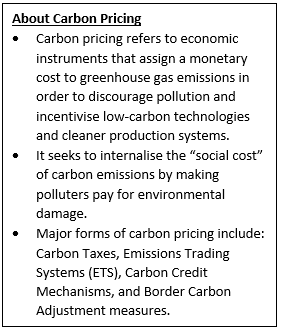
  • The Report tracks global developments in carbon taxes, Emissions Trading Systems (ETSs), and carbon credit markets.
  • It highlights the continued expansion of carbon pricing mechanisms across both developed and developing economies, with new ETSs being implemented in countries such as India, Japan, and Viet Nam.
  • It also notes the growing integration of climate policy with global trade through mechanisms such as the European Union’s Carbon Border Adjustment Mechanism (CBAM).
  • The report further underlines the increasing importance of high-integrity carbon credit markets, international aviation-related carbon mechanisms such as CORSIA, and the operationalisation of the Paris Agreement Crediting Mechanism (PACM).

Key Findings of the Report

  • Expansion of Global Carbon Pricing
    • Direct carbon pricing mechanisms currently cover around 29% of global greenhouse gas emissions through 87 implemented policies worldwide.
    • Coverage under Emissions Trading Systems (ETSs) has tripled since 2016, rising from 8% to over 24% of global emissions, while the share covered by carbon taxes has remained relatively stable at around 4-5%.
    • If ETSs and carbon taxes currently under development are fully implemented, nearly one-third of global emissions could come under carbon pricing by 2030.
  • Rising Carbon Prices
    • The average global carbon price has nearly doubled from US$ 10/tCO₂e in 2016 to around US$ 21/tCO₂e in 2026.
    • While average carbon tax rates have remained relatively constant, scheduled increases in 2026 have taken effect in jurisdictions including Singapore, which increased its carbon tax rate by 80%.  
  • Growth in Carbon Pricing Revenues
    • Annual revenues from ETSs and carbon taxes exceeded US$ 107 billion in 2025 (from under US$ 30 billion in 2016) and have remained above US$ 100 billion annually since 2021.
    • Most carbon-pricing revenues continue to accrue in developed economies, although developing countries are increasingly adopting carbon-pricing instruments.
  • Trends in Carbon Credit Markets
    • Global carbon credit issuances increased by 8% between 2024 and 2025, though they still remain 20% below 2022 levels.
    • Credits eligible under the Carbon Offsetting and Reduction Scheme for International Aviation (CORSIA) traded at premium prices compared to most other carbon credits.
    • Buyers increasingly prefer high-integrity credits with stronger third-party verification and environmental credibility.

Significance of Carbon Pricing

  • Supporting Climate Mitigation: Carbon pricing creates economic incentives for reducing emissions and shifting toward cleaner technologies and renewable energy.
  • Mobilising Climate Finance: Revenues from carbon taxes and ETSs can support energy transition, green infrastructure, climate adaptation, and low-carbon innovation.
  • Encouraging Green Innovation: Stable carbon prices encourage industries to invest in cleaner production systems, carbon capture technologies, and energy-efficient processes.

India and Carbon Pricing

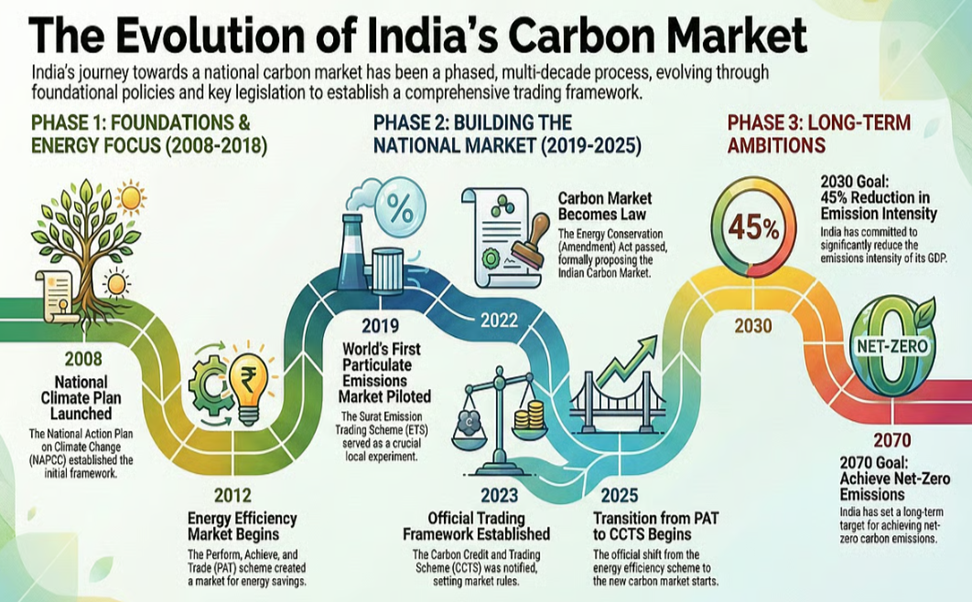
  • India’s market-based approach to emission reduction initially evolved through the Perform, Achieve and Trade (PAT) scheme launched in 2012 under the National Mission for Enhanced Energy Efficiency (NMEEE), which introduced tradable Energy Saving Certificates (ESCerts) for energy-intensive industries.
  • India subsequently operationalised the Renewable Energy Certificate (REC) mechanism to promote renewable energy generation and facilitate Renewable Purchase Obligations (RPOs) across states.
  • Building upon the experience of PAT and REC, the government notified the Carbon Credit Trading Scheme (CCTS) in June 2023, under the Energy Conservation (Amendment) Act, 2022, to establish a structured carbon market through the trading of Carbon Credit Certificates (CCCs).
  • The Bureau of Energy Efficiency (BEE) functions as the administrator of the Indian Carbon Market framework, while the Central Electricity Regulatory Commission (CERC) regulates the trading aspects of the carbon market.
  • The Report has pointed out that India has emerged as one of the world’s largest new carbon markets with the launch of its CCTS, with only the ETSs of China, the European Union, and the Republic of Korea currently covering larger absolute volumes of GHG emissions than India’s newly implemented system.
footer image

The most trusted learning platform on your phone

With our training programs, learning online can be a very exciting experience! Take the next step toward achieving your professional and personal objectives


app-storeplay-store
logo
Khan Global Studies Pvt. Ltd. 5th Floor,
A13A, Graphix 1 Tower B, Sector 62,
Noida, Uttar Pradesh 201309

Course Related Query:

Ask Your DoubtsStore Related Query:[email protected]

Get Free Academic Counseling & Course Details

KGS best learning platform

About Khan Global Studies

We love learning. Through our innovative solutions, we encourage ourselves, our teams, and our Students to grow. We welcome and look for diverse perspectives and opinions because they enhance our decisions. We strive to understand the big picture and how we contribute to the company’s objectives. We approach challenges with optimism and harness the power of teamwork to accomplish our goals. These aren’t just pretty words to post on the office wall. This is who we are. It’s how we work. And it’s how we approach every interaction with each other and our Students.


What Makes Us Different

Come with an open mind, hungry to learn, and you’ll experience unmatched personal and professional growth, a world of different backgrounds and perspectives, and the freedom to be you—every day. We strive to build and sustain diverse teams and foster a culture of belonging. Creating an inclusive environment where every students feels welcome, appreciated, and heard gives us something to feel (really) good about.

Copyright 2026 KhanGlobalStudies

Have a question?

Get Free academic Counseling & Course Details

floatButton
State and Trends of Carbon Pricing 2026 | Current Affairs