You're all caught up—no notifications available.
Explore All Exams at KGS


All Exams
Explore All Exams at KGS

Khan Sir Courses
Geography I Polity I History | World Map I Indian Map I Economics I Biology

UPSC & State PSC
UPSC I BPSC I UP-PSC I MP-PSC

State Exams
UP I Bihar I MP | Rajasthan

NEET | JEE | CUET
NEET | JEE | CUET

Defence Exams
NDA I CDS I CAPF I AFCAT I SSB I Agniveer

Police Exams
UP SI | Bihar SI | Delhi Police | UP Constable

SSC Exams
CGL I CPO I CHSL I MTS I SSC GD I Delhi Police

Foundation Courses
Physics I Chemistry I Biology I History I Geography I Polity I NCERT I Math I English | Map I Reasoning

Railway Exams
RRB | RPF

Teaching Exams
TET | Teaching | UGC

Banking Exams
SBI | RBI | IBPS

Engineering Exams
Civil | Electrical | Mechanical
UGC NET
UGC NET/JRF
Current Affairs provides you with the best compilation of the Daily Current Affairs taking place across the globe: National, International, Sports, Science and Technology, Banking, Economy, Agreement, Appointments, Ranks, and Report and General Studies

SYLLABUS
GS-2: Functioning of the Executive and the Judiciary; Government Policies and Interventions for Development in various sectors and Issues arising out of their Design and Implementation.
Context: The Supreme Court observed that the time has come for a Uniform Civil Code (UCC) while hearing a petition challenging discriminatory inheritance provisions under Muslim personal law.
More on the News
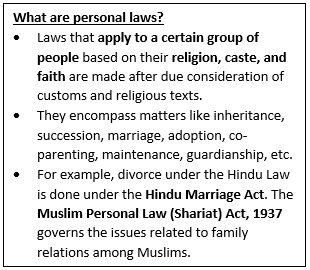
• The observation came during the hearing of a petition challenging provisions of the Muslim Personal Law (Shariat) Application Act, 1937, related to inheritance.
• The petition argued that the existing provisions are discriminatory because Muslim women receive a smaller share of inheritance compared with men.
• The court stated that striking down the Shariat inheritance provisions could create a legal vacuum because there is currently no separate statutory law governing Muslim inheritance.
• The bench indicated that such reforms would be more appropriately addressed by the legislature rather than through judicial intervention.
Key Observations of the Supreme Court
• Possibility of Legal Vacuum: The court stated that striking down the Shariat inheritance provisions could create a legal vacuum in the absence of an alternative statutory framework governing Muslim inheritance.
• Need for Legislative Action: The bench suggested that the issue of discrimination in personal laws should be examined by the legislature, which has the authority to enact a Uniform Civil Code.
• Caution Against Judicial Overreach: The court observed that in the process of pursuing reforms, judicial intervention may unintentionally deprive affected groups of existing rights if a legal framework is removed without replacement.
• Issue of Gender Discrimination: The petition highlighted that under existing inheritance rules, daughters receive half the share of sons and widows receive a limited portion of family property.
Widow’s Share in Inheritance: The share of a widow depends on whether the deceased husband had children. The widow receives 1/8th of the property if there are children and 1/4th if there are no children. If there is more than one wife, they share this portion equally.
Daughter’s Share in Inheritance: Under the traditional rule of Muslim inheritance, a daughter receives half the share of a son, which is commonly described as the 2:1 ratio between male and female heirs.
• Reference to Earlier Legal Precedent: The petitioner referred to the case of Mary Roy v State of Kerala, where the court granted equal inheritance rights to Syrian Christian women by invalidating discriminatory provisions of a regional law.
About Uniform Civil Code (UCC)
• UCC implies the formulation of one law for India, which would be applicable to all religious communities in matters such as marriage, divorce, inheritance, and adoption.
• Currently, India has different personal laws for different religions (like the Hindu Succession Act or the Shariat Act). The UCC aims to substitute these various codes with one law that applies equally to everyone, regardless of their faith.
• Article 44 of the Constitution states: “The State shall endeavour to secure for the citizens a uniform civil code throughout the territory of India”.
• Article 44 comes under the Directive Principles of State Policy (Part IV), whose provisions are non-justiciable, i.e., not enforceable by the court.
• The Supreme Court has, on multiple occasions in cases like the Shah Bano case (1985), Sarla Mudgal case (1995), and Shayara Bano case (2017), called for the implementation of UCC.
• As of February 2026, Goa and Uttarakhand are the only two Indian states with a Uniform Civil Code in effect.

The most trusted learning platform on your phone
With our training programs, learning online can be a very exciting experience! Take the next step toward achieving your professional and personal objectives



Course Related Query:
Ask Your DoubtsStore Related Query:[email protected]NCERT Books
Resources
We love learning. Through our innovative solutions, we encourage ourselves, our teams, and our Students to grow. We welcome and look for diverse perspectives and opinions because they enhance our decisions. We strive to understand the big picture and how we contribute to the company’s objectives. We approach challenges with optimism and harness the power of teamwork to accomplish our goals. These aren’t just pretty words to post on the office wall. This is who we are. It’s how we work. And it’s how we approach every interaction with each other and our Students.
Come with an open mind, hungry to learn, and you’ll experience unmatched personal and professional growth, a world of different backgrounds and perspectives, and the freedom to be you—every day. We strive to build and sustain diverse teams and foster a culture of belonging. Creating an inclusive environment where every students feels welcome, appreciated, and heard gives us something to feel (really) good about.
Get Free academic Counseling & Course Details