SYLLABUS
GS-2: Welfare Schemes for Vulnerable Sections of the Population by the Centre and States and the Performance of these Schemes; Issues Relating to Development and Management of Social Sector; Functions and Responsibilities of various Constitutional Bodies.
Context: A recent audit by the Comptroller and Auditor General of India has highlighted serious gaps in the implementation of welfare schemes for Particularly Vulnerable Tribal Groups (PVTGs) in Odisha.
More on the News
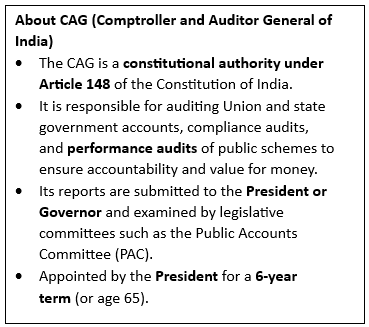
- The report reveals that over half of the eligible PVTG population did not receive benefits under targeted schemes, raising concerns about governance and last-mile delivery.
- The audit, tabled in the Odisha Assembly, scrutinised the ST and SC Development Department, and schemes like the Odisha PVTG Empowerment and Livelihood Improvement Programme.
- The findings assume importance in the context of recent initiatives like PM JANMAN, which aim to improve the socio-economic conditions of PVTGs but depend heavily on effective identification and delivery mechanisms.
Key Findings of the CAG
- Exclusion of Beneficiaries: The audit found that about 54% (around 160,000 out of Odisha’s total PVTG population of 294,000) of the PVTG population were not covered under major welfare schemes.
- Non-Coverage of Newly Identified Villages: A baseline exercise identified 1,138 new PVTG villages, yet welfare programmes were implemented in only 541 villages, covering 1.34 lakh people.
- This exclusion was linked to the non-operationalisation of newly created Micro Project Agencies (MPAs), which were meant to extend coverage to these areas.
- Defunct Infrastructure and Poor Asset Creation: A significant proportion of development assets were found to be non-functional:
- 55% of drinking water projects and 58% of irrigation projects were defunct.
- 46% of livelihood-related processing units were non-operational despite substantial investments.
- Basic Services Deficit in Excluded Households: Among excluded PVTG households, access to basic amenities was extremely limited, as only about 18% had access to safe drinking water, and around 34% had LPG connectivity.
- MGNREGS Failure: MGNREGS provided the mandated 100 days of work to just 10% of PVTG households. 1.22 lakh households got no work but were denied unemployment allowances.
- Failure in Addressing Child Marriage: The late marriage incentive programme covered only 43% of villages between 2019 and 2024, indicating weak implementation.
Who are PVTGs?
- Particularly Vulnerable Tribal Groups (PVTGs) are a distinct sub-category within the Scheduled Tribes (STs), identified as the most marginalized and disadvantaged among them.
- They are marked by stagnant or declining population, pre-agrarian level of technology (hunting, gathering, shifting cultivation), economic backwardness, geographical isolation, and extremely low literacy levels.
- The Dhebar Commission (1960–61) first highlighted intra-tribal disparities and recommended special attention to the most vulnerable sections of STs.
- Acting on this, the Government of India created a separate category called Primitive Tribal Groups (PTGs) in 1975, listing 52 communities. In 1993, another 23 were added, bringing the total to 75.
- In 2006, the term PTG was officially renamed as Particularly Vulnerable Tribal Groups (PVTGs) to reflect their special status.
- Currently, 75 PVTGs are spread across 18 States and 1 Union Territory (Andaman and Nicobar Islands). Among the 75 listed PVTGs, Orissa has the highest (13) number of them.
- As per a 2023 survey of MoTA, there were an estimated 47.5 lakh PVTGs across India. At 13.22 lakh, Madhya Pradesh had the highest estimated population of PVTGs, followed by Maharashtra with an estimated population of 6.7 lakh.
Challenges Faced by PVTGs
- Socio-economic Marginalisation: Small population size, geographical isolation, and pre-agrarian subsistence practices keep PVTGs at the lowest rung of development indicators.
- Limited Access to Basic Services: Inadequate healthcare, education, sanitation, and infrastructure in remote areas restrict their human development and perpetuate poverty.
- For instance, a 2018 survey on 13 PVTGs in Odisha revealed a significantly low literacy rate of approximately 37.4%, much below the state average of about 73%.
- Land Alienation and Displacement: Encroachment for mining, industrialisation, and development projects has led to large-scale loss of traditional lands and livelihoods.
- For instance, the Great Nicobar Development Project threatens the survival of the Shompens.
- Weak Implementation of FRA: Despite being crucial for recognizing their traditional habitat and livelihood rights, progress has been dismal.
- For instance, as per a response given by MoTA in the Lok Sabha, in the last 2 decades after the Forest Rights Act (FRA) of 2006 came into effect, only 10 PVTGs have been granted habitat rights across 14 districts in three States of Odisha, Madhya Pradesh, and Chhattisgarh.
- Cultural Erosion and Climate Vulnerability: Traditional knowledge and cultural identity are threatened by assimilation pressures, while climate change exacerbates livelihood insecurity through resource depletion and extreme weather events.
Measures Taken by the Government
- Pradhan Mantri Janjati Adivasi Nyaya Maha Abhiyan (PM JANMAN): Launched on Janjatiya Gaurav Divas (15th November) in 2023, it aims to uplift the socio-economic status of PVTGs by addressing gaps in health, education, livelihoods, and infrastructure.
- Eklavya Model Residential School (EMRS): The MoTA is implementing the flagship scheme of EMRS to provide quality education to ST Students from class 6th to 12th. 5% seats in each of the EMRSs are reserved for PVTG students.
- Higher Education Support: In the scheme of National Fellowship, 25 slots out of 750 slots, and under the National Overseas Scholarship for ST students, 3 slots out of 20 slots are reserved for PVTG candidates.
- National Scheduled Tribes Finance and Development Corporation (NSTFDC): It provides concessional financial assistance for income-generating activities, skill development, and self-employment ventures of Scheduled Tribes, including PVTGs.
SOURCES
Down to Earth
Bussiness standard
Hindustan Times
Indian Express