You're all caught up—no notifications available.
Explore All Exams at KGS


All Exams
Explore All Exams at KGS

Khan Sir Courses
Geography I Polity I History | World Map I Indian Map I Economics I Biology

UPSC & State PSC
UPSC I BPSC I UP-PSC I MP-PSC

State Exams
UP I Bihar I MP | Rajasthan

NEET | JEE | CUET
NEET | JEE | CUET

Defence Exams
NDA I CDS I CAPF I AFCAT I SSB I Agniveer

Police Exams
UP SI | Bihar SI | Delhi Police | UP Constable

SSC Exams
CGL I CPO I CHSL I MTS I SSC GD I Delhi Police

Foundation Courses
Physics I Chemistry I Biology I History I Geography I Polity I NCERT I Math I English | Map I Reasoning

Railway Exams
RRB | RPF

Teaching Exams
TET | Teaching | UGC

Banking Exams
SBI | RBI | IBPS

Engineering Exams
Civil | Electrical | Mechanical
UGC NET
UGC NET/JRF
Current Affairs provides you with the best compilation of the Daily Current Affairs taking place across the globe: National, International, Sports, Science and Technology, Banking, Economy, Agreement, Appointments, Ranks, and Report and General Studies

SYLLABUS
GS-1: Population and Associated Issues.
GS-2: Statutory, Regulatory and various Quasi-judicial Bodies; Issues relating to development and management of Social Sector/Services relating to Health, Education, Human Resources.
Context: The Office of the Registrar General of India (ORGI) recently released the Sample Registration System (SRS) Statistical Report 2024, highlighting important demographic trends relating to fertility, mortality, sex ratio, and population dynamics in India.
More on the News
• The Sample Registration System (SRS) is India’s largest demographic survey system for generating annual estimates of fertility and mortality indicators at the national and state levels.
• The report indicates that India’s demographic transition is continuing, with fertility levels remaining below the replacement rate and gradual improvements in mortality and child survival indicators.
• The findings assume significance for policy areas such as:
Key Findings of the SRS Statistical Report 2024
Decline in Fertility Levels
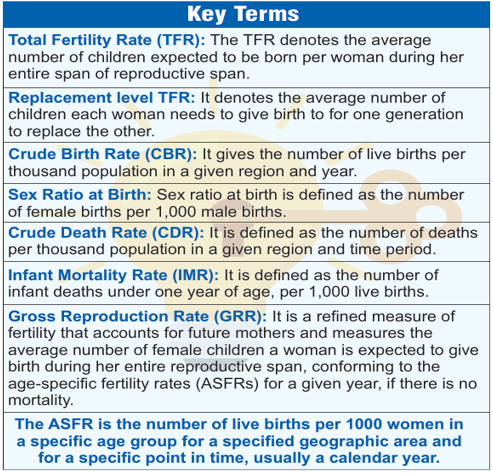
• India’s Total Fertility Rate (TFR) remained at 1.9, below the replacement-level fertility of 2.1 for the fifth consecutive year.
• Bihar recorded the highest TFR in the country at 2.9, followed by Uttar Pradesh (2.6), while Delhi reported the lowest fertility level at 1.2.
• Only six states — Bihar, Uttar Pradesh, Madhya Pradesh, Rajasthan, Jharkhand, and Chhattisgarh — continue to record fertility levels above the replacement rate.
Trends in Birth and Death Rates
• India’s Crude Birth Rate (CBR) continued its long-term decline, reflecting slowing population growth and changing demographic patterns.
• The national CBR stood at 18.3 per 1,000 population, with rural areas recording a higher CBR (20.2) compared to urban areas (14.7).
• The national Crude Death Rate (CDR) stood at 6.4 per 1,000 population, with rural areas recording a higher CDR (6.8) compared to urban areas (5.6).
Improvement in Infant and Child Mortality
• India’s Infant Mortality Rate (IMR) declined to 24 infant deaths per 1,000 live births, with rural IMR (27) remaining significantly higher than urban IMR (17).
• The Under-Five Mortality Rate (U5MR) declined to 28 per 1,000 live births, indicating improvements in maternal and child healthcare outcomes.
Sex Ratio at Birth and Still Birth Rate
• India’s Sex Ratio at Birth (SRB) improved to 918 females per 1,000 males, although several states continue to exhibit adverse child sex ratios.
• The national Still Birth Rate (SBR) stood at 5 per 1,000 total births, reflecting gradual improvements in maternal and neonatal healthcare services.
Significance of the Findings
• Demographic Transition: The report reflects India’s ongoing demographic transition from high fertility and mortality rates toward lower fertility, lower mortality, and higher life expectancy.
• Population Stabilisation: Sustained sub-replacement fertility indicates that India is gradually approaching long-term population stabilisation.
• Improving Health Outcomes: Declining IMR and U5MR reflect improvements in maternal healthcare, institutional deliveries, immunisation, nutrition, and public health interventions.
• Emerging Ageing Challenge: Continued fertility decline could eventually increase the proportion of the elderly population, creating future pressures on pensions, healthcare, and social security systems.
• Regional Imbalances: Significant inter-state variations in fertility, mortality, and sex ratio indicators highlight uneven socio-economic and healthcare development across India.
About the Sample Registration System (SRS)
• It is a large-scale demographic survey conducted every year by the Office of the Registrar General & Census Commissioner of India (ORGI) in all States/Union Territories.
• Background of SRS:
• The SRS follows a dual-record system, involving:
About the Office of the Registrar General & Census Commissioner (ORGI)
• The Office of the Registrar General & Census Commissioner, India (ORGI) functions under the Ministry of Home Affairs and is headed by the Registrar General and Census Commissioner of India.
• It was established in 1949 primarily for conducting the decennial Population Census and administering the Registration of Births and Deaths Act, 1969.
• ORGI is responsible for conducting major demographic and socio-economic surveys, including the Population Census, Sample Registration System (SRS), Civil Registration System (CRS), and various fertility and mortality studies.
The most trusted learning platform on your phone
With our training programs, learning online can be a very exciting experience! Take the next step toward achieving your professional and personal objectives



Course Related Query:
Ask Your DoubtsStore Related Query:[email protected]NCERT Books
Resources
We love learning. Through our innovative solutions, we encourage ourselves, our teams, and our Students to grow. We welcome and look for diverse perspectives and opinions because they enhance our decisions. We strive to understand the big picture and how we contribute to the company’s objectives. We approach challenges with optimism and harness the power of teamwork to accomplish our goals. These aren’t just pretty words to post on the office wall. This is who we are. It’s how we work. And it’s how we approach every interaction with each other and our Students.
Come with an open mind, hungry to learn, and you’ll experience unmatched personal and professional growth, a world of different backgrounds and perspectives, and the freedom to be you—every day. We strive to build and sustain diverse teams and foster a culture of belonging. Creating an inclusive environment where every students feels welcome, appreciated, and heard gives us something to feel (really) good about.
Get Free academic Counseling & Course Details