You're all caught up—no notifications available.
Explore All Exams at KGS


All Exams
Explore All Exams at KGS

Khan Sir Courses
Geography I Polity I History | World Map I Indian Map I Economics I Biology

UPSC & State PSC
UPSC I BPSC I UP-PSC I MP-PSC

State Exams
UP I Bihar I MP | Rajasthan

NEET | JEE | CUET
NEET | JEE | CUET

Defence Exams
NDA I CDS I CAPF I AFCAT I SSB I Agniveer

Police Exams
UP SI | Bihar SI | Delhi Police | UP Constable

SSC Exams
CGL I CPO I CHSL I MTS I SSC GD I Delhi Police

Foundation Courses
Physics I Chemistry I Biology I History I Geography I Polity I NCERT I Math I English | Map I Reasoning

Railway Exams
RRB | RPF

Teaching Exams
TET | Teaching | UGC

Banking Exams
SBI | RBI | IBPS

Engineering Exams
Civil | Electrical | Mechanical
UGC NET
UGC NET/JRF
Current Affairs provides you with the best compilation of the Daily Current Affairs taking place across the globe: National, International, Sports, Science and Technology, Banking, Economy, Agreement, Appointments, Ranks, and Report and General Studies

SYLLABUS
GS 3: Infrastructure: Energy, Ports, Roads, Airports, Railways, etc.; Conservation, environmental pollution and degradation.
Context: Recently, the Ministry of Petroleum and Natural Gas has notified the Natural Gas and Petroleum Products Distribution (Through Laying, Building, Operation and Expansion of Pipelines and Other Facilities) Order, 2026 under the Essential Commodities Act, 1955.
More on the News
• The Order provides a streamlined and time-bound framework for laying and expanding pipelines across the country.
• It resolves the problem of delays in obtaining approvals and securing access to land, and enables the rapid development of natural gas infrastructure, including in residential areas.
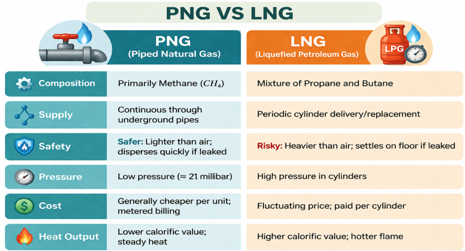
• The main objective of the order is to establish a comprehensive, transparent, and investor-friendly framework for efficient gas distribution, rapid infrastructure expansion, and equitable access to cleaner energy, especially piped natural gas (PNG), across industry and households.
Key Features of the Reform
• Transparent and Predictable Regulatory Framework: Creates a uniform framework for developing and expanding pipeline infrastructure, with standardised processes and timelines to reduce ambiguity and administrative discretion.
• Major Boost to Ease of Doing Business: Ensures time-bound, deemed approvals under a single harmonised framework, while removing arbitrary charges, defining compensation norms, and simplifying compliance to enhance transparency and reduce delays.
• Accelerated Pipeline Infrastructure Development: Enables seamless pipeline expansion, accelerates City Gas Distribution (CGD) and trunk network rollout, and strengthens last-mile PNG connectivity.
• Operational Flexibility and Certainty: Clarifies operational procedures and introduces safeguards like bank guarantees, ensuring accountability without excessive financial burden.
• Consumer-Centric Service Delivery: Ensures timely PNG connections, supports a shift from LPG to PNG, and allows flexibility where pipeline access is not feasible.
• Safeguarding Public Interest: Prevents arbitrary denial of pipeline access, provides a transparent dispute resolution mechanism, and balances consumer convenience with energy security and clean energy goals.
Significance of the Order
• Regulatory Clarity and Standardisation: Establishes a uniform, transparent, and time-bound framework for pipeline development, reducing ambiguity and improving regulatory predictability.
• Catalysing Gas-Based Economy: Strengthens the transition towards a gas-based economy, supporting India’s goal of increasing the share of natural gas in the energy mix.
• Reduction of Infrastructure Bottlenecks: Addresses critical challenges such as right-of-way issues and multi-agency approvals, enabling smoother execution of pipeline projects.
• Strengthening Urban Energy Systems: Enhances the development of City Gas Distribution (CGD) networks, improving energy accessibility in urban and emerging growth centres.
• Improved Investment Climate in Energy Sector: Creates a more investor-friendly ecosystem by ensuring policy stability and reducing procedural uncertainties, thereby attracting private and global investment.
Rationale behind the push towards PNG over LPG
• Supply Chain Resilience: Dependence on LPG exposes households to global supply risks due to its reliance on vulnerable shipping routes like the Strait of Hormuz, whereas PNG, supported by domestic gas fields, LNG terminals, and interconnected pipelines, offers a more diversified and resilient supply system.
• Lower Cost to Consumers: PNG reduces energy costs by removing multiple supply-chain layers like bottling, transport, and dealer margins, leading to 30–40% lower bills for many urban households compared to market-priced LPG.
• Greater Convenience and Safety: PNG ensures a continuous, uninterrupted gas supply without cylinder booking, delivery delays, storage, or fuel shortages, while also improving safety by eliminating risks of cylinder handling and leakage.
• Fiscal Sustainability: India’s LPG subsidy system, particularly under schemes like Ujjwala, involves significant fiscal expenditure. Shifting households to PNG can reduce dependence on subsidised LPG cylinders, lower long-term subsidy outflows and improve efficiency in energy subsidy targeting.
• Clean Energy Transition: PNG is a cleaner fossil fuel that emits less pollution than LPG, coal, and biomass, thereby helping reduce urban air pollution, lower greenhouse gas emissions, and support India’s transition towards a gas-based economy.
About the Essential Commodities Act, 1955
• The Essential Commodities Act, 1955, is a central law that empowers the Government of India to regulate the production, supply, distribution, and pricing of certain key commodities declared “essential” to protect public interest and ensure availability at fair prices.
• An “essential commodity” is any item listed in the Schedule of the Act (such as foodgrains, pulses, edible oils, fertilizers, drugs, and petroleum products), and the Central Government can add or remove items from this list depending on economic conditions and public need.
• Under Section 3, the Centre or States (to whom powers are delegated) can fix stock limits, regulate trade, control hoarding and black‑marketing, and impose licensing/permit requirements to prevent artificial scarcity and price spikes.
SOURCES
PIB
India Today

The most trusted learning platform on your phone
With our training programs, learning online can be a very exciting experience! Take the next step toward achieving your professional and personal objectives



Course Related Query:
Ask Your DoubtsStore Related Query:[email protected]NCERT Books
Resources
We love learning. Through our innovative solutions, we encourage ourselves, our teams, and our Students to grow. We welcome and look for diverse perspectives and opinions because they enhance our decisions. We strive to understand the big picture and how we contribute to the company’s objectives. We approach challenges with optimism and harness the power of teamwork to accomplish our goals. These aren’t just pretty words to post on the office wall. This is who we are. It’s how we work. And it’s how we approach every interaction with each other and our Students.
Come with an open mind, hungry to learn, and you’ll experience unmatched personal and professional growth, a world of different backgrounds and perspectives, and the freedom to be you—every day. We strive to build and sustain diverse teams and foster a culture of belonging. Creating an inclusive environment where every students feels welcome, appreciated, and heard gives us something to feel (really) good about.
Get Free academic Counseling & Course Details