SYLLABUS
GS-3: Indian Economy and issues relating to planning, mobilization of resources, growth, development and employment.
Context: Recently, NITI Aayog released the second edition of the Fiscal Health Index (FHI) 2026, providing a comprehensive assessment of the fiscal performance of Indian states.
About the Fiscal Health Index (FHI)
The Fiscal Health Index (FHI) data-driven framework developed by NITI Aayog
It was conceptualised to evaluate fiscal soundness, guide reforms, and promote evidence-based fiscal policymaking
The Index provides systematic benchmarking across states
The need for such an assessment has increased as state governments play a crucial role in India’s fiscal architecture and account for nearly one-third of the country’s general government debt .
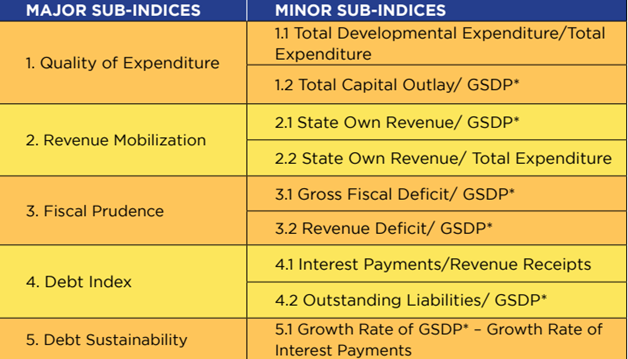
The composite FHI is developed using data from the Comptroller and Auditor General (CAG) and focuses on five sub-indices:
Quality of Expenditure
Revenue Mobilization
Fiscal Prudence
Debt Index
Debt Sustainability
The first edition (2025) assessed 18 major states , while the second edition expands coverage to include 10 North-Eastern and Himalayan states , making the Index more inclusive and representative of India’s fiscal diversity.
Due to structural differences such as geographical remoteness, limited revenue capacity, sparse population, and higher service delivery costs , North-Eastern and Himalayan states are ranked separately from major states .
The Index also provides longitudinal analysis of fiscal trends from FY 2014-15 to FY 2023-24 , offering insights for policymakers, researchers, and stakeholders.
It aligned with India’s broader vision of achieving “Viksit Bharat @2047.”
Key Findings of the Index
Overall Fiscal Trends: Fiscal outcomes vary significantly across states , reflecting differences in fiscal discipline, revenue mobilisation, and expenditure management.
Among the 18 major states , several recorded moderate FHI scores in 2023-24 , indicating emerging fiscal pressures.
States with stronger fiscal discipline and revenue mobilisation higher non-developmental expenditure and weaker fiscal sustainability
Performance of Major States: Odisha remains the top performer , supported by controlled deficits and stable revenues.
Goa and Jharkhand Achiever states , while Gujarat and Maharashtra top five .Haryana recorded a notable improvement in ranking.Bihar, Karnataka, and Telangana Chhattisgarh, Tamil Nadu, and Rajasthan Punjab, West Bengal, Kerala, and Andhra Pradesh rising debt levels, sustained deficits, and modest revenue growth .
Achiever States (Odisha, Goa, Jharkhand)
High own-tax share (above 60%)
Large capital outlay (around 4–5% of GSDP)
Fiscal deficit below 3% of GSDP
Moderate debt (below 25% of GSDP)
Front-Runner States : Gujarat, Maharashtra, Chhattisgarh, Telangana, Uttar Pradesh, KarnatakaPerformer States : Madhya Pradesh, Haryana, Bihar, Tamil Nadu, RajasthanAspirational States : West Bengal, Kerala, Andhra Pradesh, Punjab
Characterised by high debt (35–45% of GSDP), persistent deficits, high committed expenditure (50–60% of revenue receipts), and large interest burdens .
Performance of North-Eastern and Himalayan States: These states are ranked separately and classified into:
Achievers: Arunachal Pradesh, UttarakhandPerformers: Assam, Meghalaya, Mizoram, Sikkim, TripuraAspirational: Himachal Pradesh, Manipur, NagalandArunachal Pradesh strong expenditure quality and prudent debt management . Uttarakhand strong own-revenue mobilisation . Tripura debt sustainability , while Meghalaya and Assam display mixed performance across indicators.Himachal Pradesh and Manipur remain constrained by high committed expenditure and weak revenue mobilisation . Several states rely heavily on Union transfers , with some receiving over 80% of their revenue from central transfers .
Policy Priorities Identified: The report highlights several reforms to strengthen fiscal health:
Enhancing revenue mobilisation , especially by strengthening the state's own-tax capacity and broadening the GST base.Rationalising committed expenditures Improving the quality and composition of capital expenditure Adopting medium-term fiscal planning frameworks to manage deficits and debt trajectories.Monitoring off-budget borrowings and strengthening public financial management systems .
Improving transparency like the Fiscal Health Index .
About the NITI Aayog (National Institution for Transforming India)
On January 1, 2015, the NITI Aayog was established as the successor to the Planning Commission, created by an executive resolution from the Government of India (Union Cabinet).
it is a non-constitutional (not created by the Constitution) and non-statutory (not created by an Act of Parliament) body.
Role and Function of NITI Aayog: NITI Aayog policy think tank directional and policy inputs . NITI Aayog is responsible for designing strategic and long-term policies and programs It also provides technical advice to both the Centre and States . The one-way flow of policy Planning Commission era , is being replaced with a genuine partnership NITI Aayog encourages a collaborative command-and-control
In line with the spirit of federalism , NITI Aayog operates on a bottom-up top-down model.
The NITI Aayog Composition :
Chairperson : The Prime Minister of India .Governing Council : Includes Chief Ministers of all States, Chief Ministers of Union Territories with legislatures, and Lt. Governors of other Union Territories.Regional Councils : Formed to address issues affecting multiple states/regions, convened by the Prime Minister, chaired by the Chairperson or their nominee.Special Invitees : Experts and specialists nominated by the Prime Minister.Full-time Organisational Framework :
Vice-Chairperson : Appointed by the Prime Minister, with Cabinet Minister rank.Full-time Members : Hold the rank of Minister of State.Part-time members, ex-officio members, chief executive officer and secretariat.
Sources:Pib Newsonair Niti