KGS

All Exams

Explore All Exams at KGS

All Exams
Current Affairs made simple.

Current Affairs provides you with the best compilation of the Daily Current Affairs taking place across the globe: National, International, Sports, Science and Technology, Banking, Economy, Agreement, Appointments, Ranks, and Report and General Studies

Current Affairs

Government Notifies 2 More Offshore Mineral Blocks Near Great Nicobar Island

SYLLABUS

GS-1: Distribution of key natural resources across the world.

GS-3: Changes in Industrial Policy & Their Effects on Industrial Growth.

Context: The Ministry of Mines has notified two offshore blocks covering 1,632 sq km near Great Nicobar Island for the grant of composite licences for polymetallic nodules and crusts, highlighting India's growing focus on offshore critical-mineral resources.

More on the News

  • The two notified blocks are West Sewell Ridge-01 (1,000 sq km) and Sewell Rise-01 (632 sq km), both located in the Andaman Sea near Great Nicobar Island.
  • They have been notified for composite licences, under which the successful bidder undertakes further exploration to establish mineral potential before any subsequent mining, subject to statutory approvals and conditions.
  • The move follows the unsuccessful 2024 auction of seven polymetallic nodule-and-crust blocks near Great Nicobar, placing the latest notification in the context of India's renewed effort to develop offshore mineral resources.

Understanding Seabed Mineral Resources
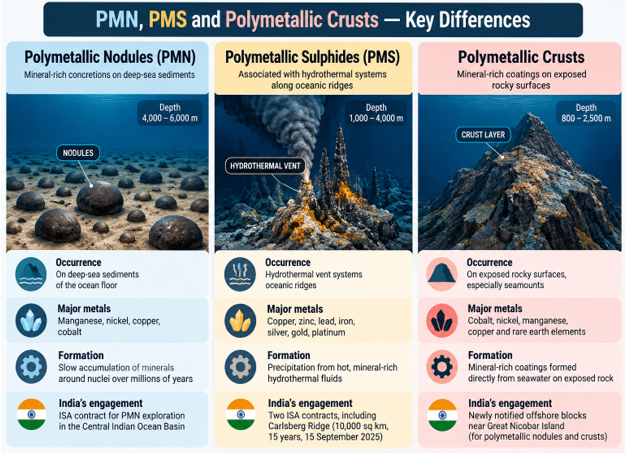
  • Seabed minerals occur in different geological settings and contain metals such as nickel, cobalt, copper and manganese that are important for renewable-energy technologies, electric vehicles, power grids and solar systems.
  • India is exploring different seabed mineral resources through ISA contracts in international waters as well as its domestic offshore-mineral framework. It currently has one ISA contract for polymetallic nodules (PMN) and two for polymetallic sulphides (PMS).
  • PMN occur as mineral-rich concretions on the seafloor; PMS are associated with hydrothermal systems along oceanic ridges; while polymetallic crusts form as mineral-rich coatings on exposed rocky surfaces, particularly seamounts.
  • In September 2025, India signed a 15-year ISA contract covering 10,000 sq km of the Carlsberg Ridge for PMS exploration, becoming the first country to hold two PMS exploration contracts with the ISA.

India's Offshore Mineral Governance Framework

  • OAMDR Act, 2002: Provides the statutory framework for development and regulation of mineral resources in India's territorial waters, continental shelf, EEZ and other maritime zones.
  • Composite licence: Introduced through the 2023 amendment, it is a two-stage operating right involving exploration followed by production, with operating rights allocated through competitive auction.
  • Domestic–international distinction: India's activities in international seabed areas are undertaken through ISA exploration contracts, whereas the Great Nicobar blocks are offered under India's domestic OAMDR framework.
  • Environmental component: India's ISA exploration contracts require resource estimation and environmental studies, including geological, geophysical, oceanographic and biological data collection and biodiversity baseline assessments.

Significance for India

  • Critical-mineral security: Offshore resources could diversify supplies of minerals important for renewable-energy and advanced technologies.
  • Deep-ocean capability: Exploration strengthens expertise in seabed mapping, ocean science, specialised equipment and deep-sea technologies.
  • Blue Economy: It expands India's scientific and technological engagement with marine resources and complements the objectives of the Deep Ocean Mission.
  • Resource diversification: Offshore exploration complements terrestrial exploration and India's international efforts to secure critical minerals.

Environmental and Socio-economic Concerns

  • Limited ecological knowledge: Deep-sea ecosystems remain poorly understood, making the consequences of large-scale disturbance difficult to predict.
  • Seabed disturbance: Future commercial extraction could physically disturb benthic habitats and affect associated marine ecosystems.
  • Great Nicobar sensitivity: Activities need to account for the region's ecological and community concerns, including coral reefs, leatherback turtle nesting sites, Nicobar megapode nesting areas and the ancestral lands of the Great Nicobarese community.
  • Mineral security vs conservation: The need for critical minerals must be balanced with recycling, resource efficiency, substitution and circular-economy approaches, rather than treating extraction as the sole pathway to mineral security.

Way Forward

  • Science-based exploration: Strengthen geological, oceanographic and biodiversity assessments before decisions on commercial extraction.
  • Precautionary regulation: Apply rigorous environmental assessment, continuous monitoring and adaptive safeguards as scientific understanding improves.
  • Reduce extraction pressure: Promote recycling, resource efficiency and material substitution to reduce dependence on newly extracted minerals.
  • Separate exploration from exploitation: Scientific exploration and technological development can continue, while commercial extraction should remain contingent on demonstrated resource potential, technological feasibility and adequate ecological safeguards.

Khan Global Studies App

The most trusted learning platform on your phone

With our training programs, learning online can be a very exciting experience. Take the next step toward achieving your professional and personal objectives.


Download on the App StoreGet it on Google Play
KGS learning dashboard and mobile application
logo
Khan Global Studies Pvt. Ltd. 5th Floor,
A13A, Graphix 1 Tower B, Sector 62,
Noida, Uttar Pradesh 201309

Course Related Query:

Ask Your DoubtsStore Related Query:[email protected]

Get Free Academic Counseling & Course Details

KGS best learning platform

About Khan Global Studies

We love learning. Through our innovative solutions, we encourage ourselves, our teams, and our Students to grow. We welcome and look for diverse perspectives and opinions because they enhance our decisions. We strive to understand the big picture and how we contribute to the company’s objectives. We approach challenges with optimism and harness the power of teamwork to accomplish our goals. These aren’t just pretty words to post on the office wall. This is who we are. It’s how we work. And it’s how we approach every interaction with each other and our Students.


What Makes Us Different

Come with an open mind, hungry to learn, and you’ll experience unmatched personal and professional growth, a world of different backgrounds and perspectives, and the freedom to be you—every day. We strive to build and sustain diverse teams and foster a culture of belonging. Creating an inclusive environment where every students feels welcome, appreciated, and heard gives us something to feel (really) good about.

©Copyright 2026 KhanGlobalStudies