You're all caught up—no notifications available.
Explore All Exams at KGS


All Exams
Explore All Exams at KGS

Khan Sir Courses
Geography I Polity I History | World Map I Indian Map I Economics I Biology

UPSC & State PSC
UPSC I BPSC I UP-PSC I MP-PSC

State Exams
UP I Bihar I MP | Rajasthan

NEET | JEE | CUET
NEET | JEE | CUET

Defence Exams
NDA I CDS I CAPF I AFCAT I SSB I Agniveer

Police Exams
UP SI | Bihar SI | Delhi Police | UP Constable

SSC Exams
CGL I CPO I CHSL I MTS I SSC GD I Delhi Police

Foundation Courses
Physics I Chemistry I Biology I History I Geography I Polity I NCERT I Math I English | Map I Reasoning

Railway Exams
RRB | RPF

Teaching Exams
TET | Teaching | UGC

Banking Exams
SBI | RBI | IBPS

Engineering Exams
Civil | Electrical | Mechanical
UGC NET
UGC NET/JRF
Current Affairs provides you with the best compilation of the Daily Current Affairs taking place across the globe: National, International, Sports, Science and Technology, Banking, Economy, Agreement, Appointments, Ranks, and Report and General Studies

SYLLABUS
GS-1: Salient features of Indian Society.
GS 2: Indian Constitution—Significant Provisions and Basic Structure; Functioning of the Executive and the Judiciary; Mechanisms, Laws, Institutions and Bodies constituted for the Protection and Betterment of Vulnerable Sections.
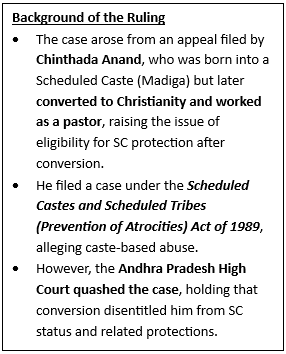
Context: Recently, the Supreme Court ruled in a judgment that a person professing any religion other than Hinduism, Buddhism, or Sikhism should not be considered a member of a Schedule Caste community.
Key Highlights of the Judgement
• The Supreme Court reaffirmed that, under Clause 3 of the Constitution (Scheduled Castes) Order, 1950, Scheduled Caste status is restricted to persons “professing” Hinduism, Sikhism, or Buddhism, and is lost upon conversion to other religions.
• The Court held that conversion results in an “immediate and complete loss” of SC status, irrespective of one’s birth in a Scheduled Caste community.
• It clarified that the term “profess” implies openly declaring and practising a religion, making religious identity a matter of public expression, not merely private belief.
• On reconversion back to Hindu, Sikh or Buddhist religions, the SC held that an individual must conclusively prove original caste, demonstrate genuine re‑conversion, and secure acceptance by the relevant caste community.
Reasons for Denial of SC Status to Dalit Christians
• The Registrar General of India (RGI) has historically opposed expanding SC status beyond Hindus and Sikhs and stated that the SC status is intended for communities facing social disabilities arising from “untouchability”, which is primarily prevalent in Hindu and Sikh communities.
• In 2001, the RGI reiterated its opposition, stating Dalit Christians and Muslims do not form a single ethnic group, which is required under Article 341 of the Indian Constitution.
• Conversion leads to loss of caste identity, and untouchability is not practised in their new religious communities.
Constitutional and Legal Framework for the Scheduled Caste
• Article 15(4): Empowers the State to make any special provision for the advancement of any socially and educationally backward classes of citizens or for SCs and STs.
• Article 17: Abolishes Untouchability.
• Article 46: Mandates the state to give special emphasis to advancing the educational and economic interests of weaker sections, particularly Scheduled Castes and Scheduled Tribes, while protecting them from social injustice and exploitation.
• Article 330 and Article 332: Provide for the reservation of seats for SCs and STs in the Lok Sabha and the State Legislative Assemblies.
• Article 341(1): Empowers the President to specify which castes, races, or tribes (or groups within them) are deemed Scheduled Castes (SC) for a particular State or Union Territory.
• Article 341(2): Empowers Parliament, rather than state governments, to pass laws that include in or exclude from the list of Scheduled Castes (SCs) any group, race, or tribe specified by the President.
• Constitution (Scheduled Castes) Order, 1950
The most trusted learning platform on your phone
With our training programs, learning online can be a very exciting experience! Take the next step toward achieving your professional and personal objectives


Course Related Query:
Ask Your DoubtsStore Related Query:[email protected]NCERT Books
Resources
We love learning. Through our innovative solutions, we encourage ourselves, our teams, and our Students to grow. We welcome and look for diverse perspectives and opinions because they enhance our decisions. We strive to understand the big picture and how we contribute to the company’s objectives. We approach challenges with optimism and harness the power of teamwork to accomplish our goals. These aren’t just pretty words to post on the office wall. This is who we are. It’s how we work. And it’s how we approach every interaction with each other and our Students.
Come with an open mind, hungry to learn, and you’ll experience unmatched personal and professional growth, a world of different backgrounds and perspectives, and the freedom to be you—every day. We strive to build and sustain diverse teams and foster a culture of belonging. Creating an inclusive environment where every students feels welcome, appreciated, and heard gives us something to feel (really) good about.
Get Free academic Counseling & Course Details