logo

All Exams

Notifications

All Exams

Explore All Exams at KGS

All Exams
Home>Current Affairs>Arctic Report Card 2025
Current Affairs made simple.

Current Affairs provides you with the best compilation of the Daily Current Affairs taking place across the globe: National, International, Sports, Science and Technology, Banking, Economy, Agreement, Appointments, Ranks, and Report and General Studies
banner-image

Arctic Report Card 2025

SYLLABUS

GS-1: Important Geophysical phenomena such as earthquakes, Tsunami, Volcanic activity, cyclones etc., geographical features and their location-changes in critical geographical features (including water-bodies and ice-caps) and in flora and fauna and the effects of such changes.

 GS-3: Conservation, Environmental Pollution and Degradation, Environmental Impact Assessment.

Context: The Arctic Report Card 2025 reveals unprecedented warming and ecosystem changes in the Arctic, highlighting accelerated climatic impacts with global environmental and socio-economic implications.

More on the News

  • The Arctic Report Card 2025 is the 20th annual edition, published by the National Oceanic and Atmospheric Administration (NOAA) with contributions from international scientists and Indigenous partners.
  • The report provides a peer-reviewed assessment of atmospheric, oceanic, cryospheric and terrestrial changes in the Arctic region.
  • It documents conditions observed mainly between October 2024 to September 2025.

Key Findings of the Arctic Report Card 2025

Arctic Climate:
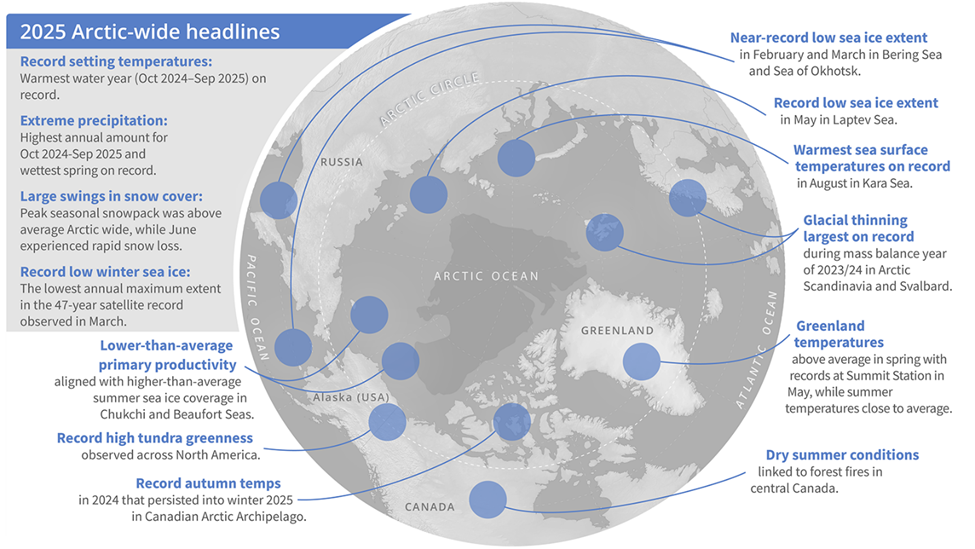
  • The Arctic recorded its warmest surface air temperatures since 1900 during October 2024 to September 2025.
  • The last ten years have been the ten warmest on record in the Arctic.
  • Arctic temperatures have risen at more than twice the global average rate since 2006.
  • Precipitation levels during the year reached a new historical high.

Arctic Ocean and Sea Ice:

  • Winter sea ice extent in March 2025 was the lowest in the 47-year satellite record.
  • September 2025 marked the tenth lowest minimum sea ice extent on record.
  • The oldest and thickest multi-year sea ice has declined by over 95 percent since the 1980s.
  • Atlantification has reached the central Arctic Ocean, weakening ocean stratification and accelerating ice melt.
    • Atlantification refers to the increasing influence of warm, salty Atlantic Ocean waters in the Arctic Ocean, leading to physical, chemical, and biological changes in the Arctic marine system.

Marine Ecosystems:

  • Phytoplankton productivity increased sharply across most Arctic regions between 2003 and 2025.
  • Warming seas and reduced ice cover are reshaping fish distribution and Arctic fisheries, affecting food security and Indigenous subsistence practices.
  • Warmer conditions are driving northward expansion of boreal species into Arctic waters and landscapes, altering food webs and traditional ecological balances.

Cryosphere and Glaciers:

  • Arctic glaciers in Scandinavia and Svalbard recorded their highest annual ice loss between 2023 and 2024.
  • The Greenland Ice Sheet lost about 129 billion tonnes of ice in 2025.
  • Long-term glacier loss is contributing to global sea level rise and increasing disaster risks.

Land Systems and Permafrost:

  • Iron and other mineral mobilization from thawing permafrost has turned waters orange in over 200 Arctic Alaska watersheds called “Rusting Rivers,” degrading water quality, habitat, and traditional water supplies.
    • Thawing permafrost refers to the melting of permanently frozen ground that has remained at or below 0 °C for at least two consecutive years, mainly found in Arctic and sub-Arctic regions.
  • Degraded water quality is threatening aquatic ecosystems and rural drinking water supplies.
  • Arctic tundra greenness in 2025 was the third highest in the satellite record.
    • Arctic tundra greenness (subset of the “Greening of the Arctic”) refers to the observed increase in vegetation growth and plant productivity in Arctic tundra regions due to rising temperatures and longer growing seasons.

Indigenous Knowledge and Partnerships:

  • Indigenous-led observation networks continue to play a critical role in monitoring environmental change.
  • Community-based initiatives are improving food safety and environmental awareness.
  • Long-standing partnerships enhance scientific understanding and adaptive capacity in the Arctic.

Significance of the Report:

  • Bellwether of Climate Change: The report underscores the Arctic as a frontline indicator of global climate change.
  • Mitigation Need: It highlights the urgency of climate mitigation due to cascading global impacts.
  • Role of Indigenous Communities: It reinforces the importance of local communities and their Indigenous knowledge in climate science.
  • Global Environmental Architecture: It informs the need to strengthen International climate policy and environmental governance efforts.

Source:
Down to Earth
Arctic Noaa

footer image

The most trusted learning platform on your phone

With our training programs, learning online can be a very exciting experience! Take the next step toward achieving your professional and personal objectives


app-storeplay-store
logo
Khan Global Studies Pvt. Ltd. 5th Floor,
A13A, Graphix 1 Tower B, Sector 62,
Noida, Uttar Pradesh 201309

Course Related Query: [email protected] Store Related Query: [email protected]

Get Free Academic Counseling & Course Details

KGS best learning platform

About Khan Global Studies

We love learning. Through our innovative solutions, we encourage ourselves, our teams, and our Students to grow. We welcome and look for diverse perspectives and opinions because they enhance our decisions. We strive to understand the big picture and how we contribute to the company’s objectives. We approach challenges with optimism and harness the power of teamwork to accomplish our goals. These aren’t just pretty words to post on the office wall. This is who we are. It’s how we work. And it’s how we approach every interaction with each other and our Students.


What Makes Us Different

Come with an open mind, hungry to learn, and you’ll experience unmatched personal and professional growth, a world of different backgrounds and perspectives, and the freedom to be you—every day. We strive to build and sustain diverse teams and foster a culture of belonging. Creating an inclusive environment where every students feels welcome, appreciated, and heard gives us something to feel (really) good about.

Copyright 2026 KhanGlobalStudies

Have a question?

Get Free academic Counseling & Course Details

floatButton
Arctic Report Card 2025 | Current Affairs