You're all caught up—no notifications available.
Explore All Exams at KGS


All Exams
Explore All Exams at KGS

Khan Sir Courses
Geography I Polity I History | World Map I Indian Map I Economics I Biology

UPSC & State PSC
UPSC I BPSC I UP-PSC I MP-PSC

State Exams
UP I Bihar I MP | Rajasthan

NEET | JEE | CUET
NEET | JEE | CUET

Defence Exams
NDA I CDS I CAPF I AFCAT I SSB I Agniveer

Police Exams
UP SI | Bihar SI | Delhi Police | UP Constable

SSC Exams
CGL I CPO I CHSL I MTS I SSC GD I Delhi Police

Foundation Courses
Physics I Chemistry I Biology I History I Geography I Polity I NCERT I Math I English | Map I Reasoning

Railway Exams
RRB | RPF

Teaching Exams
TET | Teaching | UGC

Banking Exams
SBI | RBI | IBPS

Engineering Exams
Civil | Electrical | Mechanical
UGC NET
UGC NET/JRF
Current Affairs provides you with the best compilation of the Daily Current Affairs taking place across the globe: National, International, Sports, Science and Technology, Banking, Economy, Agreement, Appointments, Ranks, and Report and General Studies

SYLLABUS
GS-3: Infrastructure: Energy, Ports, Roads, Airports, Railways etc.
Context: The Atomic Energy Regulatory Board has approved excavation activities for Units 1 and 2 of the Mahi Banswara Rajasthan Atomic Power Project, marking progress in India’s nuclear expansion.
About the Mahi Banswara Rajasthan Atomic Power Project
• It was launched in Banswara, Rajasthan, on September 25, 2025.
• The project was being implemented by Anushakti Vidhyut Nigam Limited (ASHVINI), a subsidiary of Nuclear Power Corporation of India Limited, as a joint venture with NTPC Limited.
• It was the first nuclear power project in the country to be set up by a joint venture of two Central Public Sector Enterprises (CPSEs).
• The project comprised four units of 700 MW Pressurised Heavy Water Reactors (PHWR) indigenously developed by NPCIL.
• It was to be set up on a twin-unit basis in two phases: Mahi Banswara 1 & 2 (2 × 700 MW) and Mahi Banswara 3 & 4 (2 × 700 MW), at a total cost of ₹42,000 crore.
• Technology:
o Pressurised Heavy Water Reactors (PHWRs) indigenously designed by NPCIL.
o Use natural uranium as fuel and heavy water (deuterium oxide) as coolant and moderator.
• It is part of India’s “fleet mode” nuclear programme, which aims to build ten standardised 700 MWe reactors across multiple sites to ensure cost efficiency, faster deployment, and operational standardisation.
o Other reactors under this programme are planned or operational at Kaiga (Karnataka), Gorakhpur (Haryana), Chutka (Madhya Pradesh), Kakrapar (Gujarat), and Rajasthan.
India’s Nuclear Power Status
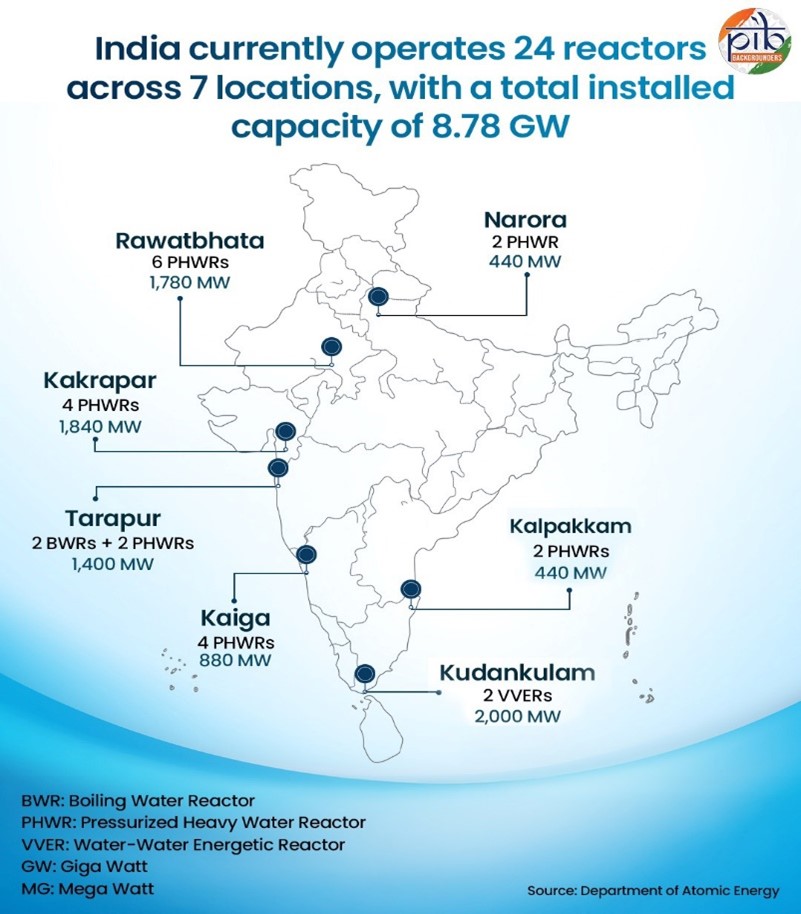
• India currently has 24 operable nuclear reactors with a total installed capacity of 8,780 MWe.
o Additionally, 8 reactors are under construction with a combined capacity of 6,028 MWe.
o There is also 1 reactor that has been shut down, with a capacity of 135 MWe.
• Nuclear energy accounts for 1.7% of the total installed power generation capacity in India.
• Under the Viksit Bharat 2047 vision, India aims to achieve at least 100 GWe nuclear capacity by 2047 to support the clean energy transition and energy security.
Government Initiatives to Achieve the 2047 Nuclear Target
• Long-Term Vision (2025): In 2025, Nirmala Sitharaman announced that at least 100 GWe nuclear capacity by 2047 is essential for India’s energy transition, aligning with Viksit Bharat 2047 and the net-zero 2070 goal.
o India is also shifting toward Light Water Reactors (LWRs) alongside Pressurised Heavy Water Reactors (PHWRs) to meet this target and enhance export competitiveness.
• Bharat Small Reactors (BSRs): In the Union Budget 2024–25, the government proposed Bharat Small Reactors based on indigenous 220 MWe PHWR technology, ensuring technological continuity and strengthening domestic capabilities.
• Nuclear Energy Mission (2025): In February 2025, the Nuclear Energy Mission for Viksit Bharat was announced to develop at least five indigenous Small Modular Reactors (SMRs) by 2033 with federal funding and legislative support.
• Development of Indigenous SMR Technologies: In August 2025, Bhabha Atomic Research Centre announced the development of a 200 MWe Bharat SMR, a 50 MWe SMR, and a 5 MWt high-temperature gas-cooled reactor for hydrogen and industrial use.
• International Cooperation (2025): In February 2025, India and France signed a Letter of Intent on advanced and SMR technologies, while India and the United States agreed to advance the civil nuclear agreement, including plans for US-designed reactors in India.
• Legislative Transformation – SHANTI Bill (2025): In December 2025, Parliament passed the SHANTI Bill, replacing the Atomic Energy Act, 1962, and Civil Liability for Nuclear Damage Act, 2010, with a single comprehensive framework to facilitate nuclear expansion.

Income Tax Act, 2025
NEWS IN SHORT
Phase I of Census 2027
Mahi Banswara Rajasthan Atomic Power Project (MBRAPP)

The most trusted learning platform on your phone
With our training programs, learning online can be a very exciting experience! Take the next step toward achieving your professional and personal objectives



Course Related Query:
Ask Your DoubtsStore Related Query:[email protected]NCERT Books
Resources
We love learning. Through our innovative solutions, we encourage ourselves, our teams, and our Students to grow. We welcome and look for diverse perspectives and opinions because they enhance our decisions. We strive to understand the big picture and how we contribute to the company’s objectives. We approach challenges with optimism and harness the power of teamwork to accomplish our goals. These aren’t just pretty words to post on the office wall. This is who we are. It’s how we work. And it’s how we approach every interaction with each other and our Students.
Come with an open mind, hungry to learn, and you’ll experience unmatched personal and professional growth, a world of different backgrounds and perspectives, and the freedom to be you—every day. We strive to build and sustain diverse teams and foster a culture of belonging. Creating an inclusive environment where every students feels welcome, appreciated, and heard gives us something to feel (really) good about.
Get Free academic Counseling & Course Details