logo

All Exams

Notifications

All Exams

Explore All Exams at KGS

All Exams
Home>Current Affairs>High-Level Committee on Demographic Change
Current Affairs made simple.

Current Affairs provides you with the best compilation of the Daily Current Affairs taking place across the globe: National, International, Sports, Science and Technology, Banking, Economy, Agreement, Appointments, Ranks, and Report and General Studies

banner-image

High-Level Committee on Demographic Change

SYLLABUS

GS-1: Population and associated issues.

Context: The Government of India has constituted a High-Level Committee to study the demographic changes arising from illegal immigration and other abnormal reasons, and to suggest measures to deal with these demographic changes.

About the High-Level Committee on Demographic Change
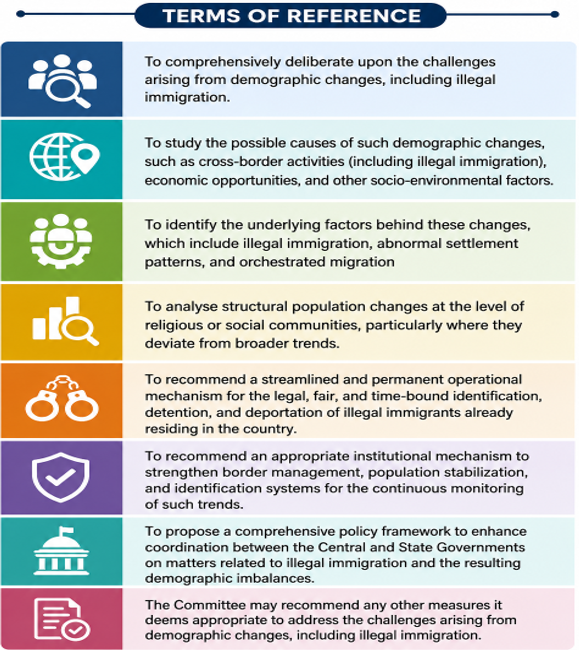
  • Prime Minister Narendra Modi announced the “High-powered Demography Mission” during his Independence Day speech on 15 August 2025. 
  • The Union Cabinet approved the proposal on 11 September 2025. The Ministry of Home Affairs constituted the Committee on 26 May 2026.
  • Chairman and Members: The Committee will be chaired by Justice Prakash Prabhakar Naolekar (Retired Supreme Court Judge). 
    The Census Commissioner of India, Durga Shankar Mishra (Retd. IAS), Balaji Srivastava (Retd. IPS), and Shamika Ravi will be members of the Committee. 
    The Joint Secretary (Foreigners-I), Ministry of Home Affairs, will function as the Member Secretary.
  • Tenure of the Committee: The Committee will submit its report within one year.
    The Ministry of Home Affairs may extend the tenure by up to six months if necessary.

Constitutional Provisions

  • Article 246 and Union List: Matters related to citizenship, immigration, foreigners, and border management fall under the jurisdiction of the Union Government under Article 246 and the Union List of the Constitution.
  • Article 355: Article 355 imposes a duty on the Union Government to protect States against external aggression and internal disturbance. Concerns relating to illegal infiltration and demographic imbalance are often linked with this responsibility.
  • Article 21: Any mechanism relating to the identification, detention, or deportation of illegal immigrants must operate within the framework of Article 21, which guarantees protection of life and personal liberty through due process of law.

Legal Framework

  • Citizenship Act, 1955: The Act governs the acquisition and termination of Indian citizenship.
  • Foreigners Act, 1946: The Act empowers the government to regulate the entry, presence, and deportation of foreigners.
  • Passport (Entry into India) Act, 1920: The Act regulates entry into India without valid travel documents.
  • Registration of Foreigners Act, 1939: The Act provides for registration and monitoring of foreign nationals.

About the Demographic Change

  • Demographic change refers to changes in the size, structure, composition, and distribution of population over time.
  • Population change is generally determined by births, deaths, and migration.

Population Change = Births – Deaths + Net Migration

  • Fertility: Fertility refers to the number of births occurring within a population. It is commonly measured through the Total Fertility Rate (TFR), which represents the average number of children a woman would have in her lifetime.
    India’s Total Fertility Rate (TFR) stood at 1.9 in 2024.
  • Mortality: Mortality refers to deaths within a population and is measured through indicators such as death rate and life expectancy.
    Declining mortality rates generally increase population growth, while higher mortality can alter population structure.
  • Migration: Migration refers to movement of population from one place to another. It may be internal or international, legal or illegal.
    Migration can significantly alter demographic patterns, especially in border regions, tribal areas, urban centres, and industrial corridors.

Need and Significance

  • National Security and Sovereignty: The Government has described demographic change arising from illegal immigration as a serious challenge linked to sovereignty, national security, and internal stability.
  • Law and Order Concerns: According to the Government, illegal infiltration and abnormal demographic changes may create administrative and law-and-order challenges in several regions.
  • Protection of Tribal and Border Areas: The Government has highlighted concerns relating to the protection of tribal societies and border regions from demographic pressures arising due to illegal immigration.
  • Scientific Assessment of Demographic Trends: The Committee is expected to provide a scientific and evidence-based assessment of demographic changes occurring across different parts of the country.
  • Institutional and Policy Reforms: The Committee’s recommendations may help strengthen border management, identification systems, population stabilisation mechanisms, and Centre–State coordination on immigration-related issues.
  • Importance in Census Context: India’s last Census was conducted in 2011, while the next Census exercise is scheduled for 2027. Accurate demographic assessment is therefore important for governance, welfare delivery, planning, and resource management.

footer image

The most trusted learning platform on your phone

With our training programs, learning online can be a very exciting experience! Take the next step toward achieving your professional and personal objectives

app-storeplay-store
logo
Khan Global Studies Pvt. Ltd. 5th Floor,
A13A, Graphix 1 Tower B, Sector 62,
Noida, Uttar Pradesh 201309

Course Related Query:

Ask Your DoubtsStore Related Query:[email protected]

Get Free Academic Counseling & Course Details

KGS best learning platform

About Khan Global Studies

We love learning. Through our innovative solutions, we encourage ourselves, our teams, and our Students to grow. We welcome and look for diverse perspectives and opinions because they enhance our decisions. We strive to understand the big picture and how we contribute to the company’s objectives. We approach challenges with optimism and harness the power of teamwork to accomplish our goals. These aren’t just pretty words to post on the office wall. This is who we are. It’s how we work. And it’s how we approach every interaction with each other and our Students.


What Makes Us Different

Come with an open mind, hungry to learn, and you’ll experience unmatched personal and professional growth, a world of different backgrounds and perspectives, and the freedom to be you—every day. We strive to build and sustain diverse teams and foster a culture of belonging. Creating an inclusive environment where every students feels welcome, appreciated, and heard gives us something to feel (really) good about.

Copyright 2026 KhanGlobalStudies

Have a question?

Get Free academic Counseling & Course Details

floatButton
High-Level Committee on Demographic Change | Current Affairs