You're all caught up—no notifications available.
Explore All Exams at KGS


All Exams
Explore All Exams at KGS

Khan Sir Courses
Geography I Polity I History | World Map I Indian Map I Economics I Biology

UPSC & State PSC
UPSC I BPSC I UP-PSC I MP-PSC

State Exams
UP I Bihar I MP | Rajasthan

NEET | JEE | CUET
NEET | JEE | CUET

Defence Exams
NDA I CDS I CAPF I AFCAT I SSB I Agniveer

Police Exams
UP SI | Bihar SI | Delhi Police | UP Constable

SSC Exams
CGL I CPO I CHSL I MTS I SSC GD I Delhi Police

Foundation Courses
Physics I Chemistry I Biology I History I Geography I Polity I NCERT I Math I English | Map I Reasoning

Railway Exams
RRB | RPF

Teaching Exams
TET | Teaching | UGC

Banking Exams
SBI | RBI | IBPS

Engineering Exams
Civil | Electrical | Mechanical
UGC NET
UGC NET/JRF
Current Affairs provides you with the best compilation of the Daily Current Affairs taking place across the globe: National, International, Sports, Science and Technology, Banking, Economy, Agreement, Appointments, Ranks, and Report and General Studies

SYLLABUS
GS-2: India and its neighborhood- relations.
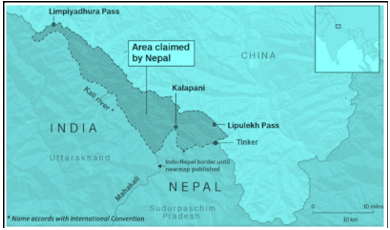
Context: India has rejected Nepal’s objection to conducting the Kailash Mansarovar Yatra via the Lipulekh Pass, calling Nepal’s territorial claims “untenable” while reiterating openness to dialogue.
Background of the Dispute
• The dispute traces back to the Treaty of Sugauli, which defined the boundary along the Kali River.
• The core issue is the uncertain origin of the Kali River, with:
• The dispute intensified after:
• Tensions also arose over road construction, trade routes, and pilgrimage access through Lipulekh.
India’s Position
• Lipulekh has been a traditional route for the Kailash Mansarovar Yatra since 1954, used continuously for decades.
• India maintains that:
• India views the issue as not new, emphasizing continuity of administrative control and usage.
• It has expressed willingness for constructive engagement through dialogue and diplomacy to resolve boundary issues.
Nepal’s Position
• Nepal asserts that Limpiyadhura, Lipulekh, and Kalapani lie east of the Kali River and are therefore integral parts of Nepal under the 1816 treaty.
• It has objected to India–China activities (trade, road building, pilgrimage) in the region without Nepal’s consent.
• Nepal argues that the dispute should be addressed through:
Key Issues Involved
• Territorial Sovereignty: Competing interpretations of historical treaties and cartographic evidence.
• Ineffective Joint Mechanisms: Joint mechanisms like the 1981 Border Inspection and 1997 Border Management Committees were set up by India and Nepal but key boundary issues remain unresolved.
• Religious and Cultural Access: The Kailash Mansarovar Yatra is a major pilgrimage for Indians.
• India–China Factor: Trade and connectivity via Lipulekh add a third-party dimension.
• Open Border Dynamics: Despite a traditionally open border (post-1950 treaty), unresolved boundaries persist.
Way Forward
• Revive Bilateral Mechanisms: Expedite boundary talks through existing India–Nepal diplomatic channels.
• Clarify River Origin Scientifically: Joint technical surveys to determine the true source of the Kali River.
• Confidence-Building Measures: Maintain status quo in disputed areas while negotiations continue.
• Separate Pilgrimage from Politics: Ensure the Yatra proceeds smoothly without escalating tensions.
• Strengthen Diplomatic Engagement: Regular high-level dialogue to prevent politicisation of the issue.
• Avoid Unilateral Actions: Both sides should refrain from steps that alter ground realities.
Sources:
Newsonair
The Hindu
Indian Express
The most trusted learning platform on your phone
With our training programs, learning online can be a very exciting experience! Take the next step toward achieving your professional and personal objectives



Course Related Query:
Ask Your DoubtsStore Related Query:[email protected]NCERT Books
Resources
We love learning. Through our innovative solutions, we encourage ourselves, our teams, and our Students to grow. We welcome and look for diverse perspectives and opinions because they enhance our decisions. We strive to understand the big picture and how we contribute to the company’s objectives. We approach challenges with optimism and harness the power of teamwork to accomplish our goals. These aren’t just pretty words to post on the office wall. This is who we are. It’s how we work. And it’s how we approach every interaction with each other and our Students.
Come with an open mind, hungry to learn, and you’ll experience unmatched personal and professional growth, a world of different backgrounds and perspectives, and the freedom to be you—every day. We strive to build and sustain diverse teams and foster a culture of belonging. Creating an inclusive environment where every students feels welcome, appreciated, and heard gives us something to feel (really) good about.
Get Free academic Counseling & Course Details